


[ad_1]
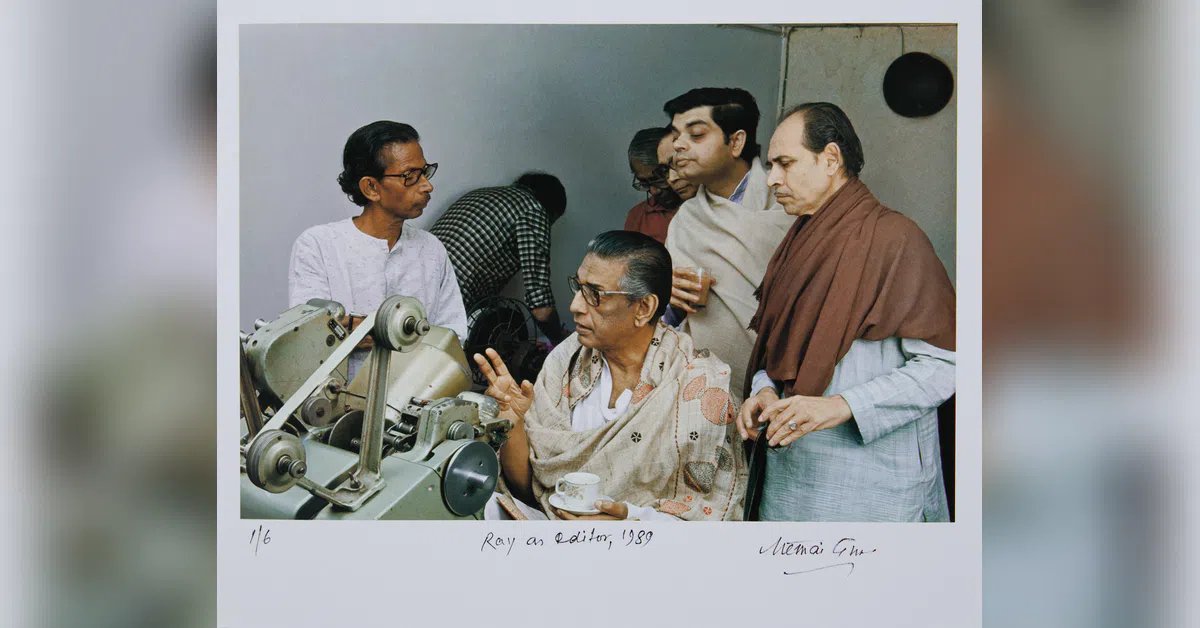
A packet from Adi Dhakeswari Bastralaya sits in the corner. Ashtrays crowd a table. Books sit across shelves. In a photograph taken in 1982, Satyajit Ray is at home, surrounded by the unkemptness of everyday life. It is one of the many intimate moments captured in “Faces and Facets: Satyajit Ray in Colour”, an exhibition of photographs by Nemai Ghosh at DAG, New Delhi, on display till July 4.
What emerges across the photographs is not simply a portrait of a renowned filmmaker, but of a man immersed in the act of making.
In a photograph from 1977, Ray is seen designing Wajid Ali Shah’s crown for Shatranj Ke Khilari. Elsewhere, he composes music for Ghare Baire (1984). In another image, he peers through the camera – he operated it himself. The photographs repeatedly return to the same theme: Ray’s involvement in every aspect of filmmaking.
The images are also populated by the people who weaved through Ray’s creative universe. Actors such as Soumitra Chatterjee, Aparna Sen, Ranjit Mallick and Ajit Banerjee who collaborated with Ray over decades appear throughout the exhibition. So do musicians, filmmakers and collaborators, including Ravi Shankar, Shyam Benegal and Adam Low.
Yet even in crowded frames, Ray remains the focal point. Different groups assemble around him, but the photographs consistently draw the eye back to his presence. In one image he listens; in another he sketches; in a third he directs. The roles change, but the central figure remains constant.
That quality is perhaps what distinguishes Ghosh’s photographs from conventional behind-the-scenes documentation. Rather than recording finished films, they document the labour that precedes them. The images capture Ray thinking, planning, revising and creating. They reveal a filmmaker whose authority stemmed not from distance but from involvement.
For audiences familiar with Ray through his films, “Faces and Facets” offers a different encounter. It presents him not as an institution of Indian cinema, but as a working artist — one who remained deeply engaged with every detail of the worlds he brought to life.
The writer is a 2026 batch Business Standard-Rahul Khullar intern
[ad_2]
Source link