


[ad_1]
Stumps New Zealand 213 for 0 (Latham 109*, Conway 94*) vs England
If, by the end of it, their opponents already felt baked alive amid the UK’s red-weather warning, then they suppressed their exhaustion with admirable grit. The extraction of both centurions, followed by two more wickets from the final two balls of the day, ensured there’ll be two fresh batters at the crease on Friday morning, including a nightwatcher in Will O’Rourke. There’s plenty more mercury-melting in store, but at 361 for 4 at stumps, there’s the outside chance that it won’t be exclusively England fielders feeling the heat
And yet, none of that could detract from New Zealand’s day. Conway top-scored for his team with 157 from 224 balls; Latham, the captain, was not far behind on 151 from 214. And yet, the most crucial contribution that the skipper made to his team’s cause arguably came before he had even strapped on his pads. By calling correctly at the toss, Latham not only seized the opportunity to bat first in pristine conditions, he mitigated his team’s chaotic build-up, in which two of their heroes from last week’s Oval victory, Matt Henry and Glenn Phillips, were subbed out late through injury.
The implications of those absences can now wait, thanks to a command performance at the top of the order. With runs on the board on a surface that, so far, has been flat and true but has already shown signs of dusting up in the intense heat, New Zealand have the chance to set the agenda for everything that follows in this Test. Latham’s century was his 17th in his 95th Test, equalling the haul of the late, great Martin Crowe, whose name has been immortalized in the series trophy. For Conway, it was his eighth in 36, and his third against England, the team whom he took for a debut 200 at Lord’s in 2021, to set up their last series win against these opponents.
Both men eventually fell in the space of seven balls in the evening session to trigger a late wobble of 4 for 44. First, Stokes stretched the definition of “inevitable” by finding Latham’s tired edge in his 13th over, before last week’s England captain, Joe Root, induced a weary slog from Conway to wide long-on. But the pair’s efforts across the preceding 72 overs had been utterly relentless.
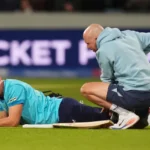
Henry Nicholls and Rachin Ravindra looked set to guide their team through to the close, though they didn’t have it all their own way. In particular, Nicholls was rattled by a sharp bouncer from Archer, which necessitated a change of helmet and a concussion test. And, after Ravindra’s ungainly slog had handed Gus Atkinson an overdue first wicket with minutes of the day remaining, Archer responded with a snorter outside off that Nicholls couldn’t help but snick to the keeper.
That epitomised an England seam attack that toiled gamely on a largely unresponsive deck, and England’s celebrations were unbridled as they left the field with a notable spring in their step. But the overs already in their legs could yet prove problematic as the match wears on. Notably, Josh Tongue bowled just one over in the evening session before feeling his hamstring, even though he remained on the field until the close.
Realistically, there was little that England could do to prevent the inevitable runs pile-on, save a handful of notable opportunities that went begging. The first of these came in Archer’s third over, when Stokes – pulling the strings once again as captain – reshuffled his slip cordon and moved third slip to a second gully. The very next ball, Archer found Latham’s edge, clean through the resulting gap. It could hardly have been a more telling harbinger of the toil to come.
Trent Bridge’s typically fast outfield offered full value for shots, particularly to the short West Bridgford Road side, and England were already resigned to a day of hard toil when the recalled Shoaib Bashir entered the attack in the 11th over. He proceeded to bowl nine overs before lunch, the most by an England spinner in the first session of a home Test since 2013, and though he started reasonably encouragingly, he was belted out of the attack as Latham and Conway grew into their work, with 66 runs leaking from his final 11 overs.
Bashir, however, might have made the breakthrough midway through the afternoon session. Conway, by now on 71, pushed down the line of a good-length delivery from round the wicket, and defended with a tangle of bat and pad. England opted against the review, assuming it was an inside-edge, but in fact the ball was shown to have hit the knee-roll first, and would have been smashing the stumps.
England’s only other chance throughout their ordeal was a far more glaring shocker. Jamie Smith had looked lively behind the stumps on his return to the side after paternity leave, but on 129, Latham swung across a pull and gloved a dolly down the leg-side. Smith was across to the chance instantly, but the ball burst clean through his gloves, to the horror of the luckless bowler, Atkinson.
Stokes himself had entered the attack in the second hour of the morning, to loud acclaim from the Trent Bridge faithful. The stage was set for a “who writes your scripts” moment, to match that of the recalled Ian Botham against the same opponents 40 years ago. Instead, Conway leant out to meet his second ball, and drilled him straight down the ground for the fifth of his 22 fours, to which he later added three emphatic sixes.
Stokes did locate a decent rhythm in his afternoon spell, with a hint of late swing. Latham, on 86, came within a whisker of an under-edge into his off stump, then spooned a clip off the pads into no-man’s land later in the same over. Worryingly for England, however, that latter delivery was the first of a handful to burst through the top of a dry and baked surface. It may be smooth going for batting so far, but that might not remain the case for the duration of this match.
Both openers had endured a fallow tour to date, with no fifties between them in eight previous innings. However, this was an extraordinary means to make amends. For Conway, who had dashed off home between the first and second Test for the birth of his child, his cover-driving was a key feature of his stay, with the majority of his boundaries coming in the arc from deep third to extra cover. Latham was arguably the more fluent of the pair, though with less recourse to the money shots. His total of 15 fours in a near five-hour stay included a burst of compact and controlled pulls, as England briefly switched to a short-ball approach after tea.
The pair’s success was the ideal means to mitigate the loss of two of New Zealand’s outstanding performers from last week’s 253-run win at The Oval. Matt Henry, Player of the Match with 11 wickets in that contest, was ruled out before the toss with a calf injury, as was Glenn Phillips, who sustained a side strain while compiling his maiden Test century in New Zealand’s first innings of that match.
Mitchell Santner and Ben Sears were called up in their places, with Blair Tickner also included as a like-for-like for Kyle Jamieson, who was rested as part of his recovery from a back stress-fracture. Given the short turnaround from The Oval, the chance for the entire attack to put their feet up for an extra day and a half could yet prove critical in the destination of this series.
Andrew Miller is UK editor of Cricinfo. @miller_cricket
[ad_2]
Source link