

[ad_1]
It would be hard to discredit France’s status as the most eye-pleasing team of the FIFA World Cup 2026.
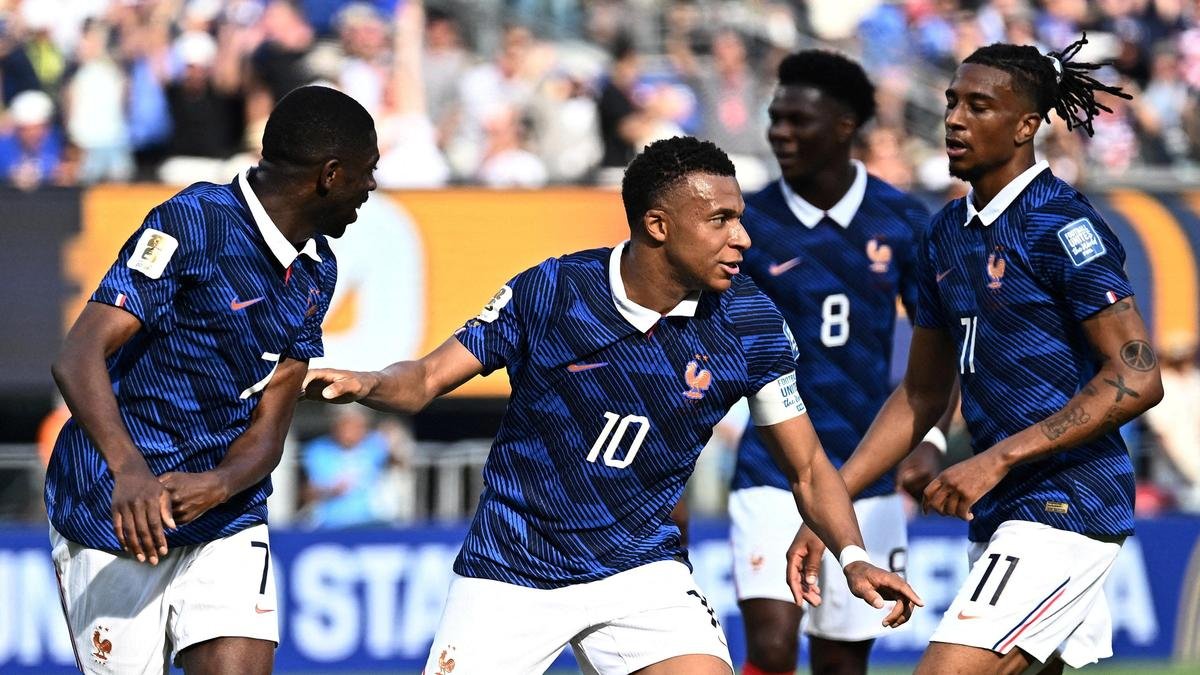
From just four games, the Les Blues have clattered in 13 goals, with their attacking quartet operating in mesmeric synchronicity.
Kylian Mbappe, Ousmane Dembele, Michael Olise and Bradley Barcola/Desire Doue have ducked and weaved past defenders, constantly interchanging positions and roles to create goal-scoring opportunities for themselves and others.
What they haven’t done much is cross the ball, a critical attacking tool in football across eras and levels.
France has averaged just 2.3 accurate crosses per match, the joint-seventh lowest for a team in this World Cup. This is also a sharp decline from its 2022 numbers (6.1) — the second-highest in that edition.
Not a single French goal in this tournament has been a direct outcome of a cross. This, coming from a side which scored four goals directly from crosses in Qatar, the third-highest for all teams.
So, what has changed? To put it simply, France doesn’t need to rely on crosses anymore.
In 2022, France’s forward line was headed by Oliver Giroud, a traditional centre forward who revelled in aerial duels.
Now, anchoring the French attack is Mbappe, a much more mobile striker who prefers the ball on the carpet rather than in the air.
What has also changed is the primary creative outlet. In Qatar, France leaned heavily on Antoine Griezmann for chance creation, and crosses were his currency. He fired in a tournament-high 17 successful crosses, targeting Giroud and even Mbappe in the box.
In 2026, pulling the strings for France is Olise, an agile and electric attacker who is better suited to create chances with short-range passes in tight spaces.
Also read | Ashley Westwood on data, tactical discipline, and breakout stars of the tournament
Olise has already racked up five assists in this World Cup, with four of them coming from penetrative, turf-hugging through balls that spliced defensive lines.
With no target figure in the box and working on a system designed to keep the ball on the floor, France has had just five headed attempts on goal in the tournament – only nine teams have had fewer.
This shift has also allowed France to minimise game volatility. A cross-heavy strategy would require the team to push more players into the box to challenge for the ball.
In the 2022 World Cup, France averaged 3.2 players in the penalty box during crossing situations, as per a FIFA Training Centre report.
The challenge arises when the opposition defence clears the cross, as the attacking team would invariably be left with a numerical disadvantage in the midfield and a risky transition to deal with.
But with the current setup, France is likely to have more players behind the ball when they lose it, allowing the side a better chance to counter-press and regain possession. It also helps that the likes of Dembele, Doue and Barcola play for PSG, a team renowned for its tenacious pressing.
Despite foregoing a major offensive option, France has registered scintillating attacking numbers, thanks to its ability to break defence through other means.
At the heart of it all is French head coach Didier Deschamps’ decision to shed his pragmatic stance. Over the last three World Cups, he has persisted with a safety-first approach, often going in with an extra defensive option in the midfield.
But, finally in 2026, he has surrendered to the temptation, allowing a surplus of attacking options in the frontline.
The resultant French attack quartet has so far overpowered opponents with fluid football, even without the crutches of crosses.
In the Round of 16, on Saturday, France will be up against Paraguay, a team known to pack the central areas and defend resolutely with a low block.
It remains to be seen if France would revert to its cross-heavy strategy if it fails to unlock Paraguay through the middle.
Published on Jul 04, 2026
[ad_2]
Source link