

[ad_1]
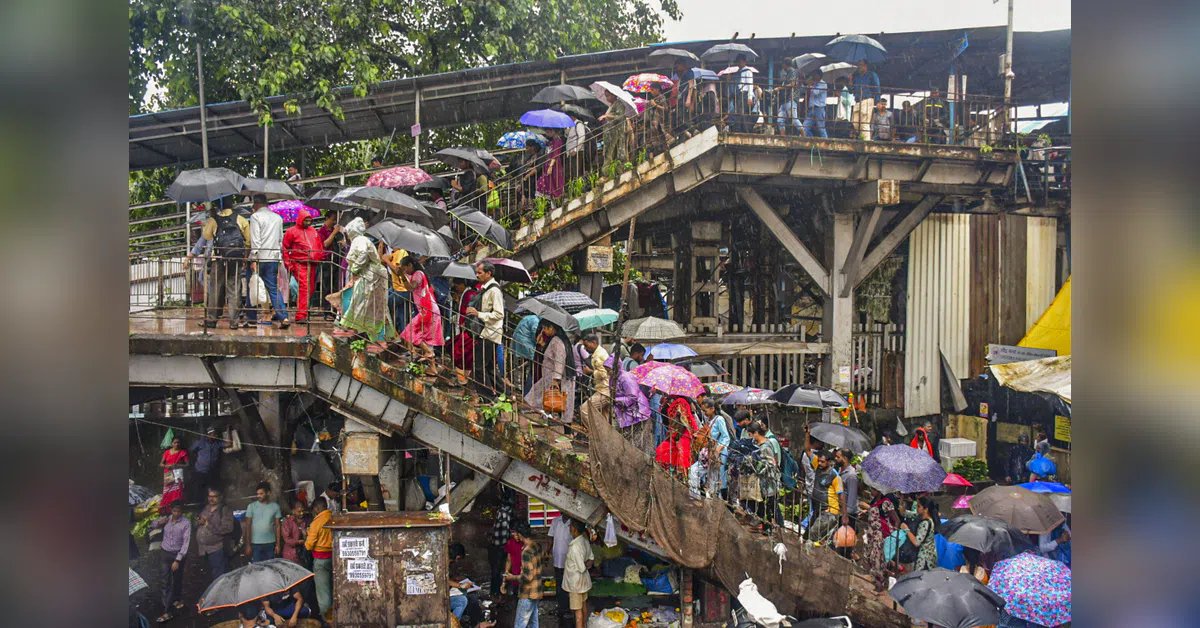
Heavy rains across the Mumbai Metropolitan Region (MMR) disrupted rail, road, and airport services, consequently affecting businesses and daily life in India’s financial capital on Monday. Some estimates peg the economic loss at over ₹1,000 crore.
This prompted the Maharashtra government to advise private establishments to allow employees to work from home wherever possible. A half-day was also announced for non-essential and semi-government offices on Monday. What’s worse is that the IMD has predicted heavy rainfall to continue till July 8.
Chief Minister Devendra Fadnavis said Mumbai had received nearly 90 per cent of its normal July rainfall in just four days. He also warned that wind speeds, which reached 40-50 kmph on Sunday, were expected to increase to 50-70 kmph later on Monday. Around 350 trees fell across Mumbai on Sunday, while trunks of about 450 trees collapsed.
According to PTI, Maharashtra Disaster Management Minister Girish Mahajan said 13 people had died in rain-related incidents over the last 3-4 days Fadnavis urged citizens to avoid non-essential travel. He identified Palghar and Vasai-Virar among the worst-affected areas in the MMR, adding that several trains arriving from Gujarat had been halted and passengers were being shifted by road where necessary.
Rail connectivity remained affected throughout the day, with trains, including local passenger services, being delayed and cancelled. According to PTI, services on the Mumbai-Pune route were suspended after landslides in the Karjat-Lonavala section, while Central Railway suspended services between Karjat and Khopoli after ballast was washed away. Western Railway said more than 40 services were affected, with 10 trains cancelled and eight rescheduled.
In the 24 hours ended 8 am on Monday, Mumbai city received an average rainfall of 105.24 mm, while the eastern and western suburbs recorded 161.11 mm and 159.40 mm, respectively, according to the Brihanmumbai Municipal Corporation (BMC).
Referring to the landslide near the Mumbai-Pune Expressway Connecting Link project, Fadnavis attributed the landslide to exceptionally heavy rainfall in the area. On the Mumbai-Pune Expressway, around 100 tonnes of debris fell following landslides; about 70 tonnes had been cleared by Monday afternoon. Traffic towards Pune resumed on three lanes, while one lane was operational in the Pune-to-Mumbai direction after being stranded since 4 am on Monday. Fadnavis said eight landslides were reported on the Mumbai-Goa Highway.
Heavy rains disrupted flight operations at the city’s two airports, forcing the cancellation of at least 24 flights, according to data from Flightradar24.com, including 18 at Chhatrapati Shivaji Maharaj International Airport in Mumbai and 6 at Navi Mumbai International Airport. Five flights were diverted to airports in cities such as Hyderabad, Ahmedabad, Bengaluru, and Vadodara.
Fadnavis urged citizens to avoid non-essential travel. He identified Palghar and Vasai-Virar among the worst-affected areas in the MMR, adding that several trains arriving from Gujarat had been halted and passengers were being shifted by road where necessary.
Mumbai’s healthcare system remained largely resilient with hospitals reporting that emergency services, outpatient departments and elective surgeries continued with minimal disruption. However, doctors say the monsoon has triggered a sharp increase of about 20 per cent in seasonal illnesses, while waterlogging and traffic congestion have slowed ambulance movement across parts of the city.
Industry bodies said recurring monsoon disruptions continue to affect economic activity in Mumbai.
“Every year we speak about making it (Mumbai) comparable with global cities, but basic civic issues such as drainage, roads and maintenance continue to remain unresolved,” said Vijay Kalantri, president of the All India Association of Industries and chairperson of the MVIRDC World Trade Centre Mumbai.
Kalantri estimated that the disruption in Mumbai alone could result in economic losses of more than ₹1,000 crore, with businesses dealing in perishable goods, retailers, transport operators and daily wage workers among the worst affected. He said recurring disruptions highlight the need for greater accountability in the execution and maintenance of civic infrastructure.
Real estate developer Parthh Mehta, CMD, Paradigm Realty, stated that due to heavy Mumbai rains, overall construction speed has reduced by approximately 25 per cent, with productivity currently operating at around 75 per cent over the last five days. Labour availability remains stable, but execution speed has been moderated for outdoor and weather- sensitive activities.
“All workers have been provided with raincoats and necessary protective gear. Proper safety measures are being followed across sites. Medical facilities and emergency support are available at the sites as part of the safety protocol. No high-risk or unsafe construction activities are currently being undertaken during heavy rainfall and strong wind conditions,” Mehta noted.
In Vasai, the area has been flooded for the last two days. Although water levels briefly receded on Sunday, Monday’s heavy rains have caused them to rise again, with the ground floors of several buildings being heavily flooded. People are unable to get drinking water or even receive essential supplies, as local shops remain closed. Electricity supply in the area has been shut off since Sunday. However, the situation is even worse in other parts of Vasai, where water levels have remained waist-high or higher for nearly two days, a resident said. Some other low-lying areas in the city too have seen such flooding.
Tourists’ destination Lonavala has also been seeing heavy spells of rain since Saturday, with roads flooded and traffic stuck within the town because of a collapsed bridge near Bhushi Dam and further disruptions on the Mumbai-Pune Expressway. The tourists who went to visit the town have been facing a power outage, water crisis, and constant rains over the last three days, a traveller there told Business Standard.
According to PTI, both Houses of the Maharashtra legislature were also adjourned because of the heavy rain.
Quick commerce (qcom) services in the city were also impacted. An executive at a qcom company, who spoke on the condition of anonymity, said the company is sending regular updates to its delivery partners about the weather situation. The person added that while the business is going on as usual, they are closely monitoring the developments and in any case, will prioritse the safety and well-being of its partners.
Akanksha Hazari, founder and chief executive officer of quick commerce (qcom) platform LoveLocal said, “Monsoons test every delivery business operationally. At LoveLocal, our priority has been ensuring rider and merchant safety, including distributing rain gear to our delivery partners, even as around 9 per cent of our fleet has reported sick. On the consumer side, however, we’ve seen no adverse impact. Instead, repeat purchases have grown by around 25 per cent, reflecting the growing trust customers place in reliable neighbourhood delivery when physical shopping becomes difficult.”
(With inputs from agency, Ajinkya Kawale, Sohini Das, Aathira Varier, Udisha Srivastav)
[ad_2]
Source link