


[ad_1]
When Sanjay Arora, a resident of Delhi’s Kalkaji, received his electricity bill in June, he was taken aback by the amount.
The bill was nearly double what he had paid during the cooler months. With temperatures regularly crossing 40 degrees Celsius, his family’s air conditioner remained switched on for longer periods, while ceiling fans ran throughout the day.
“We had no choice. The house becomes unbearable without cooling,” he said. “The electricity bill has become one of our biggest summer expenses.”
Arora’s experience is becoming increasingly common as extreme heat reshapes household finances across India. For families like Arora’s, the impact is measured not only in degrees Celsius but also in monthly expenses. They are spending more on cooling, water and healthcare, while many workers are simultaneously losing income as prolonged exposure to high temperatures makes outdoor work difficult and, at times, dangerous.
The India Meteorological Department’s (IMD’s) forecast of above-normal heatwave conditions and warmer-than-usual nights largely played out across large parts of the country during the April-June period.
According to the IMD’s monthly report, heatwave conditions prevailed in Delhi on May 18, 19, 20, 21, 24 and 27. The city also experienced warm-night conditions on May 21 and 25. A recent report by the Centre for Science and Environment found that Delhi recorded a minimum temperature of 32.4 degrees Celsius on May 25, making it the warmest night in 14 years. The national capital also witnessed above-normal temperatures in June.
According to the IMD, a warm night occurs when the maximum temperature remains above 40 degrees Celsius and the minimum temperature departs from normal by 4.5-6.4 degrees Celsius.
Below-normal rainfall, driven by prevailing El Niño conditions, has kept temperatures elevated across large parts of the country. In Delhi, the mercury climbed to 38.6 degrees Celsius on July 14 — 3.1 degrees above normal — while the heat index, or “feels-like” temperature, touched 45.8 degrees Celsius in the evening, according to the IMD.
There appears to be little immediate relief. The IMD has forecast below-normal rainfall across much of the country in July, with both maximum and minimum temperatures expected to remain above normal in most regions, raising the likelihood of continued heat stress.
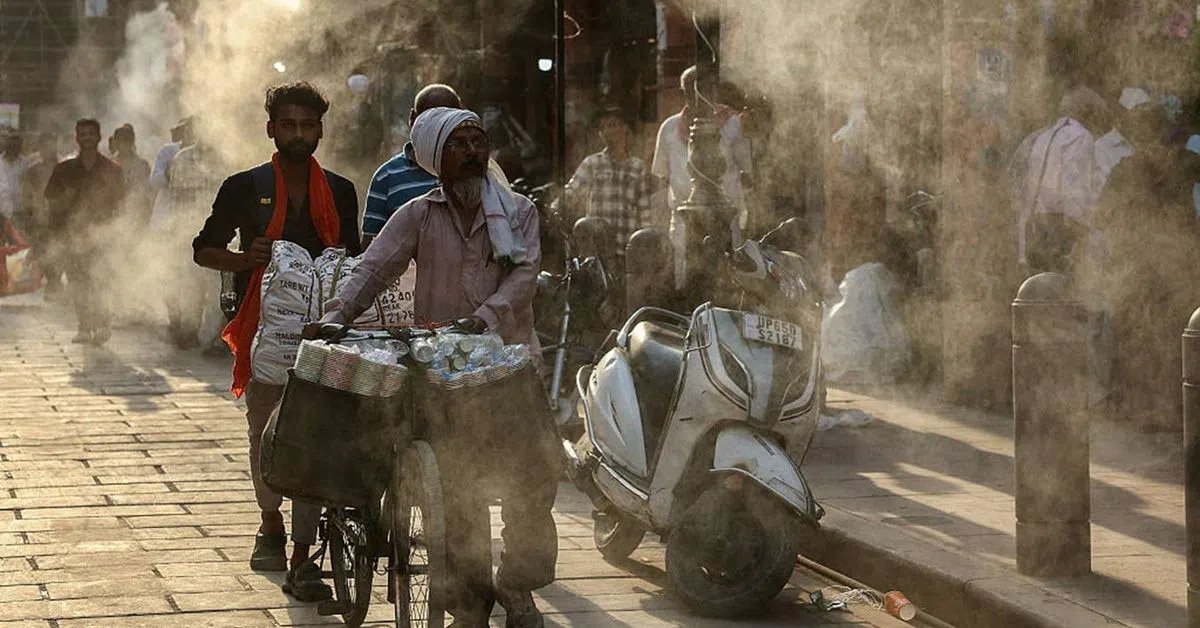
The consequences of these rising temperatures are increasingly visible not just in weather records but also in household budgets. For Mohd Arif, a delivery rider in Delhi, the heat has directly affected both his earnings and expenses. On particularly hot days, he avoids taking orders during the afternoon hours, when “roads feel like furnaces”.
“I find myself in a quandary,” Arif said. “If I continue working in that heat, I risk falling sick. But if I stop working, I earn less.” His experience reflects a growing challenge facing India’s informal workforce. Arif said his electricity bill had increased as multiple fans ran throughout the day and night. Staying hydrated while working outdoors has also become an added expense. “Even when I am out for work, I constantly have to buy water and drinks to stay hydrated,” he said.
According to E Somanathan, head of the Centre for Research on the Economics of Climate, Food, Energy and Environment at the Indian Statistical Institute, Delhi, heatwaves are increasingly becoming an economic issue for households, particularly those dependent on daily earnings.
“Heatwaves can result in a large loss of income for people on daily wages or who are street vendors. It can become too hot to work or work can become less productive,” Somanathan said.
In a study co-authored by Somanathan, researchers found that a one-degree increase in mean temperature was associated with a decline in net earnings of about 16 per cent, while a one-degree increase in wet-bulb temperature was associated with a decline in net earnings of nearly 19 per cent. Wet-bulb temperature refers to the lowest temperature that can be reached through the evaporation of water and is widely used to assess heat stress on the human body.
Arjun Singh, an autorickshaw driver in Delhi, faces similar challenges. “I could not work for four days last month because I suffered from loo,” Singh said, referring to heatstroke-like symptoms caused by prolonged exposure to extreme temperatures.
The illness not only cost him several days’ income but also forced him to spend on medical treatment. “After I recovered, I bought a cooler for around Rs 9,000 because I didn’t want my family to go through the same thing,” he said. “It was an unplanned expense, but it was necessary.”
While electricity bills and healthcare costs are among the most immediate consequences of extreme heat, food expenses are also beginning to reflect the impact of rising temperatures.
A report by HSBC titled India Economics: Why RBI May Need a Thermometer noted that temperature now has a greater influence on food output and inflation than even rainfall and reservoir levels. “Even the prices of dairy, poultry and fishery products, which we collectively call animal protein sources of food, are becoming increasingly more sensitive to rising temperatures,” the report noted.
Research by the Reserve Bank of India (RBI) has similarly highlighted the vulnerability of food prices to extreme weather conditions. Vegetables, which account for 6.04 per cent of the Consumer Price Index basket, are particularly sensitive to temperature shocks. According to the RBI study, a one-unit increase in temperature deviation adds 2.60 points to vegetable price momentum on average, compared with 0.07 points for rainfall deviations.
For families already grappling with rising electricity costs, even modest increases in food prices can stretch household budgets. Sakshi Devi, a homemaker in Delhi, said food prices had risen sharply in recent months. “Vegetable prices have almost doubled over the last two months,” she said. “During summer, we spend around Rs 1,000 extra every month on drinking water, fruits and other food items. It changes our entire monthly budget.”
The latest inflation data reflects some of these pressures. The food inflation rate, based on the All India Consumer Food Price Index, rose to 4.78 per cent in May from 4.2 per cent in April. Somanathan said rising temperatures could contribute to food inflation, particularly when extreme weather affects agricultural output and supply chains.
The burden is often compounded by increasingly warm nights, which offer little respite from daytime temperatures. According to Somanathan, minimum temperatures can be as important as daytime heat in determining economic outcomes.
“In our study, we found that the minimum temperature played an equally important role in reducing workers’ earnings as did the maximum temperature. So, protection from heat at night will definitely help,” he said.
[ad_2]
Source link