

[ad_1]
I first saw Gary Sobers in the flesh at Taunton in 1971. Of course, I had watched him countless times on television, in the 1963, 1966, and 1969 Test series, for example, but somehow never live before. Somerset—some things remain ever the same—was chasing the John Player League title. A massive, throbbing crowd had come to watch this crucial game. Just the thing to stimulate the aged, slightly lame champion.
His appearance was sleek as a greyhound, slim, graceful in movement, yet almost hobbling in that strange, hiccuppy walk of his.
Sobers took a blinding catch, four wickets, scored 73 not out, and guided his Nottinghamshire team to victory. A performance by a virtuoso, an all-rounder who, when roused, could dominate a game to an extent matched only by Mike Procter in top flight cricket.
To my young eyes the most impressive aspect of this performance was its discipline. It was not a spectacular, chancy effort. Sobers simply bowled straight and batted with intelligence and care. With wise humility, he treated Somerset’s best bowlers, Tom Cartwright and Brian Langford, with respect. Cartwright even slipped a few balls past his bat. But as these men finished their spells, Sobers was still in, biding his time. He tore into the change bowling with relish, ending the game with a magnificent straight six off Bajan fast bowler Hallam Moseley. This stroke, executed from the back foot, is in the repertoire of very few men. Viv Richards played it at Hove against John Snow, but then he can bat a bit, too. Anyhow, not bad for a man suffering from arthritic knees. What on earth could he do earlier in his career?
Grace and charm
Somerset’s hopes were destroyed once again, yet no one could resent it. Even the most trenchant cider-saturated supporters enjoyed the quality of Sobers’ cricket. And it was all done with such grace and charm. For goodness’ sake, he was smiling and joking most of the time. It is hard to despise any enemy who is so pleasant; it quite disturbs one’s prejudices—rather as if the Red Indians collected rags for refugees, the Sheriff of Nottingham took in orphans, or the Germans ate liquorice all-sorts instead of children.
Sobers continued to play for several seasons after that genial disruption of Somerset’s ambitions. He never seemed fully fit again; the well-oiled engine never purred quite so smoothly. He remained the best cricketer in the world almost until he retired but lost that little sparkle that suggested he might have, in his prime, been the most brilliant cricketer in the history of the game. As late as 1973, Sobers, recalled to a West Indies team shaken by defeat by Denness’s England touring team, returned to the fray, leaner, more arthritic still. He managed to hobble to the crease with sufficient life to take several vital wickets, equal the Test catching record (six in the innings at Lord’s), and score a controlled 150 in the final Test. Not bad for an old man who, were he a horse, would have been put to grass or put down long before.
Incidentally, in the third Test came one of cricket’s more dispiriting moments. The sight of Sobers resuming an innings interrupted by injury on 109 with his team’s score 568 for five. Time to throw in the towel, the selectors, the wife, the car, and the kids. Time to retire to some Siberian camp where a bowler’s lot is a bit less arduous.
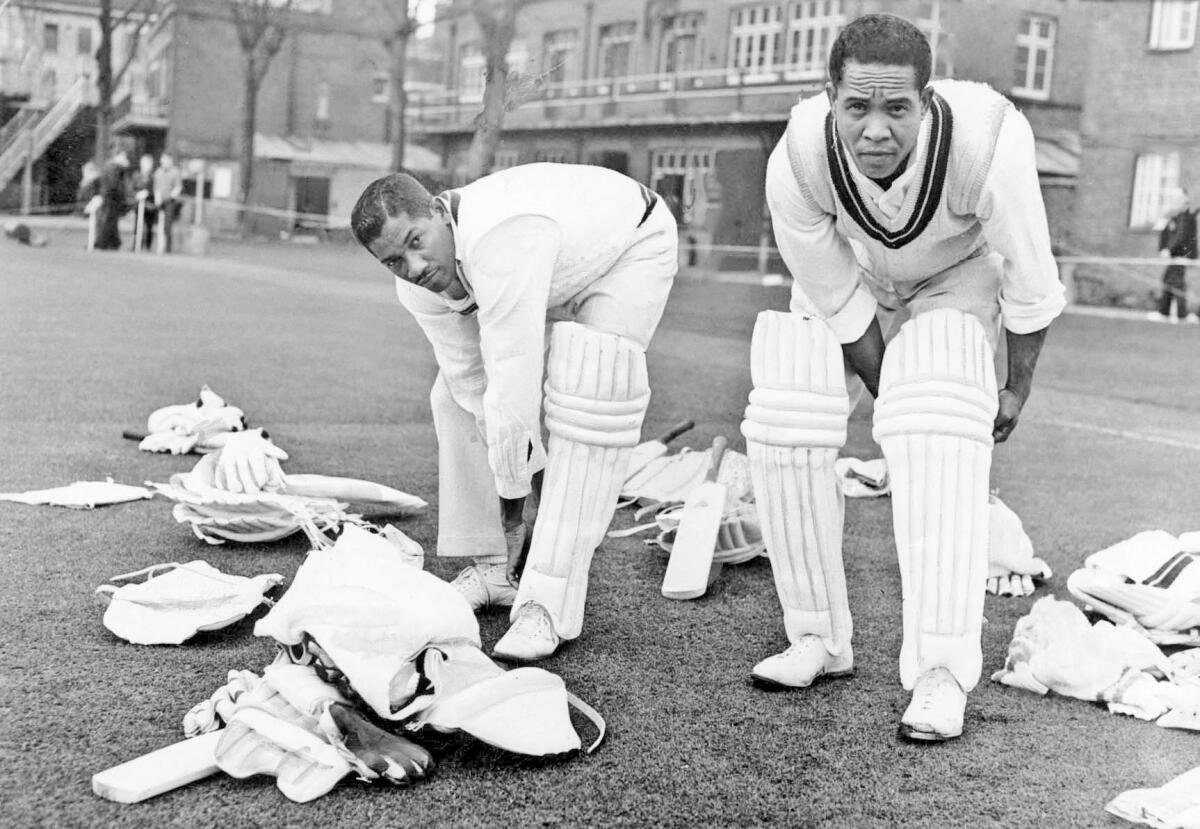
B. Butcher (left) and Garfield Sobers padding up before a spell at the net at Lord’s on April 19, 1963.
| Photo Credit:
THE HINDU ARCHIVES

B. Butcher (left) and Garfield Sobers padding up before a spell at the net at Lord’s on April 19, 1963.
| Photo Credit:
THE HINDU ARCHIVES
Sir Garfield St. Aubrun Sobers of Barbados, South Australia, Nottinghamshire, West Indies and Rest of the World. Beyond doubt a cricketing genius. Genius emerges in many shapes and forms. Keith Miller was a maverick, unpredictable. Ian Botham is aggressive, instinctive, irrational. Don Bradman was ruthless, masterful. Sobers stands in memory as having been, like a classical composer (Mozart, say), beautifully correct. His bowling captured rhythm and relaxation, not a jink to disturb the rippling effect. This is in stark contrast to the Rolling Stones ferocity of Charlie Griffith or the fearsome, awe-inspiring approach of Wesley Hall.
One of a kind
Sobers was a genius of inspired orthodoxy; he was a cricketer’s cricket. People enjoyed playing against him, as one might have enjoyed playing tennis against Rod Laver or fighting Muhammad Ali (ignoring the painful result of this particular foray). Sobers combined flawless technique and gentle manners. He was the master in that talented, explosive West Indies team of the mid-1960s.
Rohan Kanhai could be inspired, Seymour Nurse elegant, Conrad Hunte sometimes solid, sometimes brilliant, Basil Butcher super off the back foot, Clive Lloyd could plunder, and Hall and Griffith explode. Sobers, like Frank Worrell, whom he so much admired, appeared graceful, lithe, and reliable. Less spectacular than some, less of a wizard than others, Sobers was the bastion of the team. Whatever company he kept, Sobers was the man you had to dismiss. Possibly that is one reason he batted at six for the West Indies. There was always Sobers to come, a reassuring thought for some of the more volatile men higher in the order. And a depressing one for the bowlers.

The first player to get 4,000 runs and 100 wickets in Test history, Sobers gets a round of accolades from teammates for taking his 100th wicket (Peter Philpott) at Kingston, 1965. The Windies beat Aussies, their first win against them in a home series.
| Photo Credit:
THE HINDU ARCHIVES
The first player to get 4,000 runs and 100 wickets in Test history, Sobers gets a round of accolades from teammates for taking his 100th wicket (Peter Philpott) at Kingston, 1965. The Windies beat Aussies, their first win against them in a home series.
| Photo Credit:
THE HINDU ARCHIVES
Sobers batted as he bowled, with fluency and very straight. He seemed to lean on the ball with arms and wrists extending, to flash the ball to the boundary without apparent effort. Most memorably, that graceful cut behind point and the off-drive on the up which sizzled through covers already standing 10 yards deeper than usual. I gather from C. L. R. James’ writing that these strokes were referred to in Barbados as ‘not a man move’ shots. With Sobers, the ball either went straight to the fielder or ‘not a man move’. There really would have been no point.
I well recall Sobers’ fluent grace. Not that he did not often simply stand up and belt the ball with fierce power, for, as Learie Constantine advised Bradman: ‘Sobers hits the ball as consistently hard as anyone I’ve ever seen.’ It is just that one remembers his lazy elegance rather than his vicious hitting.
Sobers rarely displayed the mean destructive power of Clive Lloyd or Viv Richards at their best. When this formidable pair are ‘in,’ a demon possesses them, like a heavyweight champion destroying an opponent like Joe Frazier, ‘steamed up,’ demolishing a challenger.
Sir Gary scored just as quickly and hit the ball every bit as hard as Lloyd or Richards, yet never appeared to be ‘steamed up.’ His batting resembled golf rather than prize fighting. He strolled to the crease; he never hurried between the wickets; he rarely darted out to spinners; he often smiled, chatting to Alan Knott even in Test matches.
Astonishing
Just once in a while, though, Sobers was overtaken by an angry, demoralising mood. His most famous innings was also his most furious. That astonishing 254 for a World XI against Australia at Melbourne in 1972 stands, with Stan McCabe’s 232 at Nottingham in 1938, as examples of inspired, destructive batting. Something must have possessed Sobers that day, some set-back in his personal life. He batted with the fury of an avenging angel—hell hath no fury, we soon understood, with Sobers roused.
Bowlers may be thankful that Sobers’ genius at the crease usually found expression in mere domination of the attack; the days when he took batting into apparently impossible realms were, inevitably, rare. His most memorable assault, apart from that 254, was the 132 he made against Richie Benaud’s Australia in the famous tied match at Brisbane 1961. Riled by suggestions that he could not play Benaud’s leg-spin, Sobers tore into a talented Australian attack, scoring his century in even time in a convincing assertion of his mastery.
READ: With Sir Garfield Sobers’ demise, cricket loses its original superstar all-rounder
Sir Gary’s bowling, too, stands in memory for its languid rhythm and late effortless movement. For several years Sobers was the most lethal new-ball bowler in the world. His wicked in-dip trapped many batsmen in front of their stumps before their eyes were in. The run-up was panther-like in its grace, with the right arm pointing high towards the skies and the pivot of the shoulders, which brought surprising pace and encouraged swing.
Contests between Gary Sobers and Geoffrey Boycott were especially lively as Sobers sought after a break in that stern defence. Boycott, a straight bat resisting the ‘snake’, a battle of wits between skilled opponents without a hint of intimidation or malpractice. Each appreciated the other’s ability; each knew the other’s purpose. Sobers was an ever-attacking bowler. He bowled at the stumps with a ring of supporting slips. He was prepared to concede runs for the chance of a wicket. He rarely bowled in a defensive vein. His spirit did not run that way. Probably this is one reason he was more comfortable in his faster style rather than in his essentially defensive orthodox spin.
And he never bowled a bouncer (’What never?’ ‘Well, hardly ever!’). His wickets were taken through skill, defeating the batsman by movement or sudden change of pace. Few of Sobers’ victims were caught at long-leg off a bouncer, few opponents were forced to duck and weave for their very lives.
As a result of this open-hearted approach, Gary Sobers’ 235 Test wickets cost 34 runs each. This contrasts with Trueman’s 307 wickets at 21, Bedi’s 266 at 28, Gibbs’ 309 wickets at 29, and Hall’s 192 wickets at 26. Sobers could be expensive, but he could also be devastating. Left-arm pace bowlers seem able to produce occasional bursts during which they are utterly unplayable. Alan Davidson, Gary Gilmour, and, even in county cricket, Malcolm Nash, have days when their swing is so late and so controlled that opponents fall before them like wheat before the harvester.
Disarray
Most often Sobers produced these electrifying spells in England, where his swing found most encouragement and where the full length to which he naturally bowled was most appropriate. Headingley, in particular, suited Sobers, for, in 1966 and 1969, he reduced England to disarray with spells of five for 41 and five for 42. Not bad for someone who entered international cricket as a left-arm spin bowler.
Pace bowling did not begin until 1960 and only emerged as a major force in Test cricket in England in 1963. Sobers continued to bowl his spinners as well, of course, often partnering Lance Gibbs in helpful conditions. His orthodox spin was accurate, with well-concealed variations, but Sobers always appeared happiest and most dangerous as a swing bowler.
As if this were an insufficient contribution, Sobers developed, for a few startling years, an inkling to bowl left-arm googlies and chinamen (if these deliveries are different!). He bowled these rather as Victor Borge plays the piano, with a smile, with talent, with varying degrees of success, and with a twinkle in the eye suggesting that he could bowl properly, really.
ALSO READ: Remembering Sir Garfield Sobers: The man who could do everything
And, if all that were not enough, it is easily forgotten that Sobers was a fielder of the utmost brilliance. Many folk remember instinctive runs-out by Sobers at short-leg to Lance Gibbs. A leg glance, a rapid stop, and flick back to the stumps, leaving the batsman stranded as he set off for a single. As an unobtrusive short-leg to Gibbs, or second slip to Hall and Griffith, Sobers moved with lightning decisiveness. He held 110 catches in Test cricket. Goodness alone knows how many he would have caught had he not been bowling most of the time.
Staggering
If this creates the impression of a staggeringly, unfairly talented man, then it is no more than the truth. But Sobers was more than that. He was, in essence, a good cricketer. He was not wild or lucky, though certainly he was dropped in the slips more than most, no doubt because he edged the ball harder than most. Sobers was not prone, as Ian Botham sometimes is, to take heroic, outrageous liberties. He was a determined, intelligent cricketer.
He bowled accurately and to a full length because that is good cricket. He refused to bowl bouncers, or balls away from the wickets, because that is bad cricket. He did not advance down the pitch to spinners because he did not need to; the risk was unnecessary. He flashed at the ball outside the off-stump with joyous abandon, yet even this stroke was calculated, as much as Ian Chappell reckoned that his hook brought him sufficient runs to justify the occasional dismissal.

He was the original globe-trotter among cricketers: Sobers has Colin Milburn, Basil D’Oliveira, and Fred Trueman in stitches with a spontaneous joke at Heathrow Airport on the way to Australia for a double-wicket competition in 1968. This was just after the cancellation of England’s tour of South Africa, which objected to D’Oliveira’s inclusion in the party.
| Photo Credit:
THE HINDU ARCHIVES
He was the original globe-trotter among cricketers: Sobers has Colin Milburn, Basil D’Oliveira, and Fred Trueman in stitches with a spontaneous joke at Heathrow Airport on the way to Australia for a double-wicket competition in 1968. This was just after the cancellation of England’s tour of South Africa, which objected to D’Oliveira’s inclusion in the party.
| Photo Credit:
THE HINDU ARCHIVES
Sobers was a superb craftsman on bad wickets, as adept against fast bowling as he was against spin. He scored over 8,000 runs in Test cricket at an average of nearly 58, despite going in at six as the team’s all-rounder and captain. Usually Sobers chased runs almost as soon as he came in, and once in a while he fell early, flashing at a wide half-volley. The physical demands of bowling so many overs forced Sir Gary to adopt an aggressive approach to batting. His team could not afford him to exhaust himself with unnecessarily long innings. And often, like Procter and Botham, Sobers would stroll to the crease still weary from the labours of bowling. It is remarkable that Sobers scored so many runs consistently for so long. No other heavy scorer in Test cricket endured such harsh demands far beyond the world of batting.
Rescue mission
Gary Sobers could, of course, play long, carefully constructed innings. Circumstances sometimes required prolonged resistance. And no cricketer can truly be designed ‘great’ unless he can save games as well as win them. Sobers’ most famous rescuing mission was his partnership with his young, inexperienced cousin David Holford at Lord’s in 1966. They came together with half the team gone and a slender lead of nine runs on the board. Conditions were helping England’s battery of seamers, Higgs, Knight, Jeff Jones, and Basil D’Oliveira. Sobers launched a counterattack, driving vividly and forcing England captain Colin Cowdrey onto the defensive. With the initiative regained, Sobers and Holford collected runs carefully until, safety achieved, they cut loose again, enabling Sobers to declare at 369 for five. Sobers 163, Holford 105.
Sobers regards this as his most valuable innings. Certainly it was one of his most disciplined. England never scented victory again until the series was in the bag. Close led his team to a massive victory as, first, Gravency and Murray and then Snow and Higgs forged vital partnerships. Ever-generous Sobers refused to attribute this heavy defeat to relaxation, preferring the view that his team had been beaten fair and square.
With this skill and the excellence of technique and temperament, one wonders just how many runs Sobers would have scored and how many wickets he would have taken had he been able to give his full energies to one discipline or the other.

Originally published in the March 1981 issue of The Cricketer, this article was reprinted in the July 27, 1985 issue of Sportstar.
| Photo Credit:
THE HINDU ARCHIVES
Originally published in the March 1981 issue of The Cricketer, this article was reprinted in the July 27, 1985 issue of Sportstar.
| Photo Credit:
THE HINDU ARCHIVES
Published on Jul 18, 2026
[ad_2]
Source link