

[ad_1]
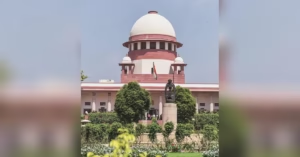
The Supreme Court on Friday agreed to hear on Monday two petitions alleging excessive use of police force against students protesting across the country over the alleged NEET paper leak, while the Delhi High Court dealt with three separate petitions arising from the demonstrations.
The matter in the apex court was mentioned before a Bench led by Chief Justice of India Justice Surya Kant by Senior Advocate Gopal Sankaranarayanan, who said police excesses against student protesters were continuing on a daily basis and sought urgent intervention.
Accepting the request, the Bench directed that the petitions be listed on July 27.
The petitions seek guidelines to regulate police action during public protests, an independent probe into the alleged police excesses during the July 20 “Sansad Chalo” march, and safeguards against the use of plainclothes personnel for crowd control.
They also challenge the repeated use of prohibitory orders under Section 163 of the Bharatiya Nagarik Suraksha Sanhita and seek implementation of police reforms ordered by the Supreme Court.
Separately, the Delhi High Court deferred to July 27 the hearing on a plea challenging continuous police videography of protesters at Jantar Mantar.
The Centre defended videography as a routine law-and-order measure, arguing that there can be no reasonable expectation of privacy at a public protest.
The petitioners, however, contended that the absence of safeguards governing the collection, storage and use of such recordings could have a chilling effect on democratic dissent.
In another matter, the High Court refused to entertain a public interest litigation (PIL) seeking a National Investigation Agency (NIA) probe into the July 20 protest, holding that the decision to hand over an investigation to the agency lies with the Centre under the National Investigation Agency Act. The petitioner was permitted to withdraw the plea and approach the authorities instead.
[ad_2]
Source link