[ad_1]
Why it matters
Nearly 165.4 million vehicles out of 304.8 million on Indian roads lack mandatory third-party insurance, leaving accident victims and their families at risk of delayed or inadequate compensation.
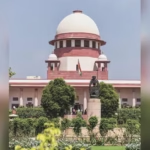
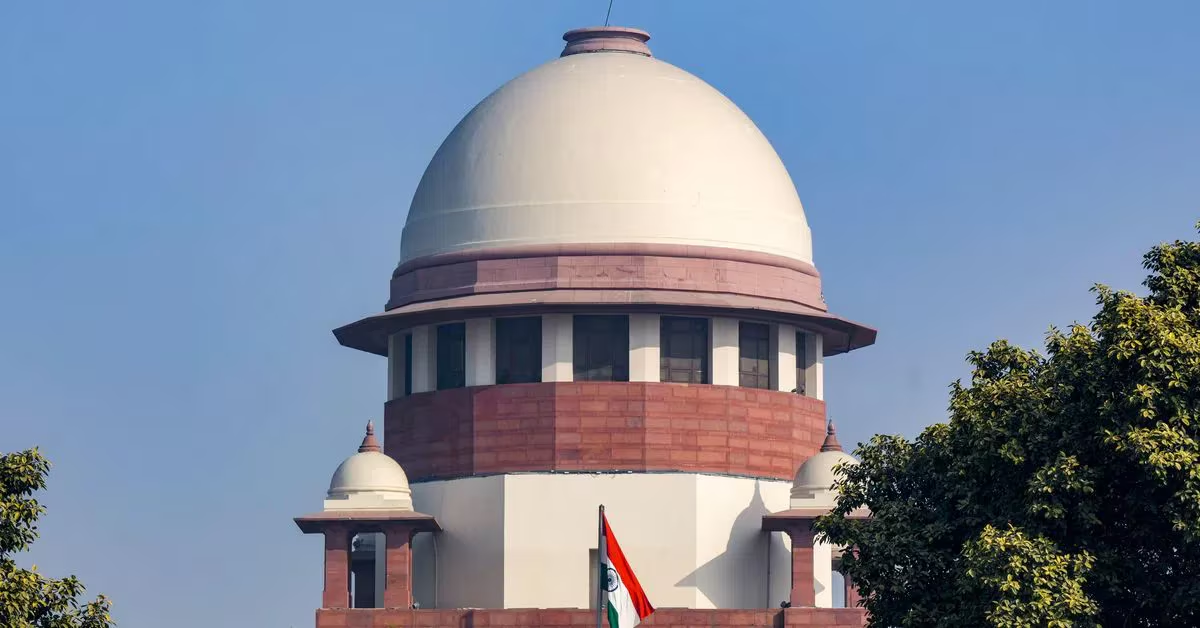
Now, as per its latest ruling, the top court wants the Centre to test a simple enforcement principle: No valid third-party insurance, no fuel.
What’s happening
Under the proposed pilot project, petrol pumps would verify a vehicle’s insurance status before dispensing fuel. Vehicles without a valid third-party insurance policy could be denied fuel until the cover is renewed. The Ministry of Petroleum and Natural Gas has, in principle, expressed no objection to the proposal.
The SC also directed that third-party insurance for new cars be extended from three to four years and for new two-wheelers from five to six years, and asked the Irdai to issue the necessary directions.
The objective, the court said, is “not just that victims of road accidents are compensated, it is also that they are not drawn into prolonged litigation.”
By the numbers
-
304.8 million: Total registered vehicles in India cited by the SC -
165.4 million: Vehicles estimated to be without valid third-party insurance -
56 per cent: Share of registered vehicles that remain uninsured -
22 per cent: Share of road accidents involving uninsured vehicles, according to government data cited by the court -
4 years: Minimum third-party insurance cover now directed for new cars, up from three years -
6 years: Minimum third-party insurance cover now directed for new two-wheelers, up from five years
How it could work
Deployment of automatic number plate recognition (ANPR) cameras at fuel stations to capture a vehicle’s registration number.
The number would be cross-checked with the VAHAN vehicle database and the Insurance Information Bureau’s records to verify whether the vehicle has valid third-party insurance.
Vehicles without a valid policy could be denied fuel until the insurance is renewed.
The same system could also identify unregistered vehicles and automatically issue e-challans for insurance violations.
The bigger picture
Third-party insurance is mandatory under Section 146 of the Motor Vehicles Act, 1988, to ensure road accident victims, or the families of those killed, receive timely compensation.
With more than half of India’s registered vehicles estimated to be uninsured, victims often face prolonged legal battles over liability and compensation. The apex court said technology-led enforcement, including linking fuel purchases to insurance status, could improve compliance and reduce delays in compensating accident victims.
What else the court ordered
The court also directed that:
-
ANPR-based insurance enforcement pilots to be rolled out in selected states to detect uninsured vehicles. -
State traffic police be equipped with handheld devices or mobile apps linked to the VAHAN portal and the Insurance Information Bureau to verify insurance status in real time. -
Automatic e-challans to be issued to uninsured vehicles through ANPR cameras integrated with insurance and vehicle-registration databases. -
Irdai to offer a basic minimum third-party insurance policy, alongside optional add-on, personal accident and own-damage covers, for private vehicle owners.
Yes, but
The verdict does not mean uninsured vehicles will immediately be denied fuel nationwide.
The proposal is still at the pilot stage. Before any nationwide rollout, the Centre and Irdai will need to finalise how petrol pumps access and verify insurance records, and test the system’s operational feasibility, such as database errors, connectivity failures and recently renewed policies.
What is third-party insurance?
Third-party motor insurance covers the legal and financial liability if your vehicle causes injury, death or property damage to someone else. The “third party” is the affected person, while you and the insurer are the first and second parties. It does not pay for damage to your own vehicle. For example, if your car hits another vehicle, the policy may cover the other vehicle’s damage, but repairing your car would require own-damage or comprehensive insurance.
[ad_2]
Source link