

[ad_1]
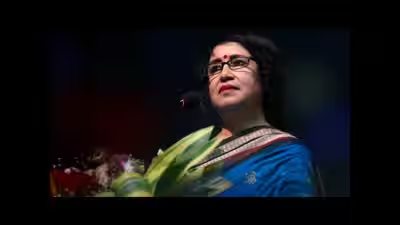
For 19 years, Taslima Nasreen carried Kolkata in her memories, longing to return but unable to do so. The city that had become her “second home” after she left Bangladesh in 1994 remained out of reach. Forced to flee her country of birth and later compelled to leave the city where she had settled, Nasreen spent much of the past three decades moving from one place to another, not in search of adventure but of refuge, without quite recovering the sense of home she associated with Kolkata.That door finally opened nearly 19 years later.Nasreen set foot in the City of Joy on July 31 and received a civic felicitation at Rabindra Sadan on August 1. The visit was accompanied by a warm official welcome from West Bengal’s new government, with Chief Minister Suvendu Adhikari assuring the writer of security whenever she chose to visit.The author, who was forced to leave Kolkata in 2007, responded with gratitude. “It’s not just the city I return to; for me, it’s a homecoming to a lost chapter of my life,” she said.The change of government has given Nasreen fresh hope of spending more time in Kolkata, something that did not become possible under the previous two administrations. But it has also raised a more difficult question: Is her return merely a ceremonial visit, or could it be the first step towards once again making Kolkata her home?
Homecoming: Delayed, but not denied
In November 2007, Kolkata witnessed violent protests by groups opposed to Nasreen and her writings, including her memoir Dwikhandito. Amid concerns over her safety and the worsening law-and-order situation, the authorities moved her out of the city.She was taken first to Jaipur and later kept under security in New Delhi before eventually leaving India for Europe. Her repeated appeals to successive governments to let her return to Kolkata did not produce a result.Almost two decades and two changes of government later, her return became possible. “Taslima Nasreen’s return proves that Bengal is in good hands now. Threats and intimidation are in the past. Every pillar of the Constitution and fundamental rights are safe,” Adhikari said at the felicitation.“You can come to Kolkata whenever you want, as many times as you want, and stay as long as you want. As the chief minister and police minister of Bengal, I am personally responsible for your security.” Nasreen was equally effusive in her gratitude.“History remembers who shut the door. Now, history will also remember who reopened it,” she said. “The opening of this door proves injustice can feel like a long night, but it’s never permanent.” But the cordial exchange also opened a larger conversation.Can Kolkata become a sanctuary to which Nasreen returns not merely as a guest but as a long-term resident? The answer is not straightforward. The chief minister can assure her of security within the state, but any longer-term residential arrangement would also depend on her visa status and decisions by the appropriate immigration authorities. Visa extensions and residential permits for foreign nationals are handled through the FRRO/FRO system and, in some cases, the Union home ministry.
Kolkata: Then and now
Nineteen years is a long time, particularly in a period of rapid political and social change. The Kolkata Nasreen knew in the early 2000s is not the city to which she has returned.For the writer, “every year in banishment looked like a door heavily bolted”. Meanwhile, although the government that moved her out of the city is no longer in power, her return has acquired a new and complicated political context.Nasreen has not forgotten how abruptly she had to leave Kolkata while the Left Front governed Bengal. She remains sharply critical of the Left, accusing sections of it of failing to defend free-thinkers while claiming to stand for secularism and progressive values.But the Kolkata of 2026 is governed by the BJP, and Nasreen’s return unfolded amid the symbols and slogans associated with its politics. Chief Minister Adhikari was welcomed at Rabindra Sadan with chants of “Jai Shri Ram”, a religious invocation that has also become a prominent political slogan.Nasreen has consistently argued that religion and the state should remain separate.“Humanity has to be bigger than any doctrine,” she said during her homecoming address.She also sought to draw a clear line between gratitude and political endorsement. “I’m thankful to this government for letting me return. But my gratitude doesn’t warrant my allegiance to them. I haven’t come here for any political party,” she said.The question, therefore, is not whether she is grateful to the government that facilitated her return. She plainly is. The harder question is whether Kolkata can protect her right to disagree with the same establishment if her views become inconvenient to it.The cultural composition of the felicitation offered another indication of how much the city’s public life has changed. For a ceremony honouring one of the Bengali language’s most internationally recognised writers, relatively few prominent members of the literary fraternity were present.Novelist Shirshendu Mukhopadhyay, who had been expected to attend, was absent. Poet Joy Goswami was present, but his appearance led to the most uncomfortable moment of the evening.When Nasreen invited Goswami to join her on the stage, a section of the audience erupted in protest, shouting slogans and objecting to his presence on the dais. Goswami, who had begun walking towards the stage, turned around and returned to his seat.The disruption continued for several minutes. Nasreen waited quietly before appealing to the audience to calm down and allow the programme to continue.The irony was difficult to miss. An event organised to celebrate a writer who had spent decades defending freedom of expression had briefly become a venue for preventing another poet from speaking.The hostility appeared to be connected to Goswami’s perceived proximity to the previous Trinamool Congress establishment and criticism that prominent cultural figures had not done enough to defend Nasreen when she was made to leave Kolkata. Whatever the political grievance, however, it could not justify denying him the opportunity to speak after Nasreen herself had invited him.Goswami did not confront the protesters and later left Rabindra Sadan without reading the poem he had written for Nasreen.“Everyone has the right to speak. When someone speaks about freedom of expression, people support it; but when a poet is invited to speak, they do not want to hear him. That is not right,” Nasreen said the following day.“It wasn’t just Joy who was insulted. I was also insulted because I had invited him.”The organisers also expressed regret over the incident. Nasreen subsequently spoke to Goswami by telephone after being unable to visit him during the trip.The episode showed how quickly cultural spaces can become arenas for political resentment. For all the celebration surrounding Nasreen’s homecoming, Kolkata is still negotiating the same difficult questions about dissent, ideological loyalty and the right to disagree that formed the background to her departure.The real test will not be how warmly the city welcomes her when her presence suits the political moment. It will be whether Kolkata continues to defend her when she says something those in power, or their supporters, do not wish to hear.
Where to next?
Kolkata has reopened its doors to Nasreen after nearly 19 years. Her own homeland, however, remains out of reach. After Lajja provoked widespread outrage among Islamist groups, Nasreen faced threats and criminal proceedings over her writings and public statements. Her Bangladeshi passport was revoked, and she left the country in 1994.Nearly 32 years later, she has still not been able to return permanently. Exile remains the defining condition of her life. “The number of years I’ve been away from home has already surpassed the sum of time I was allowed to live there,” said Nasreen, who will turn 64 later this month.And yet she has supported former Bangladesh prime minister Sheikh Hasina’s right to return to the country, even though Nasreen has said that Hasina’s government opposed her own attempts to return to Bangladesh in 1999. “I’ve criticised Sheikh Hasina in the past,” Nasreen said. “The ban on the Awami League must be revoked since it’s undemocratic. Sheikh Hasina wants to return. I want her to return for the sake of democracy in Bangladesh.”Hasina, who has been living in India since her government fell in August 2024, has said she intends to return to Bangladesh by December despite a death sentence handed down in absentia, which she rejects as politically motivated. She was scheduled to make her first public appearance since her ouster through a virtual address in New Delhi on August 5.Nasreen’s defence of Hasina’s right to return is notable precisely because of their history. It is an argument that the right to go home should not depend on political sympathy or personal gratitude. “No one wants my return. Sheikh Hasina did not. Neither did Khaleda Zia nor those who came to power subsequently,” Nasreen said, her disappointment over the repeated refusals unmistakable.But she refuses to abandon hope. “It took me 19 years to be able to say, ‘Kolkata, I’ve come back to you’,” she said. “I have tears in my eyes, but I come with a heart full of love.”Her return to the City of Joy has renewed her belief that seemingly permanent barriers can eventually fall. “Nineteen years stand between my exile and return. But the opening of this door proves injustice can be long-standing but never permanent.”Perhaps that is why Nasreen continues to dream of a day “when no writer has to live in exile from her own country”. She hopes Bangladesh will one day separate religion from the state and become a country where women have equal rights, minorities can live with dignity and free-thinkers and non-believers are not threatened for their views.In India’s neighbouring country, that day may yet come. For now, Nasreen is grateful that she can at least return to Kolkata, revisit its familiar spaces and, she hopes, attend the Book Fair as she once did.
Share your thoughts in the comments
Be respectful · TOI community guidelines
Her former address in the city no longer belongs to her. Kolkata has changed, and the pet that once helped make the city feel like home is no longer alive. But after nearly 19 years, Taslima Nasreen has returned, carrying with her hope, unfinished arguments and, perhaps, a few more lives in reserve.
[ad_2]
Source link