[ad_1]
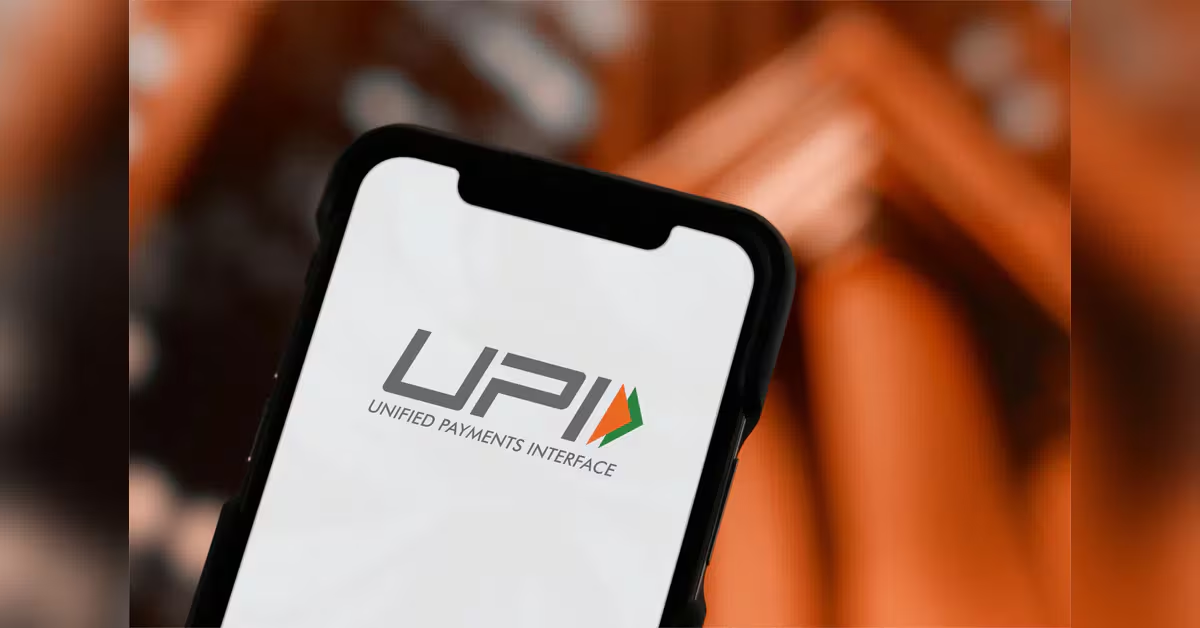
The government has clarified that transactions made through Unified Payments Interface (UPI) will continue to remain free for users.
It further stated that a merchant discount rate (MDR) on UPI will only apply to a ‘limited set of merchant transactions over a certain threshold’ at a fee lower than credit and debit cards. However, this is subject to MDR charges being introduced in the future.
The government said that peer-to-peer (P2P) transactions would continue to remain free.
“Consumers making payments will not face any transaction charges. As and when MDR charges are introduced, they will apply only to a limited set of merchant transactions, above a certain threshold, at a nominal rate, far lower than debit or credit card MDRs,” the Ministry of Finance said on Saturday.
It further added that the UPI and Services Steering Committee, headed by the National Payments Corporation of India (NPCI), will decide on a potential MDR once Section 10A of the Payment and Settlement Systems Act, 2007, is amended.
The government has called the amendment an enabling provision to ensure UPI’s long-term sustainability, technological advancement, and resilience against emerging risks.
“Some of the media reports have suggested that external influences may be driving policy changes. This is unfounded, completely false and misleading. If external pressure had been a factor, the government would not have introduced UPI in 2016 or made it free of charge for both merchants as well as citizens since January 2020 and ensured that it became the world’s largest real time interoperable payment system,” it clarified.
The industry believes that the latest clarification about the threshold hints at an MDR being levied on only large merchants above a certain annual turnover.
Last year, the Payments Council of India (PCI) had called for a nominal MDR on UPI for large merchants.
The digital payments association had said that about 60 million merchants accept e-payments, mainly UPI. 90 per cent of these were categorised as small merchants — those establishments with a turnover of less than Rs 20 lakh per annum.
It had said that the remaining 5 million merchants were above the threshold, having a payment acceptance device such as point-of-sale (PoS) machines or e-commerce websites enabling them to accept card-based payments.
“There card payment value for large merchants on an average is above 50 Per cent and on this they already pay MDR for different payment systems non-RuPay Debit Cards (~0.9%), Credit Cards (~2.0%), prepaid instruments (~1.5%),” the PCI had said in a letter to the Prime Minister’s Office (PMO) last year.
PCI had previously proposed the introduction of an MDR of 0.3 per cent for UPI only for large merchants, a rate lower than card-based transactions.
Talks around UPI MDR are still premature, and continued investment is needed to further strengthen the real-time payments system, Reserve Bank of India (RBI) Governor Sanjay Malhotra said this week.
[ad_2]
Source link