

[ad_1]
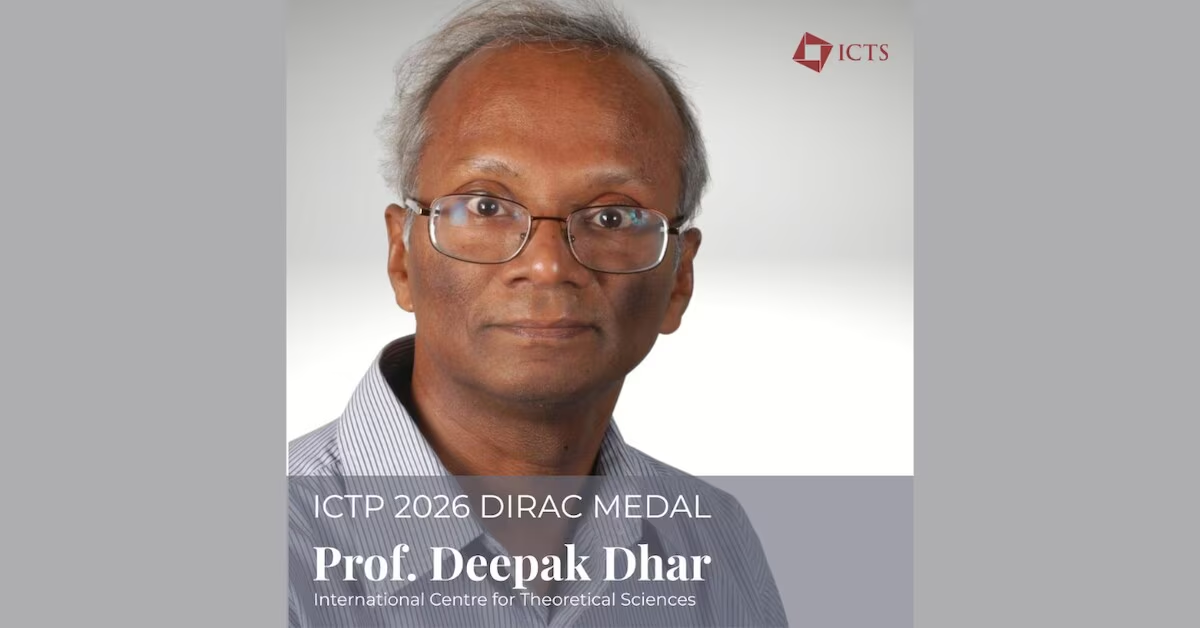
The International Centre for Theoretical Sciences on Monday said that its professor Deepak Dhar has been awarded the prestigious 2026 Dirac Medal, recognising his contributions to statistical mechanics and complex systems.
Prof Dhar, who is an Indian National Science Academy (INSA) distinguished professor at ICTS, shares the honour with three other stalwarts of statistical mechanics — Bernard Derrida, Marc Mezard and Haim Sompolinsky –, the Institute said in a post on its website.
According to the ICTS, the award recognises the four scientists “for their pioneering contributions to equilibrium statistical mechanics and for extending its concepts and methods into non-equilibrium statistical mechanics, optimization problems, theoretical neuroscience, and, finally, artificial intelligence.
The Dirac Medal is awarded annually by the International Centre for Theoretical Physics (ICTP) in honour of physicist Paul Dirac.
ICTP Director Atish Dabholkar commented, “The work of the 2026 Dirac Medallists has contributed to establishing theoretical physics, and particularly statistical mechanics, as a powerful framework to tackle a very broad range of questions that go far beyond its traditional domain of interest to encompass biology, computer science and artificial intelligence.” Describing Prof Dhar’s contributions, the award said, “Deepak Dhar showed how simple interactions can lead to complex and sometimes unpredictable behaviour in large systems.” “Through his pioneering work on the sandpile model, for example, he described a familiar phenomenon: as grains are added to a sandpile, most result in no change or only small avalanches, while occasionally a single grain can cause a much larger collapse.
“The theory shows that the sandpile, like many other complex systems, spontaneously places itself in a critical regime where small effects can sometimes trigger large abrupt events and has been used to model systems as apparently different as earthquakes, traffic jams and fluctuations in financial markets,” it said.
[ad_2]
Source link