


[ad_1]
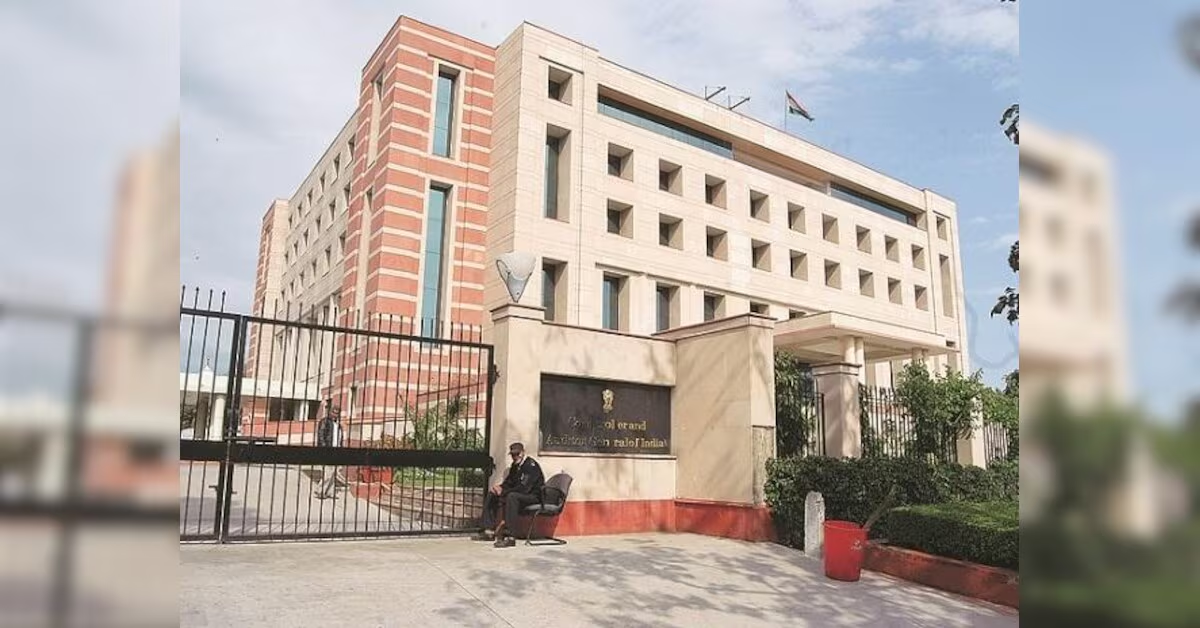
The Ministry of Education had the highest unutilised grants among ministries and departments audited by the Comptroller and Auditor General of India (CAG), with Rs 4,553.85 crore reported as unutilised by its autonomous bodies in 2022-23, even as the higher education system continued to face a large accreditation gap.
The ministry received Rs 54,732.16 crore in grants for its autonomous bodies during 2022-23, of which Rs 4,553.85 crore was reported as unutilised. This accounted for 33.82 per cent of the total Rs 13,464.22 crore in unutilised grants across the ministries and departments covered by the audit.
The CAG also flagged the limited reach of the country’s higher education accreditation system. As of March 2022, only 31.92 per cent of higher education institutions (HEIs) had been accredited. Among eligible institutions, 56.26 per cent of universities and 76.22 per cent of colleges had neither been accredited nor applied for accreditation. Only seven of 161 eligible Institutes of National Importance had been accredited.
The National Assessment and Accreditation Council (NAAC) also fell short of its annual target of 2,500 accreditations. Its achievement ranged from 12.76 per cent of the target in 2020-21 to 79.24 per cent in 2023-24. The CAG said NAAC had not provided a comprehensive action plan for achieving universal accreditation.
The revised accreditation framework also failed to improve output, with the average number of accreditations being 16.51 per cent lower than under the earlier framework. As of March 2025, only 11,581 HEIs, or 25.71 per cent, had been accredited. The CAG also found 559 institutions continuing to display expired or lapsed accreditation status on their websites.
The audit flagged delays in financial reporting by the ministry’s autonomous bodies. Of the 198 bodies whose accounts were reviewed, 102 submitted their 2022-23 accounts after the prescribed June 30 deadline. Further, the audited accounts and summary reports of 91 autonomous bodies had not been laid before Parliament within the prescribed timeframe.
Among individual institutions, IIT Bombay, IIT Guwahati and the Central Institute of Technology, Kokrajhar, reimbursed faculty members Rs 1.34 crore for laptops, desktops, tablets and similar devices using the Cumulative Professional Development Allowance, although such purchases were not permissible under the rules. IIT Bombay accounted for Rs 73.81 lakh, IIT Guwahati Rs 10.33 lakh and CIT Kokrajhar Rs 50.31 lakh.
IIM Mumbai lost Rs 58.71 lakh in interest because funds kept in its HEFA principal repayment account were not invested in short-term fixed deposits before they were required for loan repayments.
At the Central University of Tamil Nadu, an investigative audit found that 786 of the 2,711 items billed were not found, while another 387 could not be verified. It also found a short supply worth Rs 58.87 lakh, payments of Rs 2.01 crore above the original cost and Rs 3.74 crore paid without adequate invoices or running bills. The Central Vigilance Commission recommended disciplinary proceedings against four officials.
At the Indian Institute of Science Education and Research, Kolkata, three acres of land and a building valued at Rs 12.54 crore were given to a private foundation to run a school without ministry approval, resulting in Rs 6.50 crore of unrealised revenue, the CAG said.
[ad_2]
Source link