

[ad_1]
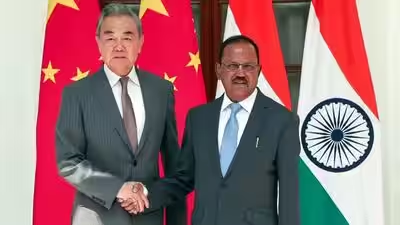
NEW DELHI: India’s national security adviser Ajit Doval arrived in Beijing on Monday for a two-day visit. He is set to hold the 25th round of Special Representatives’ Talks on the India-China boundary question with Chinese foreign minister Wang Yi on Tuesday. The visit comes as New Delhi and Beijing seek to build on recent signs of a thaw in ties.The ministry of external affairs (MEA) said Doval arrived in Beijing “at the invitation of Wang Yi”.The talks come amid efforts by the two sides to gradually normalise relations following years of tensions along their disputed Himalayan border.“The NSA will also call on China’s vice president Han Zheng during his visit,” the MEA said.
Boundary question and border stability on the agenda
The central focus of the talks will be the unresolved India-China boundary issues, with both sides expected to discuss the management of differences and the preservation of peace and tranquillity along the Line of Actual Control.Chinese foreign ministry spokesperson Lin Jian said the two sides would continue discussions in accordance with agreements reached by their leaders.India and China share a roughly 3,500-kilometre disputed border.Relations came under severe strain after the deadly military clash in eastern Ladakh in 2020, following which the two sides held repeated military and diplomatic talks to address the situation.The latest Special Representatives’ meeting comes against the backdrop of a broader effort to stabilise the relationship.
Recent thaw in ties
Doval’s Beijing visit follows his meeting with Wang in New Delhi in June on the sidelines of the BRICS National Security Advisers’ meeting.The MEA described those discussions as part of the process of rebuilding bilateral ties.According to MEA spokesperson Randhir Jaiswal, the two sides “reviewed recent developments in bilateral relations and noted progress towards gradual normalisation”.Jaiswal said Doval had stressed the importance of maintaining a stable relationship.“NSA underlined that stable, predictable and constructive bilateral relations contribute to building trust and better understanding between the two sides,” he said, adding: “The discussions were constructive and forward-looking.”The latest visit also comes after subsequent meetings between Prime Minister Narendra Modi and Chinese president Xi Jinping on the sidelines of major international summits.At the SCO Summit in Tianjin last year, PM Modi and Xi welcomed what the two sides described as positive momentum and steady progress in bilateral relations following their previous meeting in Kazan in October 2024.
Share your thoughts in the comments
Be respectful · TOI community guidelines
The two leaders had also reaffirmed that India and China were development partners rather than rivals, and that differences between them should not be allowed to become disputes.“A stable relationship and cooperation between India and China and their 2.8 billion peoples on the basis of mutual respect, mutual interest and mutual sensitivity are necessary for the growth and development of the two countries, as well as for a multipolar world and a multi-polar Asia befitting the trends of the 21st century,” the MEA had said in a statement after the leaders’ meeting.The Special Representatives’ mechanism has been one of the key diplomatic channels for addressing the boundary dispute between India and China. The 25th round comes at a time when both governments are seeking to consolidate the recent improvement in relations without setting aside their differences over the border.For New Delhi, maintaining a stable and predictable relationship with Beijing is also significant as India prepares for the BRICS summit next month, where it hopes Xi will attend.
[ad_2]
Source link