


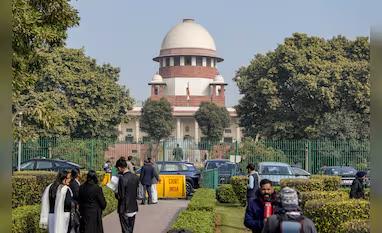
Supreme Court issues 10 directions to reduce delays in dowry death and cruelty trials.(Photo: PTI)
In an order passed on August 20, a Bench of Justices Sanjay Karol and Augustine George Masih issued 10 directions aimed at speeding up trials under dowry-related laws and improving their enforcement. The directions cover everything from framing charges and limiting adjournments to witness management, digital tracking and regular compliance reports.
What are the Supreme Court’s 10 directions?
The Court has called for the following measures:
- Prioritise dowry cases: Courts should give priority to cases involving dowry deaths and cruelty against married women, which are covered under Sections 304B and 498A of the Indian Penal Code and their corresponding Sections 80 and 85 of the Bharatiya Nyaya Sanhita.
- Track cases pending for over three years: District courts should identify long-pending cases, particularly those awaiting framing of charges or recording of evidence, and monitor their progress.
- Frame charges within 60-90 days: Trial courts should endeavour to frame charges within 60 to 90 days of a chargesheet being filed. Evidence should then begin within a reasonable period and, as far as possible, be recorded continuously or day-to-day.
- Limit unnecessary adjournments: Courts should discourage avoidable adjournments and record reasons whenever one is granted. If an accused’s lawyer repeatedly stays absent without sufficient cause, legal aid counsel or an amicus may be appointed.
- Prepare witness calendars: Trial courts should schedule the examination of key witnesses after charges are framed, while investigators should ensure summons are served and witnesses are produced on time.
- Use digital monitoring: High Courts should use existing court-management systems to track the progress of dowry cases and generate alerts for older matters.
- Review pending proceedings: High Courts should periodically examine old appeals, revisions, petitions and bail matters involving dowry offences, particularly where trials have been stayed.
- Strengthen training and prosecution: States and High Courts should regularly train judges, police officers, prosecutors, protection officers and counsellors. Experienced prosecutors may also be designated for offences against women.
- Improve support and awareness: States and Union Territories should strengthen one-stop centres, counselling centres, women’s help desks, victim assistance services, helplines and online grievance systems. Awareness campaigns on dowry, gender equality and women’s rights should also be sustained.
- Submit regular compliance reports: High Courts and States and Union Territories must submit status reports until the pendency of relevant cases is substantially reduced.
What prompted the SC’s Intervention?
The directions follow the Court’s December 2025 judgment in State of Uttar Pradesh v. Ajmal Beg, where it highlighted the continuing prevalence of dowry and the need for stronger enforcement.
The case took 24 years to reach its conclusion, highlighting the serious delays that can affect dowry and cruelty trials.
The Supreme Court has directed that the case be listed on October 15, when it will review reports from High Courts, States and Union Territories on the steps taken to implement its directions.
First Published: Aug 27 2026 | 3:06 PM IST