

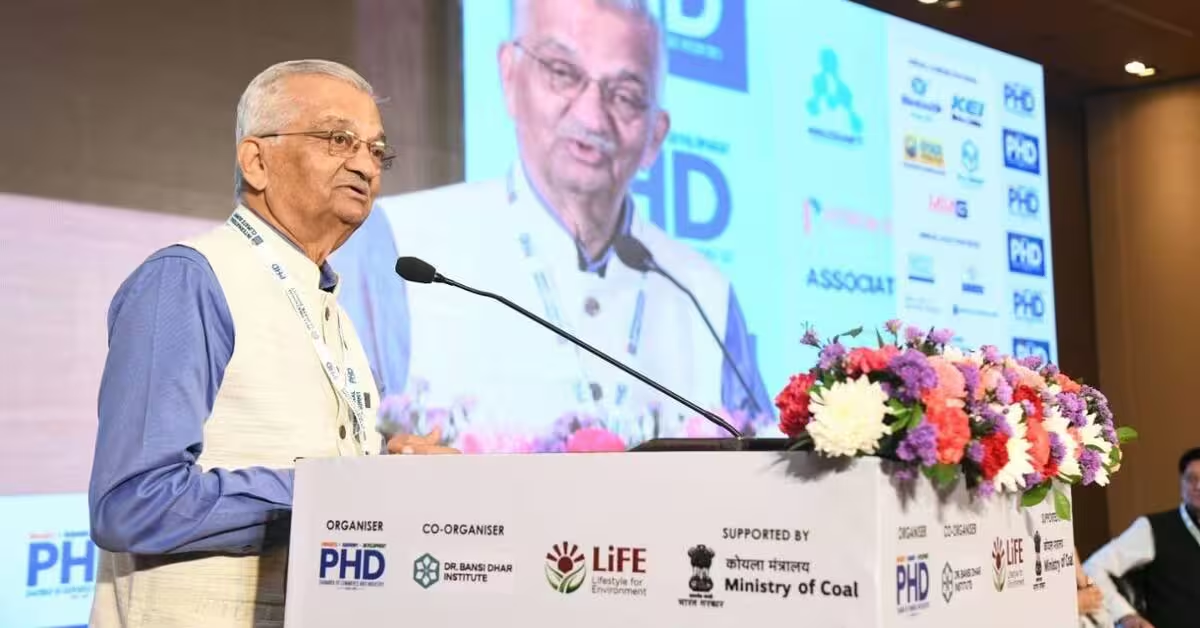
Given the structural deficit emerging in the uranium supply market, India must introduce thorium in its nuclear energy programme, said Anil Kakodkar, chancellor, Homi Bhabha National Institute and former chairman of the Atomic Energy Commission of India.
“Barring a few nations, including India, France and Russia, most countries want to ensure that uranium is used only in a once-through fuel cycle which limits its potential. However, if it is recycled, its potential increases 70-100 times. That is what India’s programme needs,” he said while speaking at the 6th International Climate Summit here.
India possesses the world’s largest reserves of thorium but it cannot be used without recycling, Kakodkar, a world-renowned nuclear scientist, said. He advocated for ways to recycle the nuclear fuel which will allow India to extract much more energy from its nuclear resources.
He also said global uranium resources can support around 550–750 gigawatts (Gw) of power generation capacity through a once-through cycle.
Assuming that reactors typically operate for 50–70 years, this represents the total capacity that can be supported by uranium currently being supplied globally under the existing system.
Total capacity could reach 1,446 Gw by 2050, surpassing the around 1,200 GWe target established under the Declaration to Triple Nuclear Energy, according to the World Nuclear Association.
“Uranium supply is going to come under increasing pressure because of this situation. The strain is already visible in today’s market, but we must think about the long term. Therefore, the transition from uranium to thorium has to be a priority. There is a structural deficit emerging in the uranium supply market, and we need to prepare for it,” Kakodkar said.
Highlighting that at least half of the 100 Gw capacity envisaged by India under the nuclear energy mission could come from
pressurised heavy-water reactors (PHWRs), Kakodkar said there is an opportunity to introduce thorium at this stage itself.
“The objective should be to irradiate thorium in such a way that the cost of electricity from PHWRs does not increase. Also, the demand for thorium does not increase while maintaining the same uranium consumption,” he said.
“This provides an opportunity to move beyond direct thorium utilisation and begin using thorium even as we wait for more uranium-233 to be produced through the fast-breeder stage of the original programme,” he added.
For largescale thorium deployment, India needs to develop high-burn-up fuel capabilities, access to higher-enrichment uranium and thorium recycling technologies, he said.
He added that thorium-based fuel in PHWRs could offer advantages in safety, economics, waste reduction and uranium savings, while enabling faster progress towards thorium-based reactors.
Kakodkar said the development of thorium-heavy-fuel recycling technology and thorium molten salt reactors should be advanced over the next 10–15 years. This would bring forward the third stage of India’s nuclear programme.