

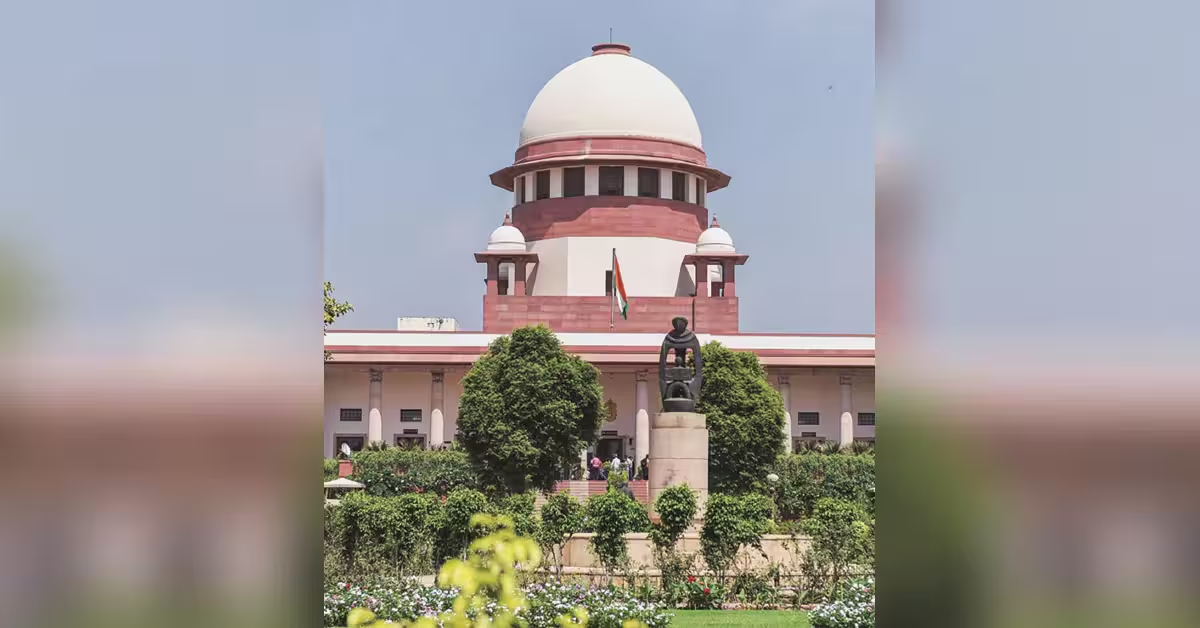
The Supreme Court on Thursday held that the Bar Council of India (BCI) has no statutory authority to take disciplinary action against law students before they enrol as advocates.
A Bench headed by Chief Justice of India Surya Kant, along with Justices Joymalya Bagchi and V Mohana, said disciplinary control over students rests with the university or educational institution where they are studying.
The BCI can regulate standards of legal education but cannot punish students for their conduct during their course, the court said.
The court was hearing a challenge to BCI communications issued after students of NALSAR University of Law, Hyderabad, protested against the invitation to CJI Kant to be the chief guest at their convocation. The BCI had initially barred the university’s 2026 graduating batch from enrolling as advocates before withdrawing the decision.
The court said the Advocates Act, 1961, does not give the BCI either express or implied powers to discipline law students. Such jurisdiction begins only after a law graduate enrols as an advocate.
“As far as the conduct of law students is concerned, the Bar Council of India has neither jurisdiction nor statutory competence,” CJI Kant observed. He said the BCI becomes the regulator once a graduate registers as an advocate.
Justice Bagchi said the BCI could examine a candidate’s eligibility at the stage of enrolment but could not dictate whether a student should be allowed to continue legal education or threaten non-enrolment in advance because of conduct during university.
The court consequently declared the BCI’s August 13 communication and subsequent modified communications to have been issued without jurisdiction. Since the BCI had already withdrawn the proceedings, the court closed the case.
The court’s earlier direction restraining punitive action against NALSAR, its students, faculty or other national law universities was made absolute.
The controversy followed a representation signed by about 70 NALSAR students opposing CJI Kant’s appearance at the convocation. The students had criticised his response during a hearing concerning allegations of police brutality against protesters. Students from other batches later supported the campaign.
The BCI subsequently issued a circular blaming the campaign on alleged “groupism” and “dirty politics” involving some faculty members and sought an inquiry. It later withdrew the proceedings following criticism.
Senior advocate K Parameshwar, appearing for the petitioners, sought a clear declaration that the BCI had no authority over student conduct. BCI Chairman Manan Kumar Mishra said the matter had already been withdrawn.
CJI Kant said the withdrawal indicated that the BCI had realised that a “mistake, if not a blunder” had been made. He, however, clarified that students’ freedom of expression was not “unbridled”.