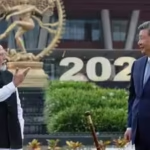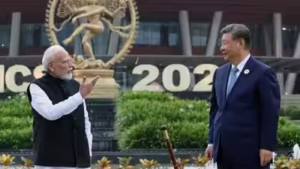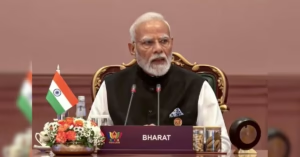


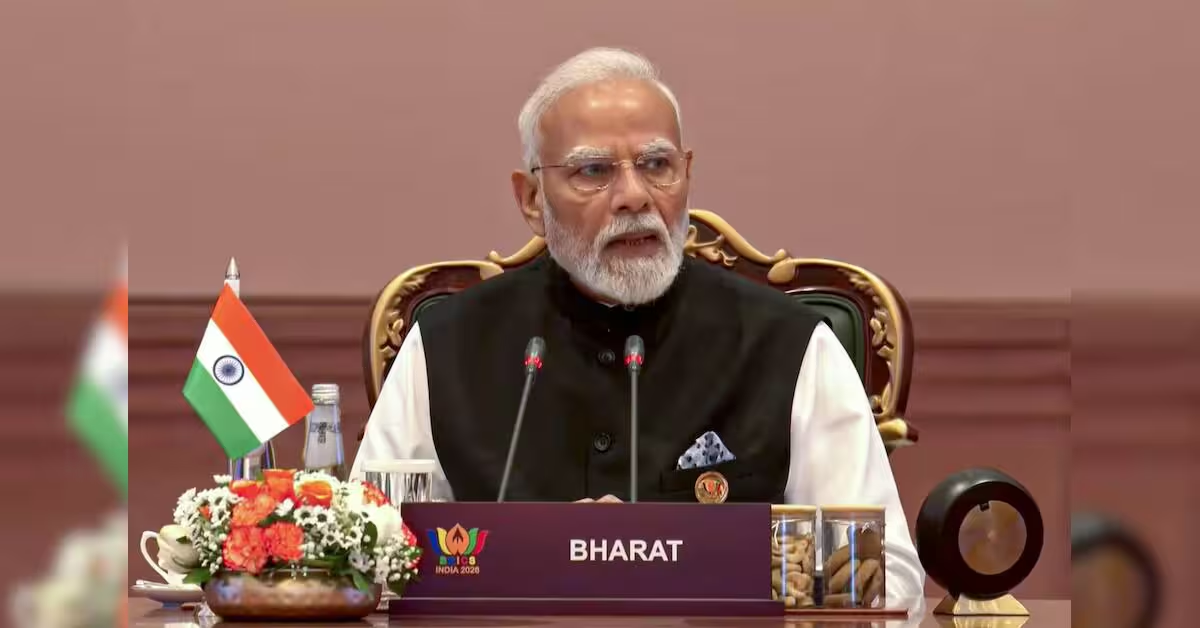
Prime Minister Narendra Modi on Day 2 of the Brics Summit 2026 warned that the “weaponisation of technology and critical minerals” could hinder common growth, calloing for inclusive access to technology and stronger, more resilient supply chains.
Addressing the Brics session on Resilience, Innovation, Cooperation and Sustainability on Sunday, PM Modi said, “The weaponisation of technology and critical minerals could hinder our shared progress. Therefore, we have emphasised inclusivity in the adoption of technology.” The remarks came as Chinese President Xi Jinping is among the leaders present at the summit. China accounted for 60 per cent of global mined production of magnet rare earths in 2024 and 91 per cent of refined output, according to the International Energy Agency (IEA). Its share of global sintered permanent-magnet production stood at 94 per cent.
In April 2025, Beijing introduced export restrictions on seven rare-earth elements and finished magnets, requiring exporters to secure licences. The measures led to delays in shipments and raised concerns over production disruptions among Indian automobile and electric vehicle manufacturers.
Notably, India remains significantly dependent on China for permanent magnets. Government data show that China accounted for roughly 85-90 per cent by quantity of India’s permanent-magnet imports during 2022-25, depending on the category. India also currently imports all its requirement of sintered neodymium-iron-boron rare-earth permanent magnets used in downstream applications.
Strengthening resilience among Brics nations
PM Modi said the number of tensions across the world was rising and having a “significant and widespread negative impact” on the lives of ordinary people.
Pandemics, climate disasters and supply-chain disruptions had demonstrated that, in an interconnected world, crises could no longer remain confined to a single region, he added.
PM Modi said India had, therefore, placed particular emphasis on strengthening resilience within Brics, including identifying challenges early, preparing for them and responding quickly.
“With this approach, a consensus has been reached on a Brics Integrated Early Warning System for the prevention of and response to infectious diseases,” he said.
Early Warning Data Integration Guidelines had also been prepared for disaster management, while the Brics Logistics Supply Chain Cooperation Framework would help make supply chains more reliable and resilient, he added.
“Under India’s Brics presidency, we have focused all our efforts on four pillars: resilience, innovation, cooperation and sustainability. I am pleased that with your cooperation and support, we have been able to transform our shared vision into a win-win cooperation,” PM Modi said.
He said India had sought to use the four pillars to promote inclusive global growth through Brics, while ensuring that solutions developed by the grouping could also be adapted to meet the needs of the Global South.
Brics in technology
Under the innovation pillar, PM Modi highlighted the Brics Incubator Network, which will connect startups and incubators across member countries.
India has also proposed a Brics Startup Innovation Fund to promote innovative and scalable solutions.
PM Modi said the Brics Network on Digital Agriculture would seek to align artificial intelligence (AI), geospatial technology and digital public infrastructure with the needs of farmers.
Through ‘Brics Connect’, the grouping has also sought to promote skills, employability, women’s participation in the workforce, social security and capacity building, he said.
An initiative for a Brics micro, small and medium enterprises (MSME) cooperation portal has been launched to connect small businesses with knowledge, finance and new markets, while a Brics Urban Mobility Hub has been established to enable cities to share best practices.
Linking sustainability with development
PM Modi said sustainability required striking a balance between human development and environmental protection.
“In Indian civilisation, nature is revered as a mother. For centuries, we have held the belief that development and the environment are not alternatives to each other, but are complementary,” he said.
He said a Brics Digital Centre of Excellence for smart grids and energy storage had been set up to help make clean-energy systems more reliable, efficient and accessible.
Centres of excellence for agroecology and regenerative agriculture would seek to combine traditional knowledge with modern science, while principles for community-based climate adaptation would help establish indigenous knowledge as an important part of climate action, Modi said.
The New Delhi Declaration adopted at the summit also called for “reliable, responsible, diversified, resilient, fair, sustainable, and just” critical-mineral supply chains, while recognising their importance for energy security and low-emission technologies.