

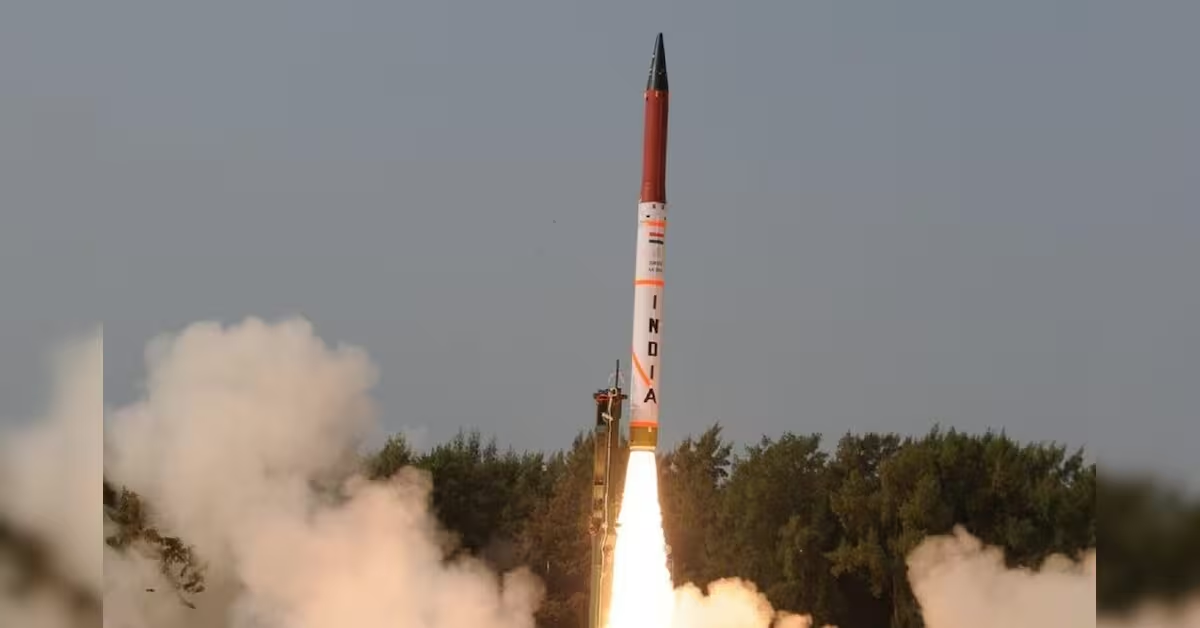
India is all set to redraw the geography of its missile-testing infrastructure with new facilities proposed to come up in Andhra Pradesh and West Bengal.
While a specialised range is taking shape at Nagayalanka in Andhra Pradesh, the new government in West Bengal has agreed to facilitate a weapon-testing facility at Junput on the Bay of Bengal coast in Purba Medinipur district.
The emerging network is being designed to support a rapidly expanding portfolio of ballistic and cruise missiles, air-defence interceptors and ballistic-missile defence systems to give India the testing capacity needed to sustain its strategic competition with its neighbouring countries.
Defence sources said New Delhi is moving beyond its long-standing dependence on the missile-testing complex in Odisha. “The upcoming Junput facility near Digha will work like an extension of the Chandipur test range, located around 75 km away,” said a defence official, refusing to divulge details of the weapons to be tested there.
The Integrated Test Range (ITR) at Chandipur and Dr APJ Abdul Kalam Island off the Odisha coast has been the centre of gravity for India’s missile flight-testing programme for decades. But the character and scale of that programme have changed dramatically, with India developing weapons across a far wider range of speeds, ranges and mission profiles, giving rise to the requirement for multiple launch sites, tracking radars, telemetry and electro-optical systems.
The Andhra Pradesh facility is being designed with a launch centre, technical instrumentation facilities, indigenous radars, telemetry systems and electro-optical tracking systems. Prime Minister Narendra Modi had laid the foundation stone for the Navdurga missile test range, estimated at around ₹1,460 crore, in Nagayalanka last year.
However, the location of the proposed Junput facility is significant as it will add another coastal launch and tracking node to India’s eastern testing facility. Both Chandipur and Kalam Island already have direct access to maritime flight corridors for missile trials. The proposed Nagayalanka facility in Andhra Pradesh, by contrast, is being developed inland in Krishna district, and its location is expected to provide a different testing geometry and operational envelope from the coastal ranges.
“The geographical diversification could give DRDO greater flexibility in designing flight trajectories, positioning tracking and telemetry assets and conducting complex tests that require more than one launch or tracking location,” said the defence official.
However, unlike Junput, which was conceived principally to provide additional operational capacity for the Chandipur facility, Nagayalanka has a particularly important role in India’s Phase-II Ballistic Missile Defence (BMD) programme.
DRDO’s Phase-II BMD programme is intended to deal with more sophisticated and longer-range ballistic missile threats. Unlike a conventional missile test, a BMD trial involves an incoming target missile and an interceptor, often requiring carefully controlled trajectories and multiple tracking and sensor systems.
Although proposed in the early 2020s, the Junput project saw no significant progress as the previous Trinamool Congress government did not respond to communications from the Ministry of Defence (MoD). The site was selected to meet safety requirements while providing access to the Bay of Bengal for missile flight-testing.
The land acquisition for the test centre has been completed along with the road to the project site. “We have already responded to the letters from the Centre and are working to facilitate the test facility,” West Bengal Chief Minister Suvendu Adhikari said recently.
According to the prevailing safety protocols, people living within a one-kilometre radius would be evacuated temporarily, with compensation and safe shelter arrangements prescribed for such trials.
Since India is trying to move from being a large defence importer to becoming a major defence manufacturer and exporter, the government is encouraging private companies to participate in missile and weapons production, while DRDO is transferring technologies to Indian industry.
Experts said as production capacity expands, development cycles will also multiply. More ranges mean greater testing throughput, more flexibility in scheduling trials and potentially shorter development cycles.
“A defence company may have the manufacturing capability to produce weapons, but it still requires access to an appropriate test range for developmental and validation trials. If range availability becomes a bottleneck, the country’s manufacturing ambitions cannot translate into faster induction or exports,” pointed out N K Samal, a defence analyst.