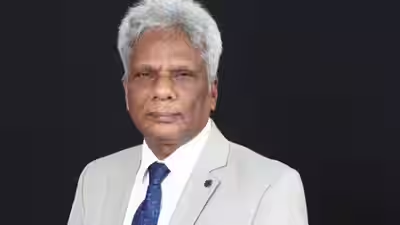
MUMBAI: In a major step towards strengthening India’s nuclear diplomacy, Atomic Energy Commission chairperson AK Mohanty announced that the country is ready to share its nuclear expertise and experience in indigenous technology development, capacity building, closed fuel cycles and peaceful applications as a frontline nuclear power with proven capabilities.Speaking at the 70th International Atomic Energy Agency (IAEA) conference on Monday, Mohanty told the gathering of global nuclear leaders and experts that last month, India joined the launch of IAEA’s Atomic Technologies Licensed for Applications at Sea (ATLAS) initiative in Washington DC, which, he said, closely aligns with the country’s Nuclear Energy Mission and broader vision of reliable, low carbon-generating power that strengthens energy security while supporting climate goals.The ATLAS project aims to explore safe nuclear power for commercial shipping and floating energy plant. India will share its expertise in this new project, Mohanty said.He further said that in May 2026, India assumed the chairmanship of Regional Co-operative Agreement (RCA) under the banner of Vishwa Bandhu Bharat, which focusses on deepening collaborative research, technology dissemination, and human resource development across the Asia-Pacific region. “India’s chairmanship of RCA is a reaffirmation of our strong commitment to South-South cooperation and ensuring that the benefits of nuclear science reach every nation that seeks them,” he added.In March 2026, the engineering procurement and construction contract for the mega science project — Laser Interferometry Gravitational Wave Observatory, LIGO-India in Hingoli — was issued, marking a key milestone in the project.
Share your thoughts in the comments
Be respectful · TOI community guidelines
He said that the Shanti Act passed in Dec 2026 has helped to align domestic liability provisions with the best practices globally.The representative from Pakistan said that his country attaches paramount significance to nuclear security and has established a robust and comprehensive nuclear security framework encompassing legislative, regulatory, and institutional elements.He said that the Pakistan Centre of Excellence for Nuclear Security, in collaboration with IAEA, has been instrumental in enhancing capacity in nuclear security and has evolved into a regional hub for capacity building.Syria’s minister for foreign affairs and expatriates Asaad-Al-Shaibani said his country maintained a policy of transparency in its nuclear affairs. “Our country’s doors are open to IAEA inspectors,” he said.