

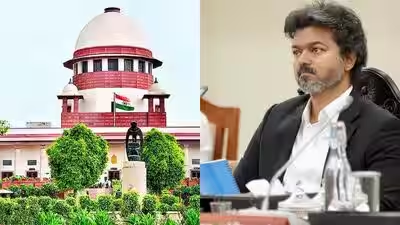
NEW DELHI: Supreme Court on Thursday directed the Tamil Nadu government to comply with its December 15, 2025 order to identify land in every district for establishing Jawahar Navodaya Vidyalayas, while urging the state and Centre to resolve their differences over the schools through dialogue.A bench of Justices BV Nagarathna and Augustine George Masih also questioned Tamil Nadu’s opposition to the three-language policy followed by Navodaya schools and said the state should not view the establishment of the centrally funded institutions as a threat to its existing education system.“You have to change your mindset, it can’t be that Hindi will not be taught in the soil of Tamil Nadu,” Justice Nagarathna observed during the hearing.The bench also said the people in Chennai should not alienate those in Delhi while stressing the need for cooperative federalism.“We are saying in addition to all the good things you’re doing in your State, having something in addition will not bring down your standards. Coming from Delhi, will not lower the standards of Chennai. People in Chennai should not alienate Delhi and vice versa,” the Court said.The court granted Tamil Nadu three more months to identify suitable land in each district and directed representatives of the state and Central governments to hold further discussions on the policy for establishing the schools. The matter has been posted for December 14.
Tamil Nadu raises language concerns
The case relates to Tamil Nadu’s challenge to a Madras High Court direction to establish Navodaya Vidyalayas in every district.Navodaya schools are centrally funded, co-educational residential schools run by the Navodaya Vidyalaya Samiti under the Union Ministry of Education. Tamil Nadu has opposed their establishment, among other reasons, because the schools follow a three-language policy that includes Hindi, while the state follows a two-language policy.Senior Advocate Jaideep Gupta, appearing for Tamil Nadu, told the court that the state’s objection was not to schools or the teaching of Hindi as such, but to the language policy associated with the Navodaya scheme.“It is against the State policy. It supersedes Tamil. This kind of unification is not the purport of the Constitution. It is not a Central government school. It is a school run by a society. There is an adamancy that Hindi must predominate.”Justice Nagarathna said the language issue could be discussed between the Centre and the state.“If you want Tamil as a second language, it is a matter which can be considered,” the Judge said, asking the state Secretary to speak to the corresponding Central government Secretary.Gupta said discussions had already taken place but the Centre had remained adamant about Hindi. He nevertheless agreed to another round of consultations.
Court stresses cooperative federalism
Tamil Nadu also argued that the judiciary could not compel a state to adopt an optional Central government policy through a mandamus.Gupta submitted that education is in the Concurrent List and that Tamil Nadu has constitutional authority to frame its own education policy. He also argued that the Navodaya scheme was not compulsory.Justice Nagarathna questioned the consequences of individual states refusing to accept Central policies.“Education is in the Concurrent List. There has to be cooperative federalism. If each State says that I don’t accept your policy, what will happen?” the Judge asked.The bench said Tamil Nadu could continue running its own institutions and following its own syllabus, while Navodaya schools would provide an additional educational option.The court also rejected the argument that the establishment of Navodaya schools would lower Tamil Nadu’s educational standards.“We are not alienating you and we are not alienating them. Some more type of schools come in your state also which will only enhance the high standard which we are aware of. This is not going to lower your standards. If Navodaya schools were going to lower the standard of education in Tamil Nadu we would have said that irrespective of what you would have said. That is not the case here. It will provide more opportunity,” Justice Nagarathna told Gupta.“Ultimately everybody must work together,” Justice Nagarathna said.
State raises financial concerns
Tamil Nadu also raised financial concerns, submitting that the Centre had promised to release Rs 5,000 crore for education but had not done so.Gupta argued that the state could not take on additional financial liabilities when funds under existing schemes had allegedly not been released.Additional Solicitor General KM Nataraj, appearing for the Centre, submitted that the state’s primary requirement under the scheme was to provide land, while construction and other expenses would be borne by the Central government.Nataraj said the scheme was at an early stage and construction would take several years, during which the language-related differences could be addressed through discussions.Gupta, however, said around 30 acres of land would be required in each district and that identifying land before deciding whether to accept the policy would create difficulties.The bench clarified that it was not directing the state to acquire land immediately, but only to identify suitable land in its government plan.
Supreme Court refuses to recall land direction
The Supreme Court had in December 2025 directed Tamil Nadu to identify land required for establishing Navodaya Vidyalayas in every district within six weeks. The state subsequently sought recall of the order.On Thursday, the bench declined to recall the direction and instead granted the state three months to comply.
Share your thoughts in the comments
Be respectful · TOI community guidelines
In its order, the bench recorded that Tamil Nadu had cited the change in government and lack of material progress in discussions with the Centre as reasons for non-compliance.“Be that as it may, we direct the petitioner to comply with our order of 15.12.2025 in so far as identification of the land necessary to establish the school in each district,” the order stated.The bench also directed the Centre and Tamil Nadu to continue discussions on the policy while the state works on identifying the land.Advocates G Priyadarshini and Rahul Shyam Bhandari, appearing for Kumari Maha Sabha, the petitioner before the High Court, argued that Tamil Nadu could not deny students access to free education through Navodaya schools.“The Court should not get into this debate,” Gupta said during the hearing.Justice Nagarathna responded: “That perception that you are surrendering to the central govt should not be there.”