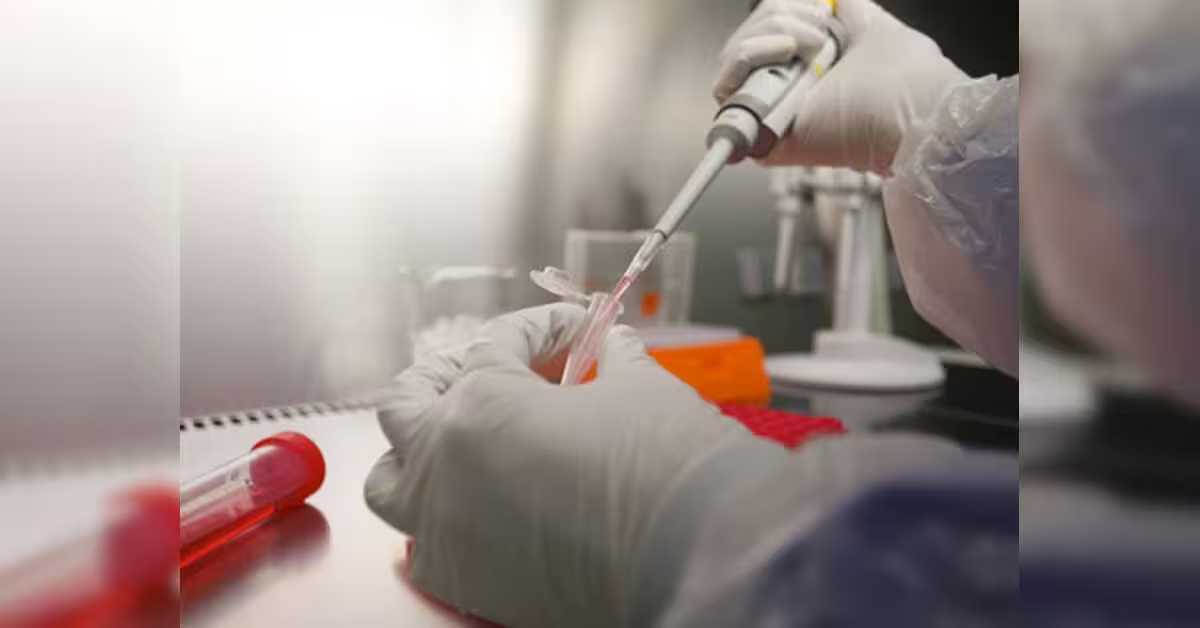
The Union Health Ministry has asked states and Union Territories (UTs) to regulate the use of stem cell therapy as standard clinical care only for approved disease conditions, while its use for autism remains restricted to duly approved clinical trials.
With regard to Autism Spectrum Disorder (ASD), the advisory states that the therapeutic use of any type of stem cell is to remain restricted to duly approved clinical trials, in accordance with the National Guidelines for Stem Cell Research.
The guidelines were issued jointly by the Indian Council of Medical Research (ICMR) and the Department of Biotechnology (DBT) in 2017.
The advisory comes after the Supreme Court’s judgment of January 30, 2026, in Yash Charitable Trust and Others versus Union of India and Others.
The apex court had stated that administering stem cell therapy for ASD outside approved and monitored clinical trials is unethical and constitutes professional misconduct or medical malpractice.
“The advisory reiterates the existing framework governing stem cell research and therapy and seeks to ensure that stem cell therapy is permitted as standard care in routine clinical practice only for disease conditions/indications included in the list approved by the Ministry of Health and Family Welfare,” the ministry said on Thursday.
Industry executives added that stem cell therapy has been marketed in India for a long time for conditions such as ASD and cerebral palsy, but its efficacy remains unproven, with no clinical evidence of improvements.
The ministry has asked all states and UTs to widely disseminate the apex court’s directions to state and district regulatory authorities and all government and private clinical establishments involved in stem cell research, treatment, promotion or administration.
The position was further reinforced by the National Medical Commission (NMC). In its advisory dated September 5, the doctors’ registration body reiterated that unauthorised administration, prescription, promotion or advertisement of stem cell therapy beyond the approved indications would constitute professional misconduct.
The Union Health Ministry’s advisory adds that non-compliance with the statutory mandate must attract consequences, including professional misconduct under the Indian Medical Council (IMC) Regulations, 2002, as well as action under the Clinical Establishments (Registration and Regulation) Act, 2010, which provides for cancellation of registration and penalty.
“The ministry has accordingly requested the concerned state and district regulatory authorities and clinical establishments to ensure strict compliance with the applicable framework governing stem cell research and therapy,” it added.
The NMC has further advised State Medical Councils to examine cases of alleged violations brought to their notice and, where professional misconduct by a registered medical practitioner (RMP) is established after due process, take appropriate action.
State councils have also been advised to take appropriate disciplinary action in accordance with the applicable statutory and regulatory provisions.