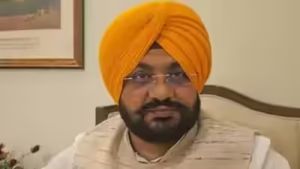


Union Home Minister Amit Shah’s recent statement that the Uniform Civil Code (UCC) will be implemented in all 21 BJP-NDA ruled states before the 2029 Lok Sabha elections has brought the issue back into focus.
But the legal debate has now moved beyond whether India should have a UCC. A more immediate question is emerging: If states introduce their own versions of a UCC, how uniform will the law actually be?
Uttarakhand is currently the only state where a UCC is in force. Gujarat, Assam, and Madhya Pradesh have passed their respective UCC legislation, but the laws are yet to become operational, pending the required presidential process.
This means India could see several state-specific civil codes before there is a common national framework.
What does the Constitution say?
The idea of a UCC comes from the Constitution’s Article 44, which says that the State shall endeavour to secure a uniform civil code for citizens throughout India.
However, Article 44 is part of the Directive Principles of State Policy. Under Article 37, these principles are not enforceable by courts. In simple terms, Article 44 does not itself create a UCC. A legislature has to pass a law to give effect to it.
“As held by the Supreme Court in State of Madras v. Champakam Dorairajan (1951), where a DPSP conflicts with a Fundamental Right, the latter must prevail, so a state UCC pursuing Article 44’s object cannot override Part III,” said Kheyali Singh, associate partner, Singhania & Co.
But states have the constitutional power to legislate on several subjects that would form part of a UCC. As Singh added, a state UCC would therefore have to independently satisfy the twin test of intelligible differentia and rational nexus, and the manifest arbitrariness standard.
Entry 5 of the Concurrent List covers marriage and divorce, adoption, wills, intestacy and succession, joint family and partition, and matters relating to personal law. Since these subjects are in the Concurrent List, both Parliament and state legislatures can make laws on them.
This is the legal basis for the current state-led approach.
However, this also brings Article 254 into the picture. If a state law conflicts with an existing central law on a Concurrent List subject, the central law generally prevails. A state law can, in certain circumstances, prevail within that state if it is reserved for the President’s consideration and receives presidential assent. Parliament can subsequently override such a state law.
Parliament or states? Omar Abdullah raises the federal question
The state-wise approach has also triggered a debate over where a law of this nature should be made.
Jammu and Kashmir Chief Minister Omar Abdullah recently challenged the BJP to bring the UCC Bill before Parliament if it has the numbers to pass it, rather than pursuing the issue through individual states. He also questioned whether a law implemented only in BJP- or NDA-ruled states could truly be described as “universal”.
His comments raise a political argument, but the legal position is more nuanced.
The Constitution does not make Parliament the only legislature that can legislate on personal-law subjects. Entry 5 of the Concurrent List gives both Parliament and states legislative competence over several of these areas.
“The most immediate difficulty with implementing the UCC through individual States is that people, unlike laws, do not remain within State boundaries. If these States adopt different UCC’S the question will not simply be whether the law is uniform within each State, but which State’s law will apply to a particular person or transaction,” said Abhinay Sharma, managing partner at ASL Partners.
One solution to reduce contradictory orders and repeated litigation, he said, could be to have a central digital registry and an inter-State dispute-resolution mechanism.
Four states, different stages
Uttarakhand became the first Indian state to adopt a UCC in January 2025. Its law covers marriage, divorce, succession, and inheritance. It also prohibits polygamy and provides for registration of marriages and live-in relationships.
Gujarat, Assam, and Madhya Pradesh have since passed their own UCC legislations. Their laws cover several of the same areas, but the provisions are not identical. Assam, for instance, has provisions dealing with marriage, divorce, succession, and live-in relationships, while the Madhya Pradesh legislation also addresses areas such as adoption and certain practices relating to Muslim personal law.
This difference is important.
If one state has one set of rules for live-in relationships and another state has a different set, or if their succession rules differ, India could end up with several versions of a law that is supposed to bring uniformity to such matters.
What happens to personal laws?
The biggest impact of a UCC would be on personal laws governing family and property matters.
Hindu personal law is now largely governed by statutes such as the Hindu Marriage Act, 1955, the Hindu Succession Act, 1956, the Hindu Adoptions and Maintenance Act, 1956, and the Hindu Minority and Guardianship Act, 1956.
Muslim personal law operates through a combination of legislation and personal-law rules. Important statutes include the Muslim Personal Law (Shariat) Application Act, 1937, the Dissolution of Muslim Marriages Act, 1939, and laws dealing with divorced Muslim women’s rights such as instant triple talaq and nikah halala.
Christians and Parsis also have specific statutory provisions governing family and succession matters.
A UCC would therefore not simply mean that all these laws disappear. Its actual effect would depend on the wording of the particular state law and the subjects it covers.
For example, if a UCC creates a common law of succession, it would have to address how that law interacts with existing succession laws.
This is significant because existing personal-law statutes already contain rights that have been strengthened by the courts.
In Vineeta Sharma v Rakesh Sharma (2020), the Supreme Court held that daughters have coparcenary rights by birth equal to those of sons under Section 6 of the Hindu Succession Act.
A new common succession law would therefore have to cater to the confusion due to the distinct nature of UCC’s.
Article 44 versus Article 25
The constitutional debate becomes more complicated when Article 44 is read with Article 25, which protects freedom of conscience and the right to profess, practice, and propagate religion, subject to constitutional limitations.
The issue is not simply whether a community considers a particular rule part of its personal law. Courts have also examined whether a practice is religious in nature or concerns a secular activity connected with religion.
In John Vallamattom v Union of India (2003), the Supreme Court dealt with the secular character of matters such as succession.
“The constitutional contest will often turn on characterisation. The State will argue that marriage, divorce and succession are secular civil consequences; a challenger may argue that a particular rule incorporates or substantially affects religious practice. Article 25 therefore cannot be treated either as an absolute veto on civil-law reform or as an automatic exemption from scrutiny,” said Tushar Agarwal, founder and managing partner, C.L.A.P. JURIS, Advocates & Solicitors.
UCC would have to satisfy other fundamental rights, particularly Articles 14, 15, and 21 of the Constitution.
This means that uniformity alone would not make a law constitutionally valid. The actual rules created by a UCC could still be tested against fundamental rights.
What have courts said about a UCC?
The Supreme Court has discussed personal-law reform in several cases, but it has never itself created a UCC.
In Sarla Mudgal v Union of India (1995), the Court discussed Article 44 in the context of conversion and marriage.
In Pannalal Bansilal Pitti v State of Andhra Pradesh (1996), the Court recognised the difficulties of introducing uniform family laws in a diverse society and indicated that reform could take place gradually.
The Court has also dealt with individual personal-law practices.
In Shah Bano (1985), it examined the right of a divorced Muslim woman to maintenance under the then Section 125 of the Code of Criminal Procedure.
In Danial Latifi v Union of India (2001), it interpreted the Muslim Women (Protection of Rights on Divorce) Act, 1986 in a manner that protected a divorced Muslim woman’s right to a fair and reasonable provision.
In Shayara Bano v Union of India (2017), the Court dealt with the validity of instant triple talaq.
The Uttarakhand UCC also takes the debate beyond traditional personal law by regulating live-in relationships.
These cases show that personal law has already been changing through a combination of legislation and judicial decisions.
Way forward
India has already introduced some common laws cutting across religious identities. Adoption, domestic violence, child marriage, and several maintenance remedies are examples of areas where secular legislation operates irrespective of religion.
The UCC would therefore not be starting from a completely blank slate.
The bigger question is how far this process should go and how different state laws will eventually fit together.