

A year after Zubeen Garg’s death on September 19 in 2025, his presence continues to be felt across Assam — in the songs that fill public gatherings, murals painted on walls and, most visibly, at the place where he was cremated and which has since been turned into a memorial-cum-tribute site for the singer.
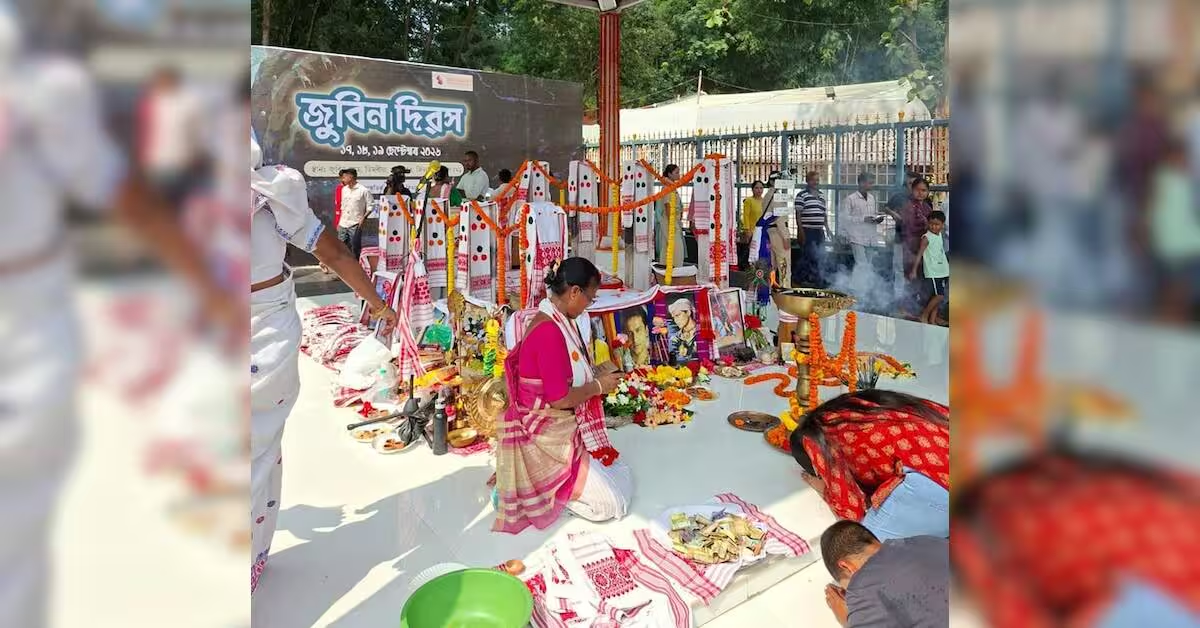
Zubeen Kshetra in Sonapur – as the memorial site is known now – continues to draw hundreds of people, with admirers making frequent visits. Many arrive carrying the Assamese gamusa, traditionally offered as a mark of respect and honour. At the memorial, the gamusas have become an almost permanent fixture, alongside flowers and other offerings left by visitors.
For many, the trip to the Kshetra is more than a visit to a memorial. It is a way of staying close to an artist whose music had become part of their everyday lives.
“I am here to pay tribute to the singer. He was our icon, he was a legend for us. We will continue celebrating him through his songs forever,” said one fan who visited Zubeen Kshetra on his first death anniversary.
For another, the visit involved a journey of around 500 kilometres.
“I have travelled around 500 km to be here on his death anniversary and express my love for him. Every Bihu will be incomplete without Zubeen da,” she said.
As Assam marks the artist’s first death anniversary, that connection is being reflected in programmes across the state.
A three-day programme at Zubeen Kshetra began on September 17, which was observed as Zubeen Divas, with people invited to mark the occasion through prayers, music and other forms of tribute. The anniversary programme has brought together religious observances, cultural performances and community participation at the Kshetra.
And at the heart of all of this is the music that made Zubeen a household name. Singer Papon performed Mayabini at the Kshetra on September 18, bringing back the song that has become inseparable from Zubeen’s memory. The song holds a special place in his own story too — Zubeen had described Mayabini as his “fantasy” and had once said he wanted people to sing it after his death.
The All Assam Students’ Union (AASU) is also organising Puhorore Saaki Gosi at district headquarters across Assam on September 19. The programmes will include performances of Zubeen’s songs and other cultural activities.
The ruling Bharatiya Janata Party (BJP) has also planned a statewide blood donation drive on September 19, with camps across all 39 organisational districts. Besides party workers and office-bearers, Chief Minister Himanta Biswa Sarma and state BJP president Dilip Saikia are also scheduled to donate blood at the party’s state headquarters in Guwahati.
But Zubeen’s presence has not been limited to anniversary programmes.
His face has appeared on murals across Assam, with artists and admirers painting his portraits on walls and public spaces. At many cultural events, his photograph now occupies a place on the stage, with the proceedings beginning with the lighting of a lamp before his image.
His presence has, in a sense, become part of the ritual of Assam’s cultural life.
That is perhaps because Zubeen’s relationship with his audience was different from that of a performer who existed only on a stage. His songs travelled into homes, cars, weddings, community gatherings, and everyday conversations. He sang about love, loss, youth, and life in a way that made his music familiar to ordinary people across generations.
For many Assamese, therefore, Zubeen was not simply a singer they listened to. His songs became part of their own memories — attached to particular people, places, journeys, moments.
That attachment has also found its way into the roads leading to his memorial.
The Assam State Drivers’ Union has announced concessional fares for passengers travelling to and from Zubeen Kshetra on September 19. A special taxi service will operate from 5 a.m. to 5 p.m., with taxis stationed at Khanapara and other nearby locations to take visitors there and back.
According to the union, fares will be substantially lower than regular rates. A journey that would ordinarily cost around Rs 800, for instance, will likely cost almost half at Rs 300-400.
The initiative offers another example of how different sections of society are observing the anniversary — not through a formal tribute on a stage, but by helping others make their way to the Kshetra.
At Zubeen Kshetra, where hundreds continue to arrive with gamusas and offerings, that connection is perhaps most visible, with a memorial that has become a part of Assam’s collective memory.
“It was amazing to see people spontaneously paying tribute to the legend. People from every caste, creed and religion participated wholeheartedly in the cultural programmes and came together to pay their respects. The surroundings reverberated with Mayabini,” said Nandini Sarma, a close friend of the Garg family, who visited Zubeen Kshetra on September 18.