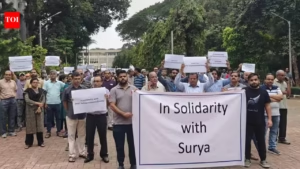


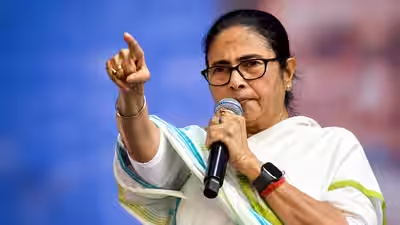
Mamata Banerjee’s political journey in West Bengal has come almost full circle.In 1998, Mamata walked out of the Congress after years of differences with its leadership and formed the Trinamool Congress. She believed the Congress was not doing enough to challenge the Left Front, which had been ruling West Bengal for decades.28 years later, Didi, as she is fondly called, is now herself a step away from losing control of her party to a rebellion. Her Trinamool Congress has split, and rivals in the party, who once worked under her are now challenging her control. The Election Commission has temporarily frozen the party’s original name and its well-known ‘Jora Ghash Phul’ (flowers and grass) symbol while it decides which faction has the “real” claim.And what’s more! In an interesting turn of events, Mamata is now desperately banking on the Congress’s support to survive the BJP’s political offensive against her in West Bengal.The change comes at a difficult moment for her.The BJP recently ended Trinamool’s 15-year rule in West Bengal in May, crossing 200 seats and forming its first government in the state. Mamata’s party, which had been in power for 15 years, fell below 100 seats.Mamata’s troubles have only grown since then.The defeat was followed by a rebellion within the TMC and finally a battle over who has the right to use the party’s name and symbol.For a leader who built her career as a rebel, Mamata is now facing a rebellion of her own.
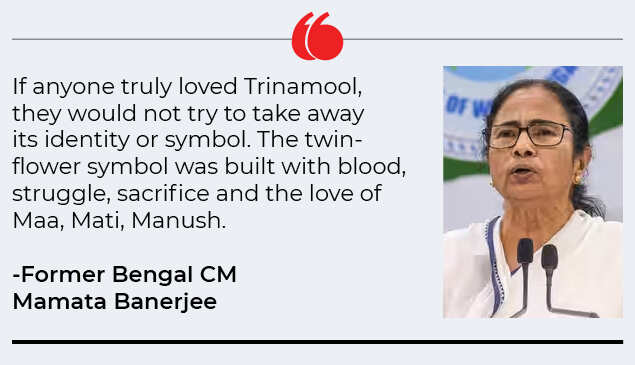
Mamata on TMC symbol row
Congress: From bitter rival to ‘sister party’
At the peak of her power-packed 15 years as chief minister of West Bengal, Mamata refused to acknowledge the presence of Congress in West Bengal. In fact, for Mamata, both the Congress and the Left were bitter political rivals and she would often accuse them of being the B-team of the BJP in the state. But that changed in the aftermath of her crushing defeat in May this year as the BJP swept the state’s political landscape and formed its first government.The shift in power dynamics was on display when Mamata announced support for the Congress candidate in the Nandigram bypoll to be held on October 6. “We are extending our support to Congress in Nandigram. We are doing this for the greater interest of the nation,” Mamata Banerjee announced. But what really surprised was her reference to the Congress as a “natural alliance” and a “sister party”. Words that would sound almost alien to those who have followed Mamata’s politics, especially the Congress leaders in the state.While the Congress has strongly backed her fight against the Election Commission, with Rahul Gandhi leading the charge, the help is unlikely to transform into a greater alliance, at least for now. The West Bengal Congress unit, which was at the receiving end of Mamata’s political aggression for many years, is very clear and categorical that it does not want any alliance with her party.
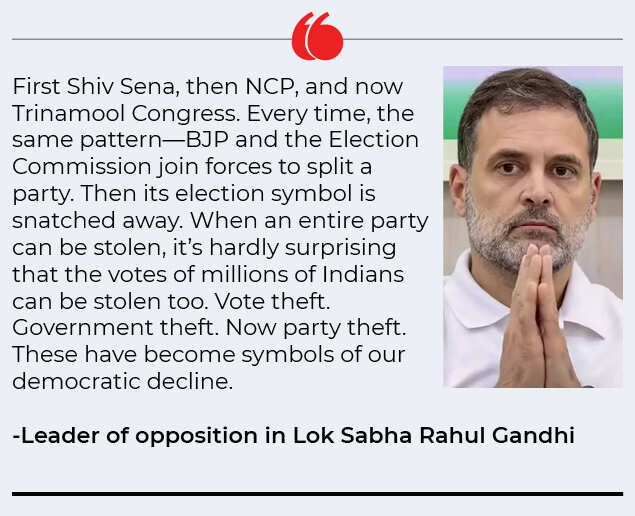
Rahul Gandhi backs Mamata Banerjee
Vendetta politics
Since losing power, Mamata has repeatedly accused the BJP of targeting her and trying to weaken her party.The irony is that Mamata herself faced similar accusations after she came to power in 2011, ending 34 years of Left rule. Both the Left and the Congress had accused the Trinamool of using political pressure and defections to weaken its rivals.The circumstances may be different, but the roles have now reversed. What is happening today to her is what she did to her opponents in the past in West Bengal.
Mamata’s beginning in politics
Mamata started her political career with the Congress in the 1970s. The first glimpse of her aggressive political style was on display during Emergency days when she made headlines for her protest against Jay Prakash Narayan.She quickly rose through the Congress ranks and, in 1984, emerged as the giant killer when she defeated veteran Communist politician Somnath Chatterjee, to win the Jadavpur parliamentary Constituency in West Bengal. She was also among the youngest MPs elected that year.There has been no looking back since then. She lost in 1989, but came back strongly in 1991 from the Calcutta South constituency and retained the seat in 1996, 1998, 1999, 2004 and 2009 Lok Sabha elections.
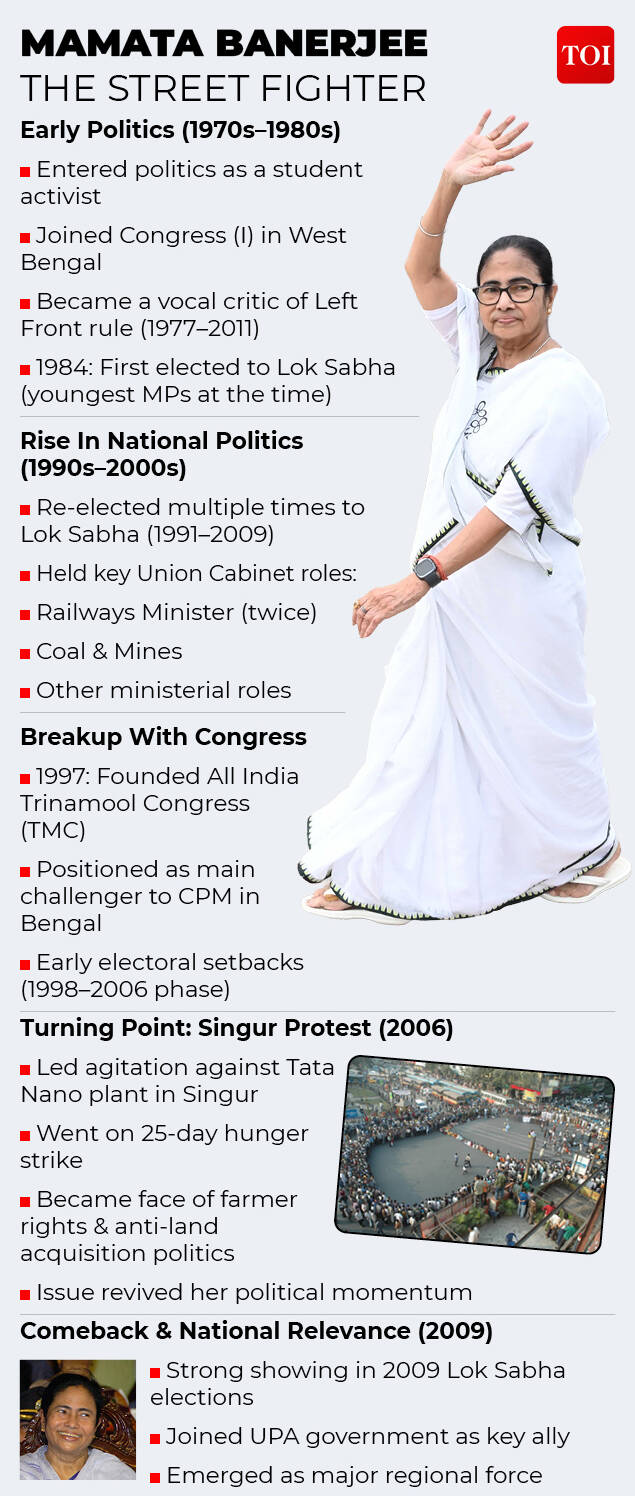
From Congress activist and street fighter to TMC founder and three-term West Bengal chief minister
The protest politics and the birth of Trinamool Congress
Mamata’s differences with the Congress grew through the 1990s. She believed the party was not aggressive enough in taking on the Left government in West Bengal.Her politics was built around street protests and agitations against the Left government.One of the most prominent moments of her political career came in 1993, as state Youth Congress chief, when she led a march to Writers’ Building demanding voter ID cards to prevent alleged electoral malpractice.Police opened fire during the protest, killing 13 Congress workers. By 1997, her differences with the Congress leadership had reached a breaking point. In 1998, Mamata walked out and formed the Trinamool Congress.Years later, the Singur and Nandigram movements turned that protest politics into a force strong enough to bring her to power for a good 15 years.
Nandigram challenge, once again
Nandigram has always had a special place in Mamata’s political career. The land protests here in 2007 helped turn her into the strongest challenger to the Left. Four years later, she came to power.But Nandigram also became one of her biggest electoral setbacks. In the 2021 assembly election, Mamata chose to contest from the seat against her former aide Suvendu Adhikari, who had joined the BJP. Nandigram was Suvendu’s bastion and Mamata wanted to prove a point. That did not happen as she lost to Suvendu by around 2,000 votes. But her Trinamool Congress returned to power in the state with a thumping majority.Five years later, in 2026, it was Suvendu’s turn to challenge Mamata in her bastion of Bhabanipur, while also contesting from Nandigram. Suvendu not just reinforced his dominance in Nandigram but also humiliated Mamata in Bhabanipur.Suvendu retained Bhabanipur and vacated Nandigram, necessitating a bypoll. But this time around Mamata faced a setback even before the contest could begin. Her candidate for the October 6 bypoll in Nandigram withdrew from the contest after meeting chief minister Suvendu Adhikari, leaving Mamata without a candidate of her own. She then announced support for Congress candidate Milan Pradhan.For Mamata, Nandigram has now seen almost every phase of her politics. It helped her rise, handed her a personal defeat, and is now showing the challenges she faces after losing power.
The road ahead …
For Mamata, the road ahead is not just about fighting the BJP. The former chief minister has a larger issue at hand at the moment. She has to hold her party together, fight for control of the Trinamool name and symbol, and rebuild her position as the main opposition force in Bengal.Congress support could help her on some issues, especially at the national level, but a wider alliance in Bengal seems unlikely, at least for now.Congress leaders in West Bengal remain wary of Mamata after years of on-and-off rivalry and large-scale defections from their party to the Trinamool under Mamata’s watch.That leaves Mamata at the junction of perhaps the most difficult phase of her political career.
Share your thoughts in the comments
Be respectful · TOI community guidelines
She began as a Congress leader, broke away in rebellion, built a party of her own and eventually ruled Bengal for 15 years. Now, with rebels challenging that very party and she being forced to return to Congress for help, Mamata’s journey has indeed come almost full circle.The future and fate of the original Trinamool Congress is now in the hands of the Election Commission. Mamata will be keeping her fingers crossed. And rightly so. Precedents from recent past in Maharashtra would worry her. Sharad Pawar lost control of the Nationalist Congress Party and Uddhav Thackeray of Shiv Sena, after the ECI ruled in favour of rebels who had split the two parties. So, will Mamata be lucky, or will she now be left with a “football player” to try another round of “khela” in West Bengal? Can Mamata once again fight adversity for a much-needed comeback? Well, we will have to wait and watch.