

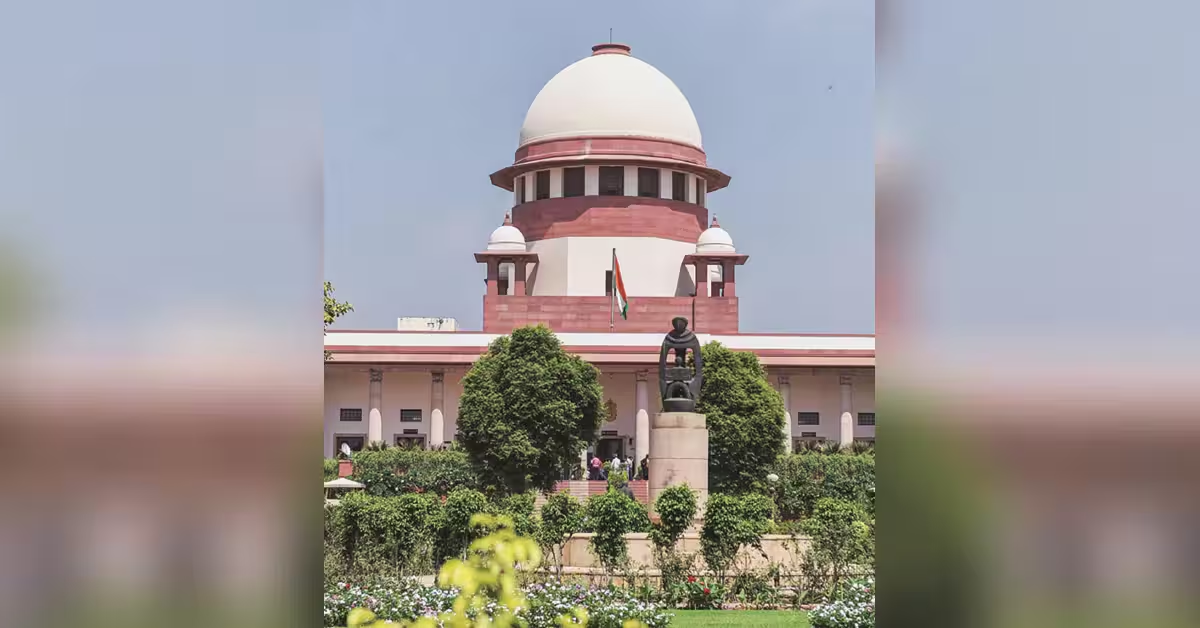
The Supreme Court has observed that a person who does not sing all or some stanzas of Vande Mataram should not face criminal action if the decision stems from a genuine conscientious objection.
The observations came while the court was hearing a plea filed by carnatic vocalist TM Krishna, who has challenged the constitutional validity of provisions dealing with Vande Mataram and the government’s directions on singing its complete version.
What did the Supreme Court say?
A bench comprising Chief Justice of India Surya Kant, Justice Joymalya Bagchi, and Justice V Mohana referred to the Supreme Court’s earlier judgment in Bijoe Emmanuel v State of Kerala.
The 1986 judgment concerned three schoolchildren who did not sing the National Anthem because of their religious beliefs. However, they stood respectfully while the anthem was played. The Supreme Court held that their conduct did not amount to disrespect and protected their right to freedom of conscience.
What is the present Vande Mataram case?
Krishna has challenged Section 3 of the Prevention of Insults to National Honour Act, 1971, following its amendment in 2026.
The amended provision deals with intentionally preventing the singing of the National Anthem or National Song, or causing disturbance to an assembly engaged in singing either of them. A violation can attract imprisonment of up to three years, a fine, or both.
Krishna’s petition argues that requiring people to sing the complete version effectively compels participation in stanzas that contain references to Hindu deities.
According to the plea, the measures infringe Article 14, which guarantees equality before the law, Article 15(1), which prohibits discrimination on specified grounds, Article 19(1)(a), which protects freedom of speech and expression, Article 21, which protects life and personal liberty, and Article 25(1), which guarantees freedom of conscience and the right to freely profess, practise, and propagate religion.
The petitioner has argued that while national symbols can be accorded respect, the State cannot compel an individual to sing against their conscience.