

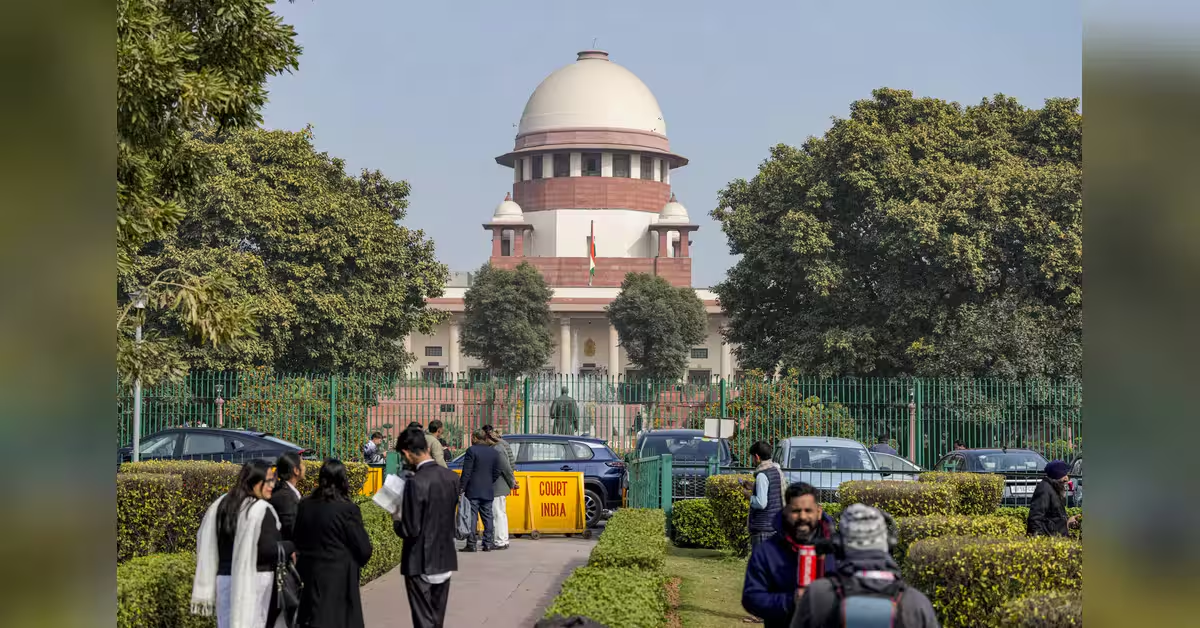
The Supreme Court on Wednesday delivered a split verdict on whether petitions challenging the Chief Election Commissioner and Other Election Commissioners (Appointment, Conditions of Service and Term of Office) Act, 2023 should be heard by a larger bench, Bar and Bench reported.
Judges differ on larger bench
Justice Datta rejected the government’s request for a larger bench and also prima facie observed that the 2023 law did not appear to ensure an independent process for selecting Election Commissioners.
“We heard these petitions for over five days, speaking in one voice would have served the voice of institutional cohesion. Unfortunately we are divided in our opinion. It is a foundational principle of the constitutional scheme that rulers are bound by law and not above it,” Justice Datta ruled, as quoted by the news report.
Justice Sharma disagreed with Justice Datta’s observations. He held that the case involved a substantial question of law that should be considered by a larger bench.
Justice Datta questions independence of selection panel
Justice Datta said independence of the Election Commission of India (ECI) was not enough and that the poll body must also be seen as independent. He said a member nominated by the Prime Minister to the selection committee could not reasonably be expected to take a position against the Prime Minister.
What does the 2023 law say?
Under the 2023 Act, the selection committee for appointing the Chief Election Commissioner and other Election Commissioners consists of the Prime Minister, the Leader of Opposition and a Union Cabinet Minister nominated by the Prime Minister, the news report said.
The petitions challenging the law argue that this arrangement affects the constitutional requirement of an independent Election Commission because the CJI is no longer part of the selection process.
What did the Supreme Court say in 2023?
The challenge to the 2023 law follows the Supreme Court’s 2023 Constitution Bench judgment in Anoop Baranwal vs Union of India.
In that case, the court had directed that appointments to the Election Commission should be made by a committee comprising the Prime Minister, the Leader of Opposition and the CJI. The arrangement was to remain in place until Parliament enacted a law on the subject.
During the present hearing, Solicitor General Tushar Mehta argued that the apex court had only filled a legislative gap through its 2023 judgment. Once Parliament enacted a law, he said, the legislature’s decision should prevail over the temporary judicial arrangement.
Court had flagged concerns over ECI independence
During the proceedings, the court had also raised concerns over the failure of successive governments to enact a law ensuring the independent functioning of the ECI, the news report said.
The court had noted that under the new selection mechanism, two of the three members of the panel are aligned with the government, while only one member represents the other side.