

The crew that saved Indian rowing from drawing an embarrassing blank at the Asian Games make an unlikely pair.
Salman Khan used to drive an Uber in Delhi while Satnam Singh is the son of a farmer from Punjab.
Even after they joined the Indian armed forces, they were in separate units — Salman is a naib subedar in the Army, Satnam a petty officer in the Navy. They had rowed together before, but never in a double sculls boat.
ALSO READ | Naruka, Dhaliwal win India’s first-ever mixed skeet medal with bronze
In an event where coordination between the rowers — the precise sequence of lowering and drawing their oars through the water — matters almost as much as the power of the stroke, they were competing against teams that had trained together in this very event for years.
Few sports produce physical specimens like rowing does.
Salman Khan and Satnam Singh are giants of men. The 28-year-old Salman is six-foot-three and nearly 100 kilos of rippling muscle. The 26-year-old Satnam is a couple of inches shorter, with sinews like wound nautical rope.
Few sports brutalise athletes like rowing does.
No easy test
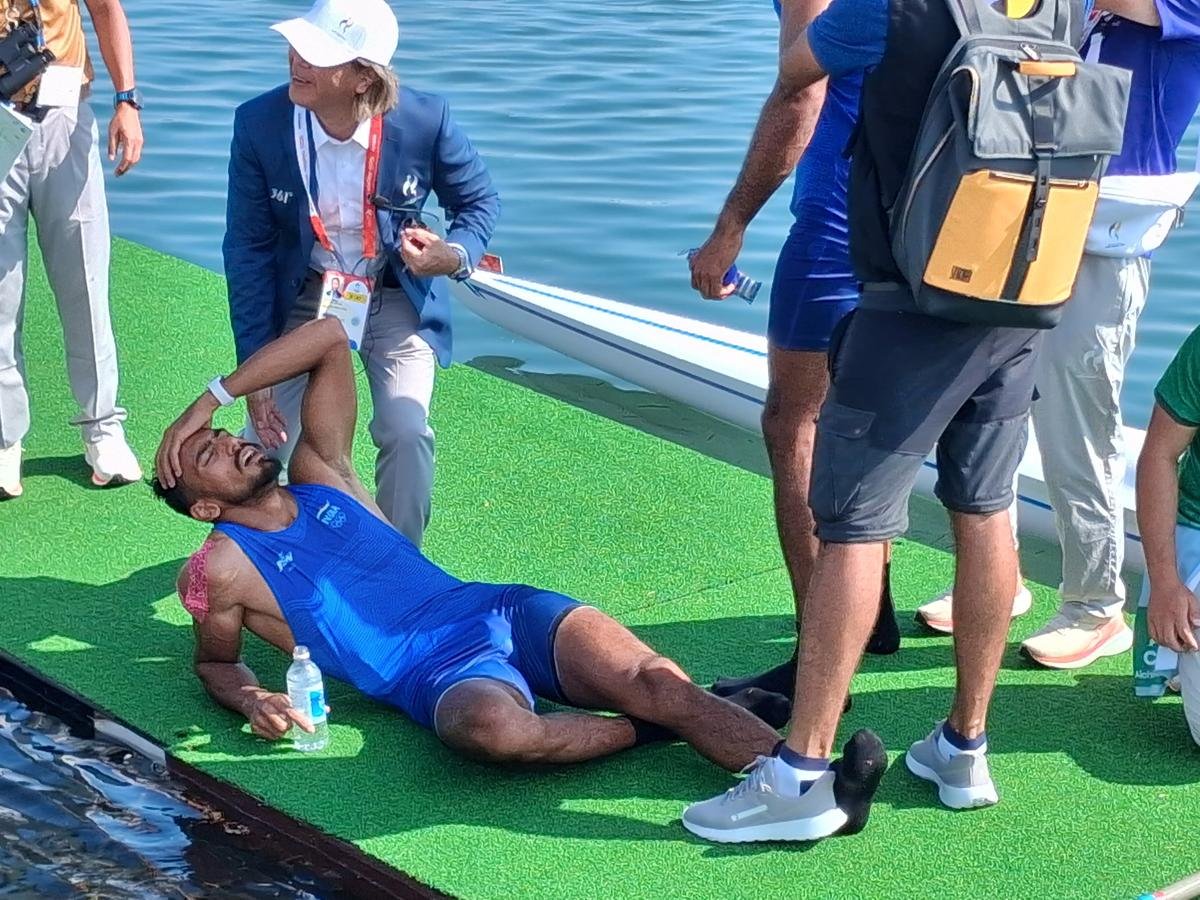
At the end of the men’s double sculls event at the 2026 Asian Games, Salman had his burly hand held up by a volunteer as he navigated the short, 10-foot ramp out of the water on trembling legs.
Satnam couldn’t even do that.
He lay sprawled on his back on the pier, his face contorted in agony, his body doubled over as it coursed with lactate. Think of the phrase “dead tired” in a sense that folks watching on television will never experience.
Under a blistering mid-morning sun, their massive frames squeezed into their narrow boat, the two had hauled themselves — and their 27kg craft — over two kilometres along the glassy waters of the Nagara river as it flowed towards Nagoya.
They completed the race in 6.13 mins, just under three seconds behind second-placed Uzbekistan.
Now they groaned. Not just in agony, but with disappointment.
Even as he lay on his back, Satnam cried out: “ Gold chala gaya (we lost the gold).”
The first thought for a ‘dead-tired’ Satnam and Salman was the agony of missing out on gold.
| Photo Credit:
Jonathan Selvaraj

The first thought for a ‘dead-tired’ Satnam and Salman was the agony of missing out on gold.
| Photo Credit:
Jonathan Selvaraj
ALSO READ | Why did Anantjeet, Parinaaz win Asian Games 2026 bronze despite levelling scores with Korea in skeet mixed team?
As uncharitable as they were to themselves, the crew had still made history. Not only were they the first Indian crew to achieve a podium finish in this event in Asian Games history, they were also the only Indian rowers to win a medal in Nagoya.
It’s almost a miracle that they did.
When he recovered enough to speak more thoughtfully, now with an Indian flag draped around his shoulders, Satnam gave himself and Salman more credit.
“I feel a lot of sadness that we didn’t win gold, but we feel proud that we were able to put a medal in India’s tally that was unexpected,” he says.
Few could have held it against them if they hadn’t.
They were meant to take part in the men’s quadruple sculls, considered the marquee event in Indian men’s rowing. Alongside Balraj Panwar, himself a former Asian Games medallist, and Jakar Khan, they had trained in that boat for the past eight months.
The four — all servicemen — had grown as close as could be.
“We are brothers, maybe not by blood but from the heart,” Salman says.
The quadruple sculls had won bronze for India in Hangzhou three years ago. This time, they believed they were going to compete for Asian Games gold.
Then, two days before the start of their competition, they got a rude shock.
ALSO READ | ‘What happened was not because of me’: Roshibina Devi answers selection controversy with Asian Games silver
The twist that no one saw coming
Inexplicably, the rowing federation had decided to split up India’s settled pairings. Satnam and Salman were moved to the double sculls, an event they had never competed in together.
“ Sab nirash ho gaye the (we were depressed). The hardest part was we were removed from quad and placed into doubles. We didn’t eat or drink or sleep that night. We were harassed,” recalls Salman.
They protested. They considered quitting. Eventually, they decided to do what they needed to.
“What matters most is desh ka naam aur nishan (the country’s name and flag). We have to keep it high. Whatever happens later happens later,” Salman says.
It wasn’t always a determination Salman had.
Originally from Khairana, a village in Uttar Pradesh’s Amethi, he lost his father when he was 16. Two years later, he decided he needed to provide for his widowed mother and five younger siblings.
After failing an attempt to clear the Army recruitment exam, he took up a job driving for Uber in New Delhi, ferrying passengers in his WagonR between Delhi and Gurgaon.
“I worked from 5am to 10am and then once again from 5pm to 10pm,” he recalls. After a year ferrying passengers, a friend asked him to try for the Army entrance exam once again. “He asked me, kyu gaadi chala rahe ho? You have height. You will get in,” he recalls.
He attempted the recruitment exam again. This time he cleared it. Not long after, his build caught the eye of the Army’s rowing coaches. “They almost forcefully put me into rowing,” he recalls.
ALSO READ | Indian rowers allege berating by RFI president over crew change protests
It’s a journey Satnam had made in similar fashion.
The son of a farmer in the tiny village of Fatta Maluka in Punjab’s Mansa district, he was recruited into the Navy and then picked for rowing because of his physical attributes.
Both have been part of the elite of India’s rowing fraternity for many years now. Satnam had previously competed at the Hangzhou Asian Games, where he was part of the bronze medal-winning quad sculls team. Salman had slowly made his way up to be considered among India’s best rowers.
But in Nagoya, after they were told they were going to compete in an entirely new event, both knew the scale of the challenge in front of them.
“In men’s doubles sculls, our confidence was zero. We are sitting for the first time together in this boat. We didn’t sit in this boat in the national camp. We didn’t even train together in the past since he’s from the Army and I am from the Navy,” Satnam says.
With next to no preparation, they took to the course on Thursday morning armed with little more than willpower.
Salman says he had spoken to his commanding officer, who had encouraged him to stick to rowing when he had once considered quitting.
“I was very upset. When I spoke to my senior officers, they filled me with motivation. They told me, Salman, aisa chakuu maro ki nadi ka paani bahar aa jaye (plunge the oar with such power that you take the water out of the lake),” he says.
That was Satnam’s strategy as well. “I told my coaches: either I’ll come back behosh (unconscious) or with a medal,” he says.
That’s indeed how they rowed. They compensated for their lack of coordination and months of missed training with little more than determination.
ALSO READ | ESFI alleges organisational lapses after Indian eFootball team knocked out in quarterfinals
“Bas power se chali ye boat (the boat moved on power alone),” says Salman. Incredibly, for the first half-kilometre, they were even in second place. But, it was not to last.
Uzbekistan, the silver medallists at Hangzhou, came back strongly at the end, finishing just ahead of the Indians. But with their final strokes, Salman and Satnam kept going, eventually crossing the line just ahead of Indonesia, which had won bronze last time.
It wasn’t the medal they had come hoping to win. But it was better than nothing.
Satnam eventually admitted as much. A crew that barely existed until two days earlier had entered the history books.
“I feel sad for my partners because a good medal has gone from our hands. But I feel proud since we have never won a medal in double sculls until today. The world will remember that a Khan and a Singh won India’s first medal in this event,” he said.
Published on Sep 24, 2026