

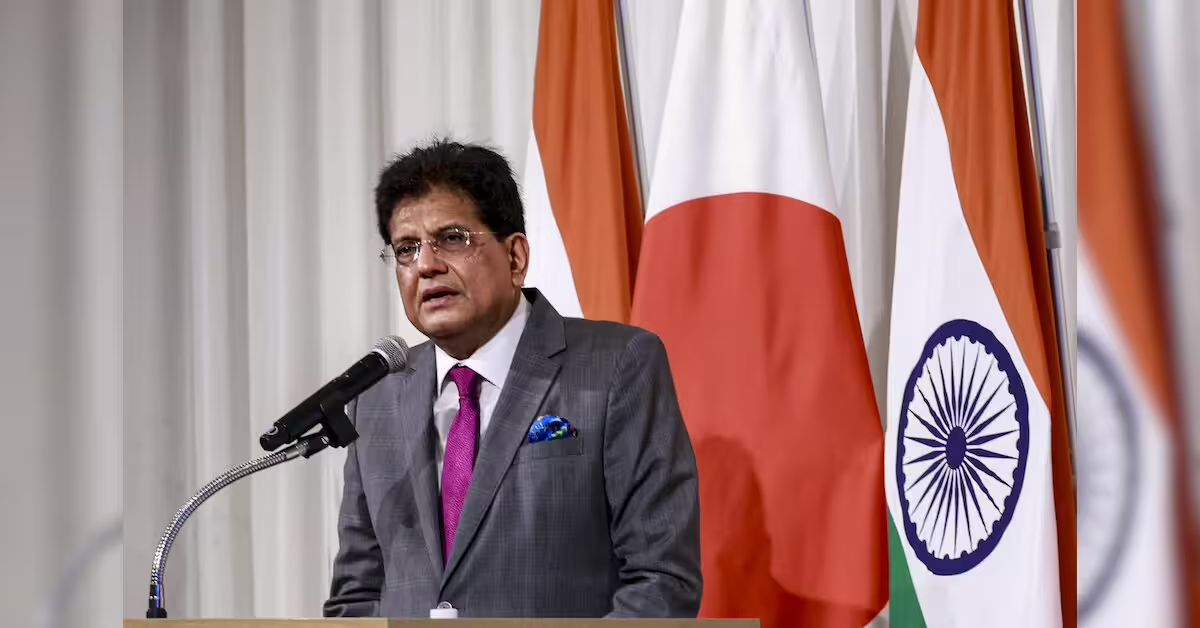
India’s nine trade agreements — including the pact with the United States that Commerce and Industry Minister Piyush Goyal described as “almost done and dusted” — will collectively give the country preferential market access to economies accounting for $60 trillion in gross domestic product (GDP), he said on Thursday.
“This collectively gives us preferential market access, to GDP of 60 trillion dollars. So now we have a 70 trillion dollar umbrella where seamlessly goods can flow,” Goyal said at the 13th Annual Forum of the Public Affairs Forum of India (PAFI) in New Delhi.
Goyal said India’s approach to trade negotiations had changed, with the country now negotiating from a position of strength and seeking fair, equitable and balanced agreements.
“All the agreements prior to ’14 collectively gave us preferential access to GDPs which aggregated 10 trillion dollars today, last year’s figure. We were very defensive. Our own thinking was of a nation scared to compete with the world,” he said.
Goyal said India was now negotiating trade agreements from the perspective of becoming a $30-trillion economy by 2047. “Today when we negotiate with the world, we put them to notice that we are a four trillion dollar economy, but on a purchasing power parity (PPP) basis we already are a twenty trillion dollar economy, the third largest in the world,” he said.
He said India was pursuing negotiations with Canada, Chile, Peru, the South African Customs Union (SACU) and Mexico, besides ongoing negotiations with the Maldives.
Goyal also defended India’s decision to stay out of the Regional Comprehensive Economic Partnership (RCEP), saying the grouping would have effectively brought India into a free trade agreement with China.
He said India already had free trade agreements with the Association of Southeast Asian Nations (ASEAN), Japan and South Korea when it entered RCEP negotiations, while negotiations with Australia were also under way.
The minister said India’s trade strategy was now focused on expanding market access while making domestic industry more competitive.
He also said India would “embrace” new-age technologies such as artificial intelligence (AI), and that the country wanted to be “at the forefront of developments in the AI world”.
“We believe in empowering the people of India. We believe in strengthening the capabilities of the youth. The rest they will figure out for themselves,” Goyal said.