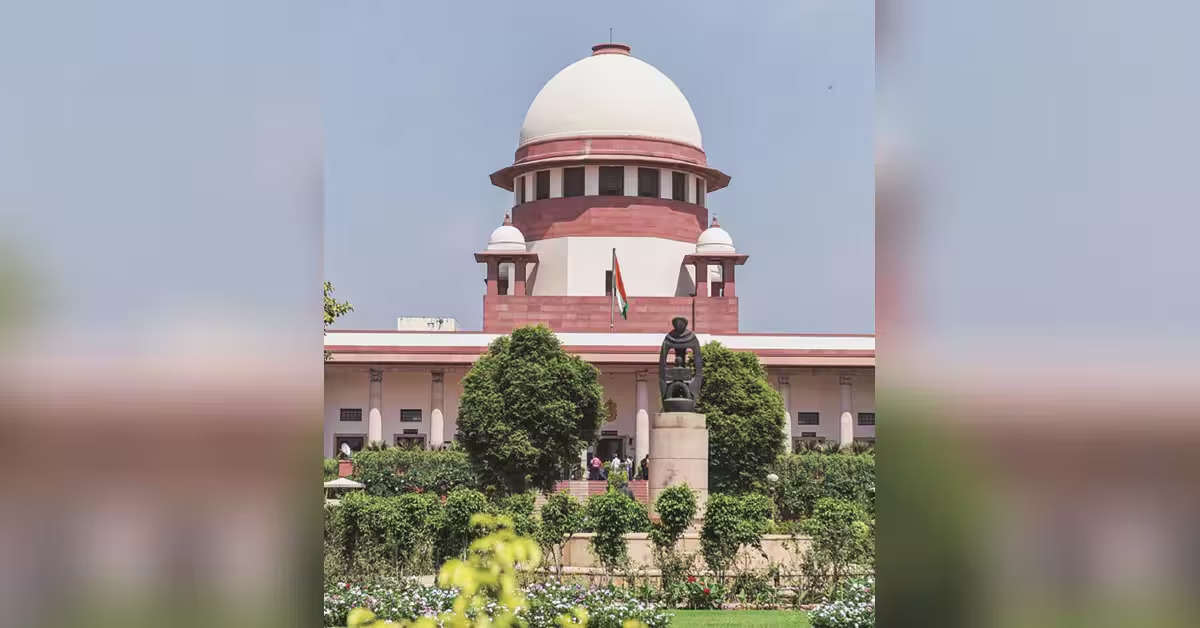
The Supreme Court (SC) on Monday refused to stay the proposed Merchant Discount Rate (MDR) on specified Unified Payments Interface (UPI) transactions above ₹2,000, while seeking the Union government’s response on the basis for imposing the charges.
A Bench comprising Chief Justice of India Surya Kant and Justices Joymalya Bagchi and V Mohana sought a response from the Centre while hearing a petition filed by advocate Anjan Datta challenging notifications issued by the Ministry of Finance on September 14 and 15.
Additional Solicitor General N Venkataraman, appearing for the Centre, told the court that the charges would take effect from October 15. He said around 96 per cent of merchant transactions would remain outside the levy and charges for essential services had been capped at ₹5.
“It is neither a tax nor a fee,” Venkataraman submitted.
The Bench sought clarity on the legal basis for the charge. “We need these facts on affidavit. It’s more of a technical issue,” Justice Surya Kant said.
Justice Bagchi asked whether the charge was a tax or fee and, if it was neither, what was the legal basis for imposing it. He also questioned the nature of the service for which the payment was being made.
Venkataraman said the government would not receive any part of the charge and that it represented a settlement cost within the payments ecosystem. Banks incur costs in processing electronic transactions, he said, adding that UPI payments had historically been exempt from such charges.
Justice Bagchi also referred to Section 269SU of the Income Tax Act, which requires specified businesses to provide prescribed electronic payment facilities. He sought clarity on the legal character of the amount involved in a UPI transaction and the source of legal authority for the charge.
The court issued notice to the Centre, Reserve Bank of India, National Payments Corporation of India (NPCI) and the UPI & Services Steering Committee. The petitioner had sought an interim stay, arguing that the charges could encourage cash and unaccounted transactions. The Bench declined to grant interim relief.
Under the framework, MDR would apply to specified person-to-merchant (P2M) UPI transactions exceeding ₹2,000. The standard MDR has been set at 0.4 per cent, subject to a maximum of ₹300 for transactions of ₹75,000 and above.
Transactions in sectors including railways, telecom, insurance, fuel and agricultural inputs would attract a flat MDR of ₹5 above the threshold. Capital market transactions would attract an MDR of 0.02 per cent, capped at ₹300.
The government has clarified that person-to-person UPI transactions will remain free irrespective of the amount. Merchant payments up to ₹2,000 and transactions covered by the zero-MDR framework for small merchants will also remain free.
MDR is a payment-processing charge within the merchant payments ecosystem and is distributed among participating banks and payment service providers. It is not a tax collected by the government or NPCI.
The finance ministry has advised banks to ensure merchants do not recover the MDR from consumers. UPI application providers have also been barred from imposing platform fees or other undisclosed charges on users.
The government has estimated that about 96 per cent of merchant transactions will remain unaffected, either because they fall below the ₹2,000 threshold or qualify for zero-MDR treatment. Small merchants receiving up to ₹1 lakh a month through UPI QR codes under the P2PM category will continue to be covered by the zero-MDR framework.
Amit Maheshwari, managing partner at AKM Global, said the Supreme Court’s refusal to stay the proposed MDR does not mean the court has upheld the levy. He said the Centre’s position that MDR is a charge within the payments ecosystem, rather than a tax or government levy, would be central to the proceedings.