


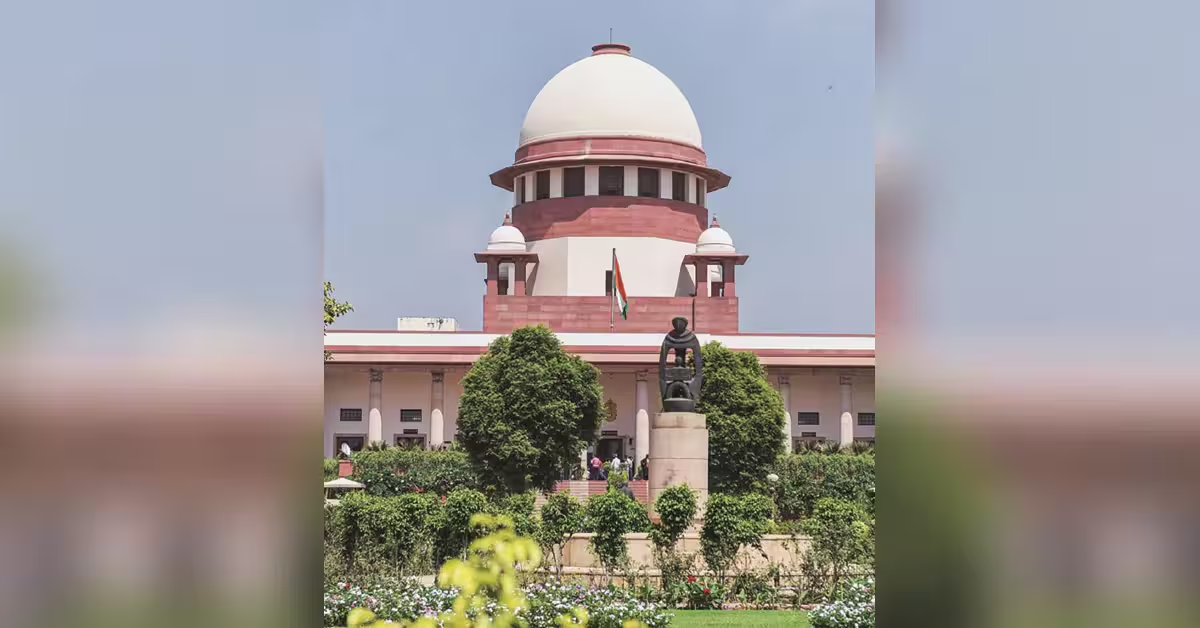
The Supreme Court on Monday stayed directions of the Delhi High Court that allowed the Goods and Services Tax (GST) authorities to search an advocate’s office where there is prima facie material indicating the lawyer’s personal involvement in an alleged offence.
A Bench of Justices Dipankar Datta and Sheel Nagu issued notice on a petition filed by advocate Puneet Batra and stayed the High Court’s directions permitting cloning and examination of data seized from his office.
The Bench questioned how investigating authorities could themselves determine whether material seized during a search was protected by attorney-client privilege.
“You collect evidence, no problem. But how will you segregate the confidential/privileged material?” the Bench asked.
Additional Solicitor General S V Raju, appearing for the GST authorities, submitted that the department could segregate and redact confidential material during the investigation.
The Bench, however, questioned the basis on which the department could make such a determination.
“How will you decide that? You can’t decide that,” it said.
Raju also submitted that the GST authorities were not required to disclose their reasons to believe to Batra at this stage.
The Supreme Court said its interim order was confined to the legality of the search and stayed the High Court’s directions relating to cloning and examination of the seized computer data. It did not stay coercive action against Batra and permitted him to respond to the summons issued by the department and appear before the concerned officer on Wednesday.
The case arose from a search conducted by the Anti-Evasion Branch of the Central Goods and Services Tax (CGST) Department at Batra’s office. The central processing unit (CPU) of his computer and other documents were seized during the search.
The department was investigating Martkarma Technology Private Limited (MTPL), a gaming company, and alleged that Batra’s role extended beyond providing legal advice to the company.
According to the GST authorities, he was involved in its business operations.
Batra challenged the search, contending that the authorities had seized material protected by attorney-client privilege. He argued that an advocate’s office could not be searched in the absence of material establishing his personal involvement in an illegality beyond his role as legal counsel.
The Delhi High Court had rejected his challenge, holding that attorney-client privilege could not prevent an investigation into an advocate’s own conduct where prima facie material existed.
It had also held that the privilege did not automatically extend to every document or file kept in a lawyer’s office.
The Supreme Court has now kept those directions in abeyance and sought responses from the Union government and the GST authorities.