

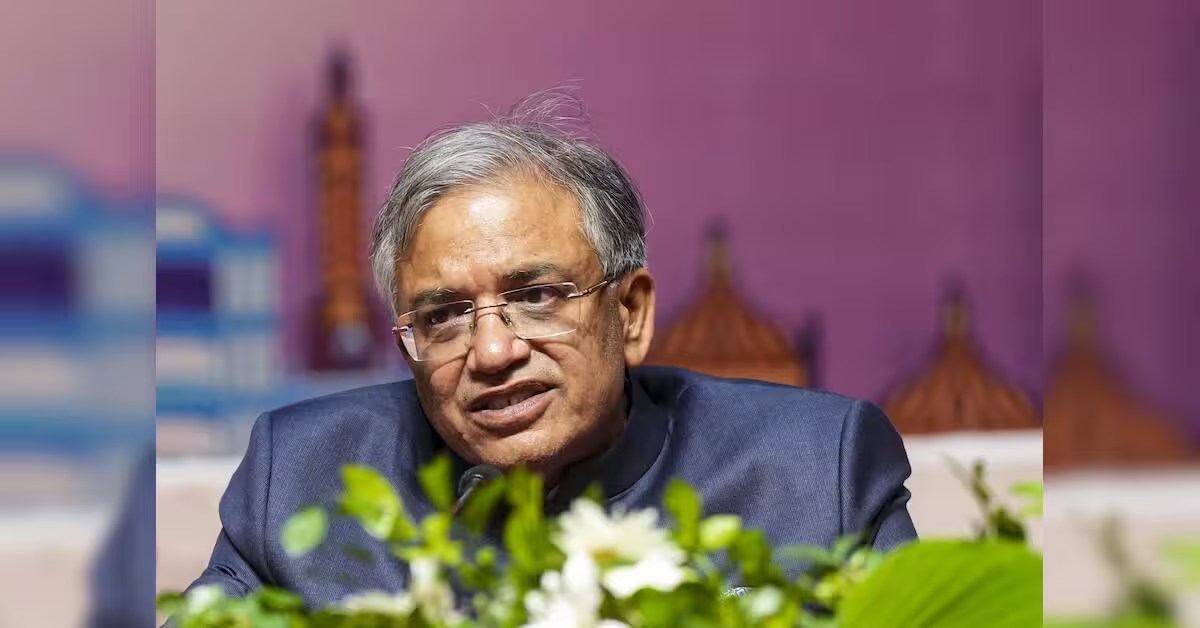
A fresh petition before the Supreme Court seeking criminal prosecution of Chief Election Commissioner (CEC) Gyanesh Kumar and an investigation into alleged voter deletions during the Special Intensive Revision (SIR) of electoral rolls has brought an unusual question into focus.
The petition, filed under Article 32 of the Constitution by advocate Shailendra Mani Tripathi, alleges that decisions, guidelines, and software modifications relating to the SIR were undertaken by Kumar without the concurrence of the other two Election Commissioners, Sukhbir Singh Sandhu and Vivek Joshi. It seeks, among other reliefs, prosecution under Section 32 of the Representation of the People Act, 1950 (RP Act), an SIT or judicially supervised inquiry into the alleged deletion of around 13 crore names from electoral rolls, preservation of electoral database records, and restoration of the original Form 6.
The ECI has since announced it is restoring the original Form 6.
The significance of the plea, therefore, goes beyond the controversy over SIR. It brings together three separate questions: how the ECI is required to take decisions, what constitutes a breach of electoral-roll duties, and how far the law protects the CEC from legal proceedings?
Are CEC decisions binding on EC?
The first question concerns the institutional status of the CEC.
The Supreme Court’s Constitution Bench judgment in T N Seshan, Chief Election Commissioner of India v Union of India dealt with the transition from a single-member to a multi-member Election Commission. The Court treated the Commission as a constitutional body and rejected the idea that the CEC could exercise authority as though the other Election Commissioners were merely subordinate officers.
That principle assumes greater significance under the 2023 law governing the ECI. Sections 17 and 18 of the Chief Election Commissioner and Other Election Commissioners (Appointment, Conditions of Service and Term of Office) Act, 2023 deal with the transaction and disposal of the Commission’s business. Section 18 provides that business should, as far as possible, be transacted unanimously, where there is a difference of opinion, the matter is to be decided according to the majority.
The present petition therefore raises a specific legal question: if decisions concerning electoral-roll revision were in fact taken without the concurrence of the other Election Commissioners, did those decisions comply with the statutory decision-making structure?
A difference of opinion between the CEC and other Election Commissioners is not itself illegal. The law allows disagreement and says the majority view should prevail. “A legal issue would arise if a matter requiring a decision of the Election Commission was implemented by the CEC despite the other two Commissioners taking the opposite view. In such a case, the question would be whether the CEC acted beyond the authority given to him under the law,” Rahul Hingmire, managing partner, Vis Legis Law Practice, told Business Standard.
That question would require the Court to establish what decisions were taken, whether there was a formal disagreement. The existence of a reported disagreement, by itself, would not establish a statutory violation and require the claim to be established.
What does electoral-roll law require?
Section 21(3) of the Peoples Representation Act (RP Act) empowers the ECI to order a special revision of electoral rolls. The Supreme Court, in its judgment concerning the Bihar SIR, upheld the ECI’s power to undertake such an exercise under Section 21(3), read with Article 324 of the Constitution.
The legality of conducting an SIR, therefore, is different from the legality of the manner in which a particular revision is carried out.
The RP Act also creates specific statutory safeguards around electoral rolls. Section 22 deals with correction of entries, while Section 23 concerns inclusion of names.
The Registration of Electors Rules, 1960 prescribes the procedures for these processes.
This becomes relevant to the allegation concerning Form 6. If a change merely concerns the electronic processing of an existing statutory form, it raises one set of questions. If the change effectively alters a statutory requirement prescribed by the Rules, a different legal question arises: can an administrative or software modification effectively amend a requirement that Parliament or delegated legislation has prescribed?
Section 32 of Peoples Representation Act
The petition invokes Section 32 of the RP Act, 1950. The provision creates an offence where an electoral registration officer, assistant electoral registration officer or another person required to perform official duties concerning preparation, revision or correction of electoral rolls is, without reasonable cause, guilty of an act or omission in breach of that duty.
The punishment is imprisonment of between three months and two years, along with a fine. However, it is important to note that Section 32(3) says that a court cannot take cognisance of the offence unless there is a complaint made by order of, or under authority from, the ECI or the Chief Electoral Officer of the State concerned.
This creates an immediate legal complication for the present petition because the allegation is directed at the CEC himself.
It also brings Section 16 of the 2023 Act into the discussion. The provision grants the CEC and other Election Commissioners protection against civil or criminal proceedings for acts, things or words done or spoken while acting, or purporting to act, in discharge of their official duty.
“Section 32 cannot be read in isolation from Section 16 of the 2023 Act. Section 32 creates a substantive offence for a specified category of election-related official misconduct, but Section 16 creates a separate procedural protection against the very institution of civil or criminal proceedings where the impugned act was committed in, or purportedly in, the discharge of official duty,” said Tushar Agarwal, founder and managing partner, C.L.A.P. JURIS, Advocates & Solicitors.
He further added that if the act falls within the protective language of Section 16, a criminal court cannot ordinarily entertain or continue the proceeding. If, however, the alleged conduct is outside the scope of official duty, the immunity question would have to be examined differently. Ultimately, the protection is statutory and its precise boundary is a matter for judicial interpretation; it should not be confused with a finding that the underlying conduct was lawful.
The 2023 law that changed the appointment architecture
The controversy also comes at a significant time for the ECI’s institutional design.
In Anoop Baranwal v Union of India (2023), the Supreme Court’s Constitution Bench held that, until Parliament made a law under Article 324(2), appointments to the ECI should be considered by a committee comprising the Prime Minister, Leader of the Opposition, and the Chief Justice of India. The judgment linked the independence of the electoral machinery with the constitutional requirement of free and fair elections.
Parliament subsequently enacted the 2023 Act.
Section 7 now provides for a Selection Committee comprising the Prime Minister as chairperson, the Leader of Opposition in the Lok Sabha and a Union Cabinet Minister nominated by the Prime Minister. The CJI is no longer a member of the statutory committee.
That arrangement is itself under constitutional challenge. On September 23, 2026, a two-judge Supreme Court Bench delivered differing opinions on whether the challenge to the 2023 law required consideration by a larger Constitution Bench. The matter has consequently been placed before the CJI for consideration of an appropriate Bench. The law has not been struck down and remains operative.
During the hearing, Supreme Court Justice Dipankar Datta said the replacement of the Chief Justice of India with the Union Cabinet Minister-led selection panel for Chief Election Commissioner (CEC) and Election Commissioners prima facie amounts to an effective veto in favour of the union government and fails the “perception test”, sending wrong signals to the public while hearing the petitions challenging the Chief Commissioner and Other Election Commissioners (Appointment, Conditions of Service and Term of Office), Act, 2023.
Thus, the present prosecution plea arrives while the constitutional architecture governing appointments to the ECI is itself under judicial examination.
Can a CEC be removed?
Prosecution and removal are separate legal processes.
“The stringent removal protection under Article 324(5) is intended to insulate the CEC from executive or political pressure. But removal from office, judicial review of an ECI decision and personal criminal liability are distinct questions,” said Dr. Adv. Rishabh Gandhi, former judge and founder of Rishabh Gandhi and Advocates.
He added that courts can examine the legality of Election Commission action, call for records, and issue appropriate constitutional directions without invoking the removal mechanism. Personal criminal proceedings, however, would additionally encounter the protection under Section 16 of the 2023 Act.
The distinction matters because a criminal complaint, an investigation, a parliamentary removal motion and judicial review are not interchangeable remedies.
Earlier India has witnessed serious disputes involving Election Commissioners. In 2009, CEC N Gopalaswami recommended the removal of Election Commissioner Navin Chawla, but the recommendation was not accepted by the government.
What is unusual in the present case is the attempt to use the Supreme Court’s constitutional jurisdiction to seek prosecution and an independent investigation into alleged conduct at the top of the electoral machinery.
The eventual legal significance of the case may therefore lie not merely in whether the allegations concerning SIR are established, but in how Indian law balances the independence of the Election Commission with mechanisms for accountability.