
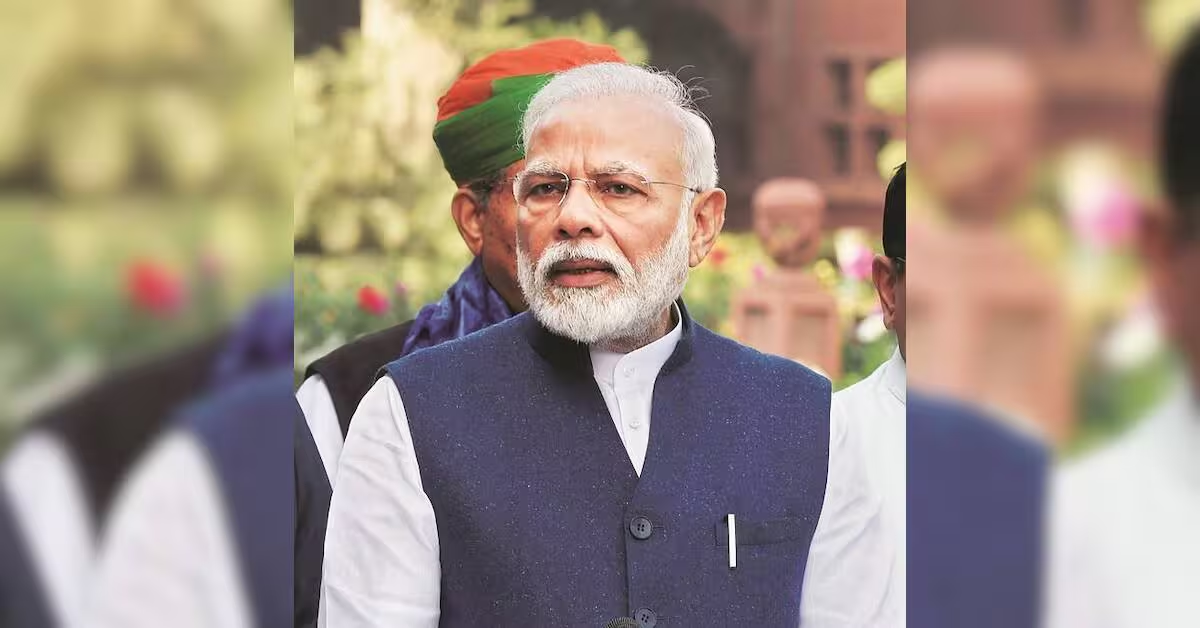
Amid continuing hiccups in India-US ties, including the prospect of the White House imposing fresh sanctions on India for its purchases of Russian oil and gas and the delay in finalising their trade deal, Prime Minister Narendra Modi on Wednesday had a telephonic conversation with US President Donald Trump. The two leaders reviewed bilateral cooperation in trade, defence, energy and critical technologies.
“Had a productive conversation with President Trump. We reviewed our bilateral cooperation in trade, defence, energy, critical technologies and other areas,” Modi posted on X. “We agreed to maintain close engagement to take our Comprehensive Global
Strategic Partnership forward,” he said.
Government sources said the conversation was evidence of the multifaceted nature of India-US ties, and the importance of the two strategic partners keeping in touch at the top levels. They said that New Delhi’s concerns have been conveyed to Washington in recent weeks, including on tariffs and sanctions.
Commerce and Industry Minister Piyush Goyal is currently visiting the US to attend a meeting of the G20 trade ministers in Wisconsin. He is also slated to meet US Trade Representative Jamieson Greer as part of the efforts by the two sides to advance a “bilateral and mutually beneficial” trade deal.
The government said during Wednesday’s telephonic conversation Modi and Trump reaffirmed their commitment to take the India-US Comprehensive Global Strategic Partnership forward. They also exchanged views on regional and international issues, including the conflicts in West Asia and Ukraine, and efforts to promote global peace and security.
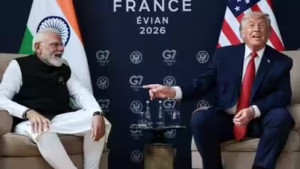
Modi and Trump last met on the sidelines of the Group of Seven, or G7, meeting in France on June 17. They are likely to meet when Modi travels to Florida, US, to attend the G20 Summit in mid-December. He is also scheduled to visit Canada, Germany, and Brussels, the European Union headquarters.
The developments come after Trump signed into law the Lindsey O Graham Sanctioning Russia and Iran Act of 2026, or SRIA, on September 18. It authorises Trump to impose up to 100 per cent tariffs on countries buying Russian oil and gas, including China and India. New Delhi said it will take all necessary steps to protect its economic interests and ensure energy security for its people, and that any sanctions could impact all aspects of the India-US relations.
On September 23, External Affairs Minister S Jaishankar met US Secretary of State Marco Rubio in New York, where the two “discussed sanctions that could be levelled against states that engage economically with Russia and Iran.” Jaishankar “reiterated” India’s “interests and concerns” on the SRIA, while Rubio “emphasised that the US remains well-positioned to help regional partners address their energy security challenges.”
Foreign Secretary Vikram Misri discussed bilateral ties with US Undersecretary of State for Political Affairs Allison Hooker on September 25 in New York, including energy security, SRIA, civil nuclear cooperation and the Indian Ocean Strategic Venture Initiative.
Earlier this week, in a conversation at the Asia Society Policy Institute, Jaishankar said India-US ties have suffered in recent times because of Washington’s lack of understanding of India’s concerns on trade, including the section 301 tariffs that are still unfolding, terrorism on which it did not show empathy to India’s concerns, and mobility.