

The issue has gained attention during the ongoing Special Intensive Revision (SIR) of electoral rolls. The Indian Express reported that Election Commissioners Sukhbir Singh Sandhu and Vivek Joshi had raised concerns about the functioning of electoral-roll software and flagged what was described as the “gradual centralisation” of the electoral roll database.
On Tuesday (September 29), Maharashtra Chief Electoral Officer S Chockalingam also sought changes to the ECINET platform, saying EROs needed greater flexibility to exercise powers available to them under the law.
So, what are ERONET and ECINET, how do they work, and why have these systems come under scrutiny?
What is an electoral roll and who controls it?
An electoral roll is the official list of eligible voters in a constituency. Under the Representation of the People Act, 1950, the responsibility for preparing and revising the electoral roll of an Assembly constituency rests with the Electoral Registration Officer.
An ERO is generally an officer of the rank of a sub-divisional magistrate. The officer processes applications for adding, correcting or deleting names, hears claims and objections and takes decisions on entries in the electoral roll. This is important because the software is not the statutory authority that decides who should be on the voter list. The ERO is.
The Election Commission’s electoral-roll systems are designed to help officials process this work digitally.
What is ERONET?
ERONET, or the Electoral Registration Officers Network, was introduced as a centralised system for processing applications related to voter registration, migration and deletion.
According to the ECI, ERONET replaced 36 separate systems and databases that states had been using to manage electoral rolls. It was designed as a “decision support system” for EROs. In simple words, the software helps officials process applications and identify issues, but the ERO is supposed to take the final decision.
For example, the system can flag possible duplicate entries based on similar demographic details. The ERO can then examine the records and, where necessary, order field verification before deciding whether an entry should be retained or removed.
What is ECINET?
ECINET is a broader digital platform that brings together several of the Election Commission’s applications and services. The ECI officially launched ECINET in January 2026. It brought more than 40 applications and websites used by voters, candidates, political parties and election officials under a common platform.
For voters, ECINET-related services include registering as a voter, searching the electoral roll, tracking applications, downloading electronic voter identity cards and finding polling-station and candidate information.
The platform also includes the electoral-roll functions that were earlier handled through ERONET.
The ECI has also used ECINET for other election functions. In 2025, for example, it introduced an ECINET-based system through which Presiding Officers could enter voter-turnout data every two hours on polling day. The data could then be automatically aggregated at the constituency level.
How does the system work during SIR?
The SIR is a detailed revision of electoral rolls. Section 21(3) of the Representation of the People Act, 1950, allows the ECI to order a special revision of the electoral roll.
The Registration of Electors Rules, 1960, allow revision to be carried out intensively, summarily, or partly through both methods.
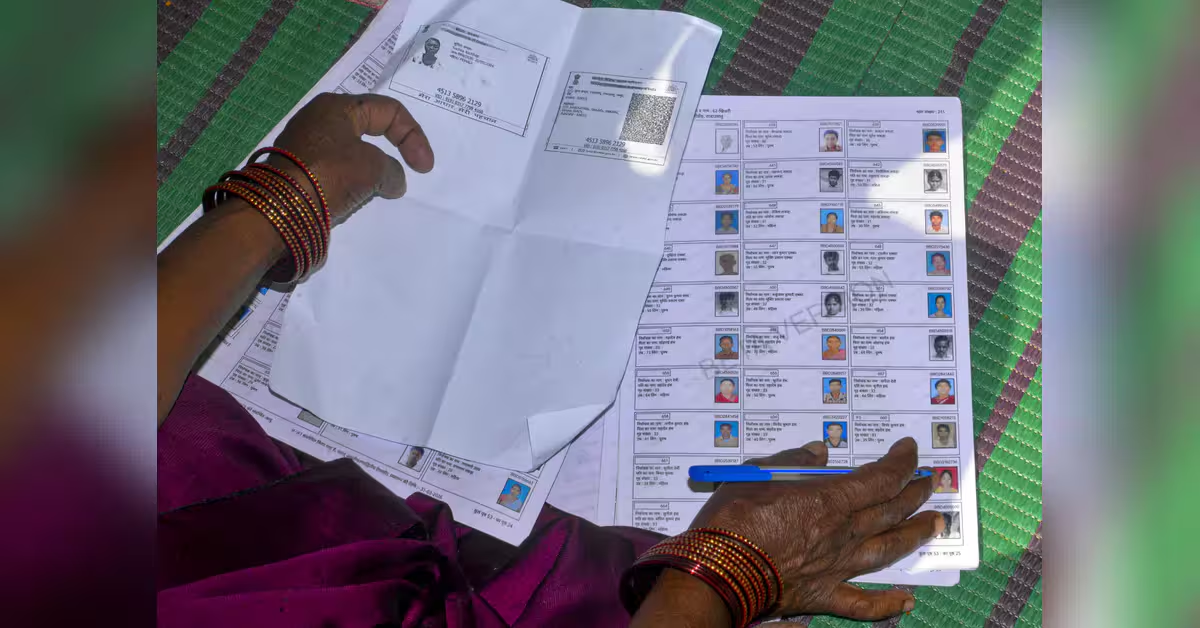
During SIR, electoral data is processed through the digital system. Booth Level Officers (BLOs) work at the ground level, including verification and collection of documents, while EROs have the statutory responsibility for deciding claims and objections.
ECINET can also flag what are called “logical discrepancies”. These are mismatches that emerge when the system tries to match an elector with a parent or grandparent in an older electoral roll. Examples include a mismatch in a relative’s name, an unusual age gap between a parent and child, or an age progression that does not appear consistent between the old and current rolls.
The ERO can examine such cases and decide what action is required.
What is the controversy around ECINET?
The controversy centres on whether the design of the software can limit the discretion that the law gives to EROs. The Indian Express reported that Election Commissioners Sukhbir Singh Sandhu and Vivek Joshi had raised concerns about the functioning of electoral-roll software, including whether EROs were being given adequate access to the electoral-roll database. The report also flagged what was described as the “gradual centralisation” of the database.
The concern was that although EROs are the statutory authorities responsible for preparing and revising electoral rolls, the software could restrict some of the decisions they were able to take directly. The Indian Express also reported that similar concerns had been raised earlier in relation to ERONET, which now forms part of the electoral-roll system under ECINET.
The ECI, however, has said that EROs and District Electoral Officers continue to exercise their statutory powers under the law. It has also said that its digital platforms operate under data-security protocols to prevent unauthorised tampering.
The Commission later announced a review of ECINET by a committee headed by a senior Deputy Election Commissioner, with an independent expert from an IIT or IIIT also to be included.
Maharashtra’s chief electoral officer raises concerns
Chockalingam wrote to the ECI seeking four changes to ECINET. One request was that EROs should be able to decide which cases involving “logical discrepancies” actually require a hearing. He also sought greater flexibility over the documents that could be accepted from voters and the discrepancies that EROs could dispose of themselves, The Indian Express reported.
Following this, the Election Commission said that EROs could exempt people flagged for logical discrepancies from personal hearings if appropriate. It also said that further flexibility required by field officers would be made operational.