

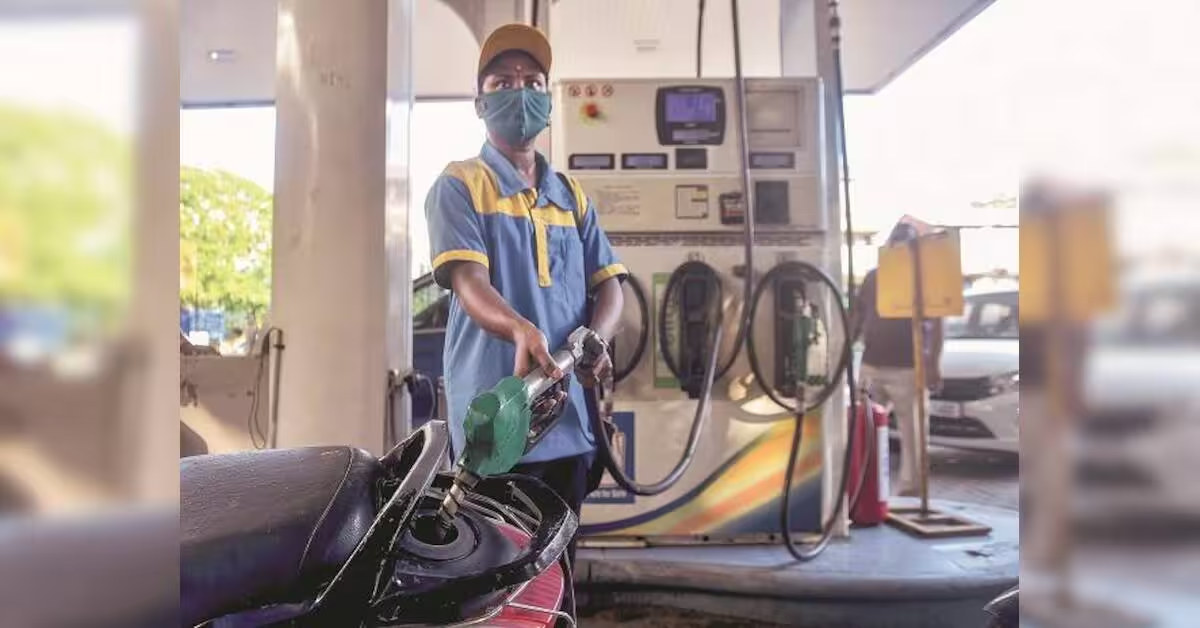
The government will ask private fuel retailers not to restrict sales of petrol or diesel, Oil Secretry Neeraj Mittal said Thursday, after Jio-bp and Nayara Energy imposed purchase limits at some of their outlets as a widening price gap drove industrial users to petrol pumps to stock up on cheaper diesel.
“Nobody is allowed to cap fuel sales. It is not acceptable; it is not done,” he told reporters here, adding that the government’s position had not changed.
Private retailers Jio-bp and Nayara Energy had last month introduced purchase limits at some outlets as factories, telecom companies, hotels, hospitals and other bulk users increasingly bought diesel meant for retail customers.
The unusual rush is being driven by a price gap of as much as Rs 50 a litre between retail diesel and fuel sold to bulk consumers, creating a powerful incentive for large users to shift purchases to petrol pumps.
Jio-bp has capped diesel purchases at 50 litres per customer per day at some outlets, while limits at Nayara Energy stations range from 70 litres to 200 litres.
“In the past, letters had been issued; instructions had been issued to them (for restricting fuel sales). There is no change in the government view on this,” he said.
Oil Minister Hardeep Singh Puri said his ministry is “in touch” with the private fuel retailers but did not elaborate.
Retail petrol and diesel prices have remained unchanged since May despite rising international crude prices. Prices charged to industrial and other bulk consumers, which are more closely linked to international market rates, have risen more sharply.
The resulting gap between retail and bulk diesel prices has widened to as much as Rs 50 a litre, prompting some large consumers to buy diesel from retail stations instead of dedicated outlets, people in the industry said.
Some industrial users are purchasing 400 to 600 litres at a time from retail outlets, significantly above the volumes typically bought by individual motorists.
The shift is putting pressure on inventories at individual petrol pumps, which have finite storage capacity and may require at least a couple of days for replenishment through the fuel supply chain, industry sources said.
Jio-bp, a joint venture between Reliance Industries and Britain’s BP, earlier this week stated that all its mobility stations were operational and adequately stocked.
“Given the prevailing demand dynamics, we are taking appropriate measures to ensure equitable availability of fuel for mobility and transportation needs, particularly in view of demand from industrial and other non-transport use,” a company spokesperson had said.
Nayara Energy said it continued to maintain fuel supplies across its nationwide dealer network and was focused on ensuring optimum supplies to more than 7,000 stations and other channels, including bulk customers.
The companies’ responses did not directly address the specific purchase limits.
Petrol and diesel prices are formally market-linked, but retail prices have often not moved immediately or fully in line with international crude prices. State-controlled fuel retailers have also traditionally moved pump prices in tandem, particularly when prices are revised.
The current divergence has created an incentive for industrial consumers to shift purchases from bulk channels to retail outlets, potentially draining stocks at pumps that primarily serve motorists.
If the price differential persists, the pressure could continue to expose a structural mismatch between retail and bulk fuel pricing. Retailers could have fuel available elsewhere in their supply networks while individual petrol stations face local inventory shortages because of unusually large purchases.