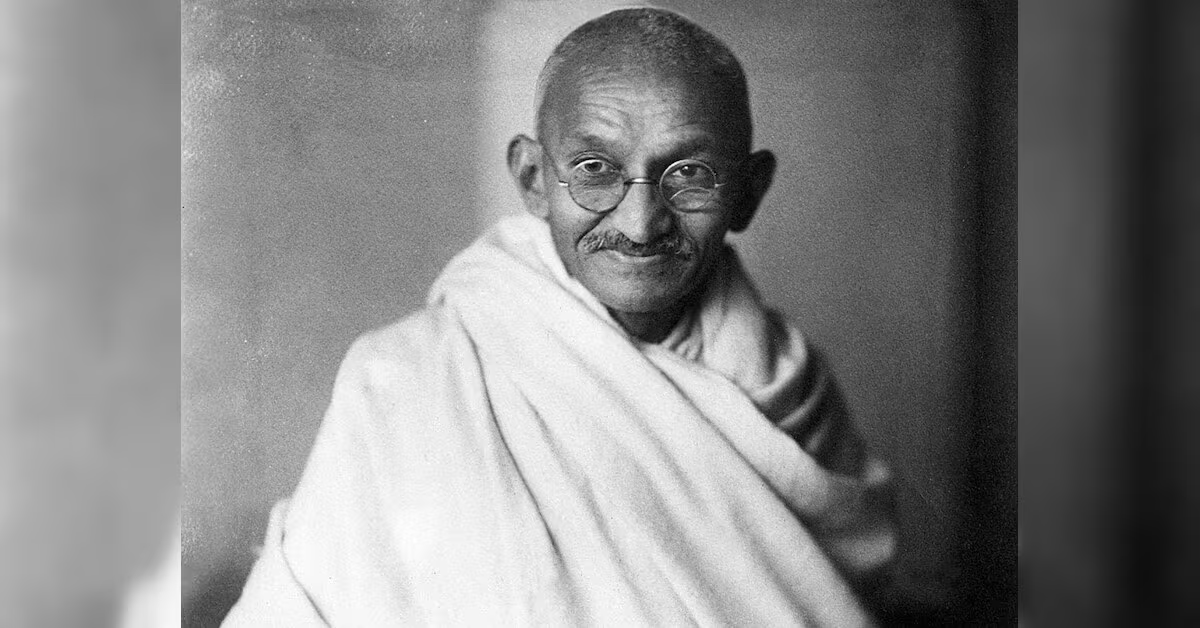
In 1921, the silent film ‘Bhakta Vidur’, directed by Kanjibhai Rathod, was banned in Bombay (now Mumbai) and Karachi by censors appointed by the British colonial government. The film drew upon the Mahabharata and focused on the character of Vidur, a wise man who served as the prime minister of
Hastinapur. Now
a lost film, ‘Bhakta Vidur’ ran into trouble with the authorities because it alluded to contemporary political developments. “The film drew… many parallels to [M.K.] Gandhi’s freedom struggle,” writes film scholar Rachel Dwyer in her book
Filming the Gods: Religion and Indian Cinema (2006), “and Vidur’s Gandhi-cap and spinning of the charkha” led to the ban.
In their report, notes film historian Jeannine Woods in her book
Visions of Empire and Other Imaginings: Cinema, Ireland and India, 1910-1962 (2011), the censors declared: “We know what you are doing, it is not Vidur, it is Gandhiji, we won’t allow it.” As the film’s makers discovered, the framework of mythology was not sufficiently cunning to deceive the censors. And ‘Bhakta Vidur’ became the first Indian film to be censored by the authorities; arguably, it was also the first one to depict Gandhi, whose 157th birth anniversary was celebrated yesterday. On one hand, the anniversary was marked by official functions as usual, and on the other, by
protests demanding the resignation of the Chief Election Commissioner Gyanesh Kumar.
Gandhi was not too fond of cinema: As film historian Someswar Bhowmik writes in his book,
Cinema and Censorship: The Politics of Control in India (2009), Gandhi told the Indian Cinematograph Committee of 1927 that he had never been to a cinema and felt that “the evil it has done and is doing is patent”. And in 1938, when a Bombay-based paper asked Gandhi’s opinion on India’s cinema’s 25th anniversary, they received a cold reply from his secretary: “one may not expect a word of appreciation from him”. During his lifetime, Gandhi watched only two films: The first one was the Hollywood production, ‘Mission to Moscow’ (1943), directed by Joseph E. Davies. Gandhi was scandalised by dancing sequences featuring women in short clothes and walked out before the end of the show.
The second film he watched was ‘Ram Rajya’ (1943), directed by Vijay Bhatt, starring Prem Adib as the Hindu god Rama and Shobhna Samarth as his consort, goddess Sita.
Gandhi often referred to Ramrajya, the reign of Rama in the Ramayana, as a sort of utopian socio-political ideal. After watching 90 minutes of the 144-minute-long film, Gandhi got up and left the show. It was on one of those days when he remained completely mute, so his opinion of the film was never recorded. But as a gesture of approval, he patted the film’s director Bhatt, writes Prakash Magdum, the managing director of the National Film Development Corporation, in his book
The Mahatma on Celluloid: A Cinematic Biography (2023).
Gandhi’s antipathy for cinema has been reciprocated by Indian cinema. Film scholar Rachel Dwyer writes in
a 2011 paper that while “Gandhi’s image is well known in India and throughout the world, mostly in photographs, chromolithographs, and newsreels, there are surprisingly few Indian films about the father of the nation”.
Historians have shown that newsreels of Gandhi’s anti-colonial movements, particularly the Dandi March and Civil Disobedience Movement of 1930, provided widespread publicity to the Indian cause in the West even in his lifetime. However, the 1982 biopic directed by Richard Attenborough, starring Ben Kingsley in the titular role, led to a renaissance of interest in the man, both in India and the West.
American sociologist Mark Juergensmeyer, in
a 1984 essay, investigated the persistence of Gandhi’s popularity. “Attenborough’s film supplies one answer,” he writes, “for it presents the picture of a lone moral individual triumphing over the conventional forces of authority in society. …It is the cowboy, the space hero, and all those cinematic incarnations of Jesus and Moses.” Juergensmeyer argues that if Gandhi had watched his biopic, he would have been pleased, because the “movie, like Gandhi’s own writings, pictures him as a reluctant saint in search of a cause”. This is the sort of stereotype through which many films since the biopic — from ‘Hey Ram’ (2000), directed by Kamal Hasaan, to ‘Lage Raho Munna Bhai’ (2006), directed by Rajkumar Hirani — have represented Gandhi.
There is also another stereotype, which is more critical. In biopics of many of Gandhi’s critics and rivals, such as Netaji Subhas Chandra Bose, B.R. Ambedkar, Bhagat Singh or V.D. Savarkar, the Father of the Nation is depicted as a far less saintly figure and more as a cunning political actor. Some of the notable films to critically approach Gandhi’s representation are ‘Dr Babasaheb Ambedkar’ (directed by Jabbar Patel, 2000), ‘Veer Savarkar’ (directed by Ved Rahi, 2001), ‘The Legend of Bhagat Singh’ (directed by Rajkumar Santoshi, 2002) and ‘Netaji Subhas Chandra Bose: The Forgotten Hero’ (directed by Shyam Benegal, 2004). Gandhi’s legacy continues to be reappraised in the public sphere through cinema — among other media — often reflecting the contemporary socio-political and cultural zeitgeist.
Perhaps the most significant aspect of Gandhi’s cinematic afterlife is not whether filmmakers represent him positively or critically, but that his image continues to be useful for negotiating questions of power, morality and national identity. From colonial censorship to contemporary political debate, representations of Gandhi reveal as much about the society producing them as they do about the man himself. Gandhi may have been the man who hated cinema, but cinema does not hate him; on the contrary, his legacy is the crucible in which Indian society reinterprets its past — and present.
Uttaran Das Gupta is an independent writer and journalist