


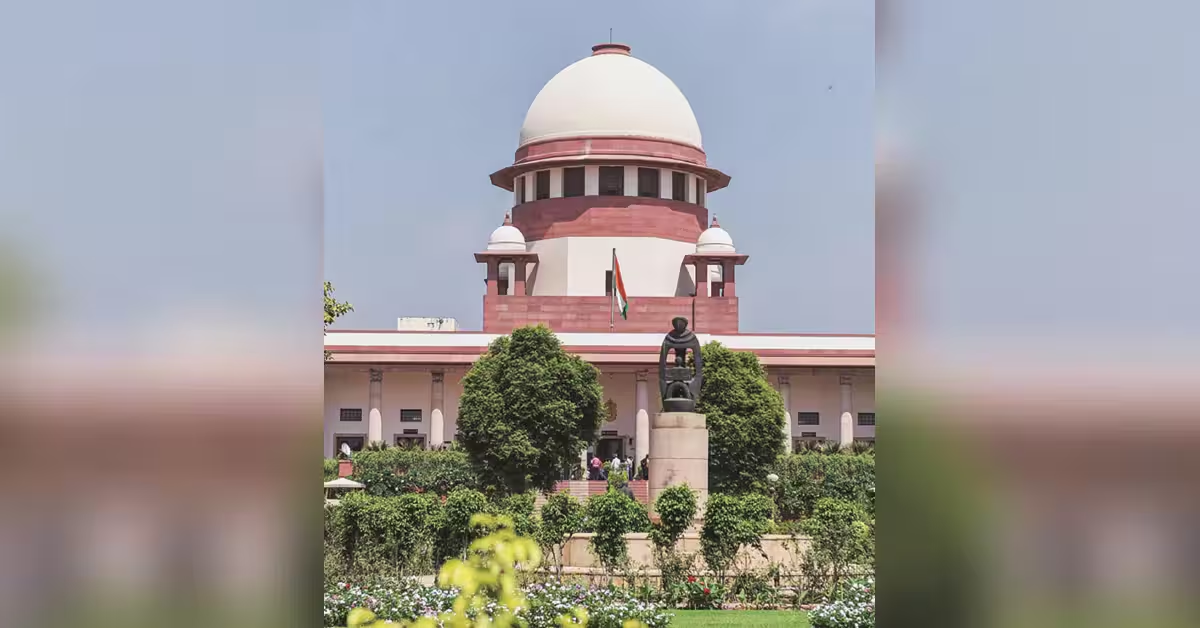
An application has been moved before the Supreme Court seeking recall of its recent split verdict on whether challenges to the law governing the appointment of the Chief Election Commissioner and Election Commissioners should be placed before a larger bench.
The plea was mentioned on Wednesday before a bench comprising Chief Justice of India Surya Kant, Justice Joymalya Bagchi and Justice V Mohana by senior advocate Gopal Sankaranarayanan.
Sankaranarayanan sought listing of the recall application, informing the bench that he had initially mentioned it before a bench headed by Justice Dipankar Datta. The matter was subsequently directed to be mentioned before the CJI-led bench after it was released from Justice Datta’s board.
“We will examine and take a call,” CJI Kant said.
The application follows the September 23 split verdict of Justice Datta and Justice Satish Chandra Sharma on pleas challenging Sections 7 and 8 of the Chief Election Commissioner and Other Election Commissioners (Appointment, Conditions of Service and Term of Office) Act, 2023.
The provisions prescribe a selection committee comprising the Prime Minister, the Leader of the Opposition in the Lok Sabha and a Union Cabinet minister for appointing the CEC and Election Commissioners.
The petitions also questioned the appointments of Gyanesh Kumar, who is now the Chief Election Commissioner, and Election Commissioner Sukhbir Singh Sandhu.
The Centre had sought reference of the matter to a larger bench, arguing that it involved substantial constitutional questions. Justice Datta rejected the request, while Justice Sharma favoured a larger bench reference. In view of the disagreement, the two judges left it to the CJI to consider constituting a Constitution Bench to adjudicate the matter.
Separately, a curative petition filed by Dr Jaya Thakur concerning the same proceedings is pending before the Supreme Court.
Thakur has questioned Justice Sharma’s participation in the case, citing a potential conflict arising from the fact that his son, Siddharth Sharma, has been serving as standing counsel for the Election Commission of India before the Madhya Pradesh High Court since July 2024.
The curative plea alleges a “reasonable apprehension of bias and propriety” and seeks exemption from the requirement of filing a review petition first. Thakur has argued that a review would ordinarily be placed before the same bench and therefore would serve no practical purpose.
Senior advocate Vijay Hansaria, who settled the curative petition and certified it as fit for consideration under the court’s curative jurisdiction, has acknowledged that there was no doubt Justice Sharma decided the case on its merits. However, he argued that the broader principle that justice must not only be done but also appear to be done warranted Justice Sharma’s recusal from the proceedings.