

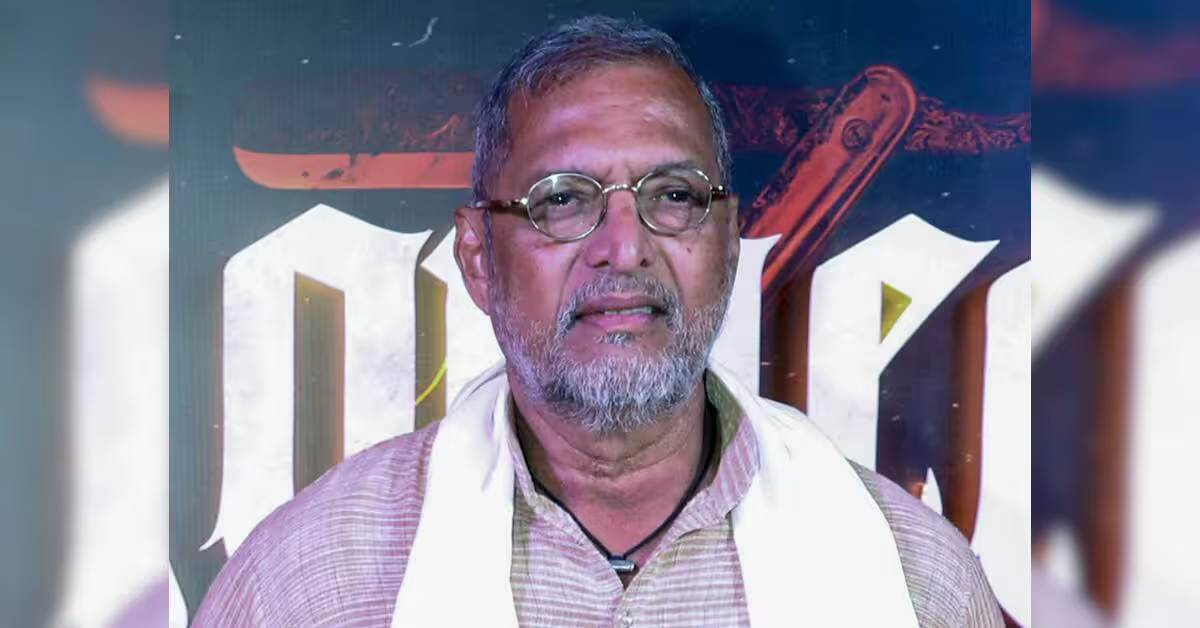
N Chandra’s Ankush was a gripping watch. The story of four wayward friends who find purpose thanks to an old lady and her granddaughter was made by an unknown filmmaker with a cast of struggling actors. It turned out to be the big sleeper hit of 1986. As a teenager, what stood out was a lovely bhajan — Itni Shakti Humein Dena Daata — and that bearded guy who played Ravi. His eyes were angry; his body language had a jerkiness that spoke volumes. In those pre-internet days, all I knew was that this actor was called Nana Patekar.
Later, in 1989, I saw him again in Vidhu Vinod Chopra’s classic Parinda. His performance as a mad gangster who is afraid of fire is scarily good. Not surprisingly, it won him both the National Award and the Filmfare Award for Best Supporting Actor.
Vishwanath Patekar had arrived.
By the mid-1990s, he was a sought-after star-actor, much like Nawazuddin Siddiqui, Jaideep Ahlawat or Pankaj Tripathi are now. Patekar, originally from Murud-Janjira on the Konkan coast, had graduated from Mumbai’s Sir JJ Institute of Applied Art. He debuted in a small role in Muzaffar Ali’s Gaman (1978) and had been acting in Marathi films. But it was Ankush that brought him to the notice of filmmakers and put him firmly on the popular cinema map.
Much like Shabana Azmi, Patekar managed to do plenty of popular films (Mohre, Krantiveer, Tirangaa) while making time for unusual subjects with lesser-known filmmakers. In Arun Kaul’s Diksha (1991), his portrayal of a strict Brahmin who declares his daughter dead after she has an abortion for a child conceived out of wedlock is haunting. So is the monk whose mind is ravaged by jealousy and lust in Nabendu Ghosh’s Trishagni (1988). It was unusual then for actors to be successful playing flawed characters. Patekar did it with aplomb.
Across close to 100 films, largely in Hindi and Marathi, Patekar displayed an attraction to the flawed, the non-hero. The heroism came from the everyday, the normal things that make us human. In Sanjay Leela Bhansali’s debut, Khamoshi: The Musical (1996), Patekar and Seema Biswas play Joseph and Flavy Braganza, a deaf-mute couple with a daughter who loves music. In a litany of great performances, this is one of Patekar’s best. He speaks with his hands, eyes, and gestures and brings tears to your eyes. Then there is Ab Tak Chhappan (2004). As police inspector Sadhu Agashe he barely raises his voice. But the image of a man carrying violence, exhaustion, and a moral code in equal measure is seared in your mind. His mastery of the craft won him three National Awards, several Filmfare Awards, and the Padma Shri.
Patekar’s plain-speaking intensity and his need to stay connected with reality stretched into his life. He trained for three years with the Maratha Light Infantry before making his directorial debut, Prahaar: The Final Attack (1991).
My abiding memory is its unusual and thought-provoking ending, and some superb performances from a makeup-less Madhuri Dixit and Dimple Kapadia. He had trained with guns and ammunition and was a national-level rifle shooter. That is why, at the height of the Kargil conflict in 1999, he was allowed to travel with the army for two months.
In 2016, he formed the Naam Foundation with fellow actor Makarand Anaspure. They provided Aarogya Cards to more than 500 widows of Marathwada farmers who had died by suicide. This helped them get free medical care at MGM Medical College and Hospital in Chhatrapati Sambhajinagar (Aurangabad) for about five years.
He loved to cook and had a 27-acre farm close to Pune where he grew vegetables and foodgrain. Old colleagues and fellow actors popped by for treats and posted videos of Patekar cooking. There were others of him gymming. At 75, he seemed fit as a fiddle.
That is why the end seems unusual. Patekar collapsed at his Goa home on Thursday this week. He was rushed to hospital, where doctors tried to revive him, without luck. He had suffered a cardiac arrest.
Patekar’s anger and intensity were as real in life as they were in his performances. He was as brutally honest as the characters he portrayed. Even when he played the funny guy, his wit could be biting, as in Jai in Aziz Mirza’s Raju Ban Gaya Gentleman (1992).
And then there was Welcome (2007). Gangster Uday Shetty nurses ambitions of becoming an actor and inadvertently
hilarious in his pursuit of that desire. The character has acquired a cult following, with memes and videos centred around him. Check your Instagram: that man in the brown suit and teeka, laughing at the end of thousands of different reels, is Patekar from Welcome.
For a man who was a bit of a character, there couldn’t have been a better compliment from the younger generation.