

[ad_1]
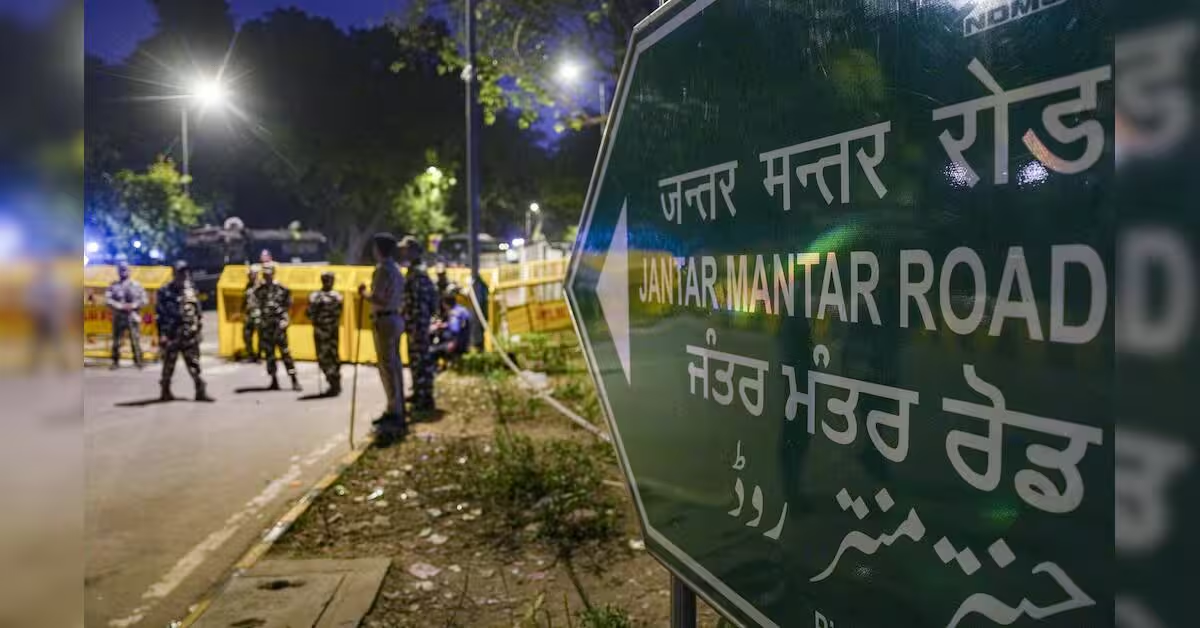
In an order made public on Monday, the Delhi Police de-notified Jantar Mantar as a designated protest site and named three new spots for holding such demonstrations. Delhi Police Commissioner Anurag Kumar issued the standing order on October 11, naming Ramlila Maidan, Burari Ground and CBD Ground as the new designated sites for protests and demonstrations.
Jantar Mantar is located in the heart of Delhi, barely a kilometre from Parliament House. The other three are at some distance from the country’s seat of power. Burari Ground in North Delhi is 23 kilometres from Jantar Mantar, CBD Ground in East Delhi’s Shahdara is 12 kilometres away, while Ramlila Maidan in Central Delhi is three kilometres away.
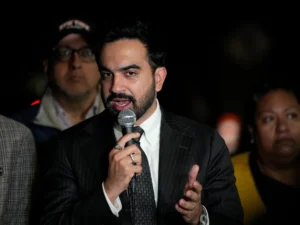
The Opposition parties, and also the Cockroach Janta Party (CJP), criticised the decision. Congress general secretary Jairam Ramesh said, “Democracy no longer matters for them (the Prime Minister and Home Minister). It is all a matter of Demokursi.” CJP co-convener Saurav Das said the government’s decision to de-notify Jantar Mantar as a protest site was “unacceptable”, and they “do not accept this arbitrary decision”.
“Denotifying Jantar Mantar for peaceful democratic protests is the biggest defeat of the Bharatiya Janata Party (BJP) government,” Samajwadi Party chief Akhilesh Yadav said. The Communist Party of India (Marxist-Leninist) Liberation, or CPI(ML) Liberation, said, “From Boat Club to India Gate, from the Red Fort to Jantar Mantar, and now to the remote corners of Delhi, successive restrictions have systematically pushed democratic protests further and further away from Parliament, the very centre of people’s representation.” It said, “Close Jantar Mantar, and thousands of Jantar Mantars will emerge everywhere.”
The New Delhi Traders Association (NDTA), which voices the interests and concerns of shopkeepers in Connaught Place, welcomed the Centre’s decision, saying the move would reduce inconvenience to the public and businesses in the national capital. In its order, the Delhi Police said, “Ministry of Home Affairs, Government of India, had constituted a committee to examine alternative proper venues for citizens’ right to organise protest/demonstrations in place of the existing ‘designated site’.” Based on the committee’s recommendations, Jantar Mantar as a protest venue has been de-notified, it said.
At least since the 1990s, Jantar Mantar has witnessed historic protests, the latest being the CJP-led protests to highlight the irregularities in the National Eligibility cum Entrance Test (NEET) in July that forced Dharmendra Pradhan to quit as the country’s education minister.
In April 2011, the India Against Corruption movement, led by social activist Anna Hazare to demand a Lokpal Bill, also began at Jantar Mantar. Opposition leaders, including the Bharatiya Janata Party’s Arun Jaitley, the leadership of the Left parties, and leaders of other Opposition parties, shared the stage with the agitation’s leaders at Jantar Mantar. The country’s prominent wrestlers protested at the site in 2023, and a year later, chief ministers of southern Indian states sat on a dharna demanding fairer devolution of central taxes.
The Jantar Mantar protest site, near the 18th-century astronomical observatory built in 1724 by Maharaja Sawai Jai Singh II under Mughal emperor Muhammad Shah, emerged as a protest site after demonstrations were restricted at the Boat Club lawns near India Gate since these disrupted traffic. One of the most famous protests at the Boat Club lawns was led by farmer leader Mahendra Singh Tikait in October 1988. Protesters would also gather at Vijay Chowk, just outside Parliament, including during the anti-cow slaughter protests of November 1966, which the Rashtriya Swayamsevak Sangh backed. Seven people were killed in police firing when the protesters tried to storm Parliament.
Ramlila Maidan, one of the three designated protest sites, according to the Delhi Police’s standing order, has also witnessed historic protests over the decades. In 2001, Sangh Parivar ideologue Dattopant Thengadi, with Communist Party of India (CPI) leader Gurudas Dasgupta by his side, protested against the then Atal Bihari Vajpayee-led National Democratic Alliance government’s foreign policies. Trade unions affiliated with the Left parties and Sangh Parivar used to take out marches against the economic policies of the Congress- and BJP-led governments at the Centre and converge at Jantar Mantar.
In its July 2018 judgment in Mazdoor Kisan Shakti Sangathan versus Union of India, the Supreme Court noted that police shifted demonstrations from the Boat Club because they were obstructing traffic. Police designated Jantar Mantar for gatherings of up to 5,000 people, while larger demonstrations were to be held at Ramlila Maidan.
The restriction on the number of people who could gather at Jantar Mantar has meant that protests have taken place elsewhere in the city, including the anti-Citizenship Amendment Act protests at Shaheen Bagh in 2019-20. In 2021, the anti-farm laws protesters were offered Burari Ground, but they remembered the fate of the Tikait-led protest in the mid-1990s, held at that site after the Boat Club lawns were made out of bounds for protests. The Tikait-led protests went largely unnoticed. In 2021, the leaders of the anti-farm laws movement instead decided to station themselves at Delhi’s three borders: Singhu, Tikri and Ghazipur.
Opposition protest
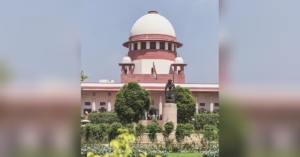
In the afternoon, Opposition leaders took out a “March for Democracy” to the Supreme Court and filed a joint petition against the Election Commission of India’s Special Intensive Revision (SIR) and alleged poll irregularities. Leaders of the Opposition (LoPs) in the Lok Sabha and Rajya Sabha, Rahul Gandhi and Mallikarjun Kharge, Samajwadi Party chief Akhilesh Yadav, former West Bengal chief minister Mamata Banerjee, and top Left leaders were among those who joined the march.
A day after the Chief Justice of India declined a request for a meeting with the LoPs on the issue, saying the matter was sub judice, the Opposition leaders filed the joint plea in the apex court over alleged large-scale voter deletions and irregularities in the SIR of electoral rolls. The police stopped the march at Bhagwan Dass Road. Several leaders, including Rahul Gandhi, Priyanka Gandhi Vadra, Tejashwi Yadav and Akhilesh Yadav, climbed atop a vehicle, and the procession moved forward after crossing the barricades as supporters cheered and waved flags.
Congress leader Rahul Gandhi announced the march at his press conference on Monday afternoon. He asked the CEC to “turn approver” and resign as the Opposition’s fight was against the bigger powers behind him. People should continue with the protests as the country cannot be saved in a day or two, he said. “This is like Shiva’s dance (tandav) and anyone can join Shiva’s ‘baraat’ (wedding procession),” he said. Gandhi also claimed that 200 government officers were in “touch with them” and providing them with information.
Union Minister Shivraj Singh Chouhan slammed the Opposition’s march to the Supreme Court as a “drama”, alleging that the Congress had been blaming the Election Commission for its defeats while its own “visionless” leadership was responsible for the electoral setbacks. Addressing a press conference at the BJP headquarters, he also slammed Gandhi for describing the Congress and anti-CEC movement as “Shiv Ki Baraat”, saying it was rather a “group of hooligans” creating anarchy on the streets.
[ad_2]
Source link