[ad_1]
Odisha Chief Minister Mohan Charan Majhi on Thursday called for greater international and inter-state cooperation to tackle the growing challenges posed by climate change and natural disasters.
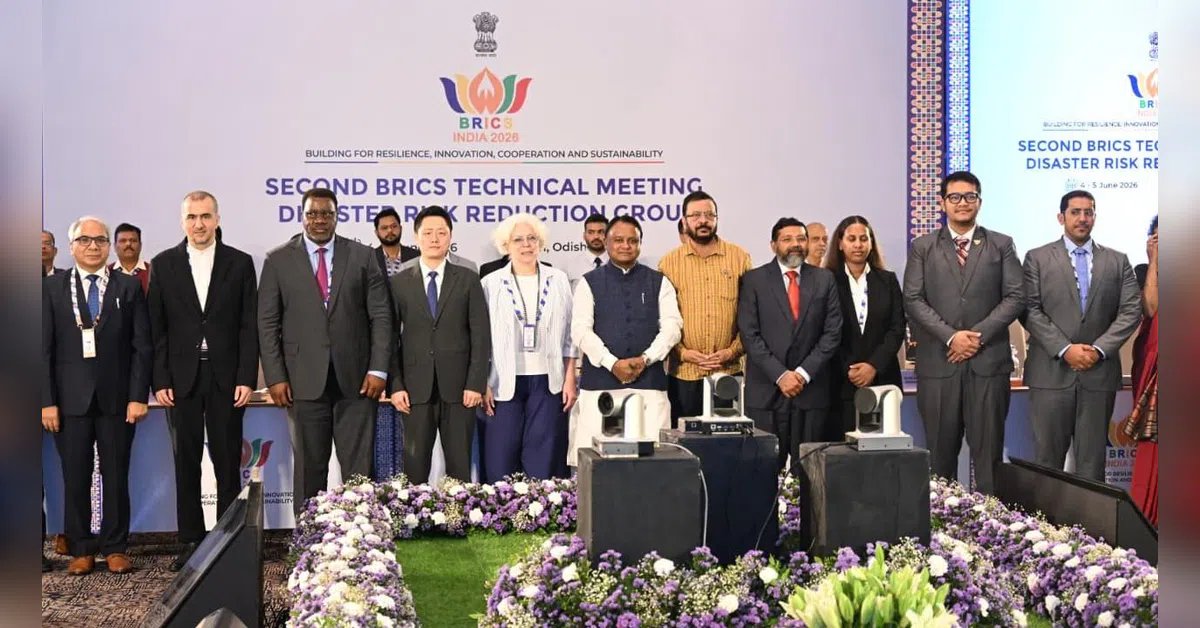
Inaugurating the BRICS Disaster Risk Reduction (DRR) Working Group technical meeting in Puri, attended by disaster management experts from BRICS nations, Majhi said disaster risk reduction has evolved beyond a sectoral concern and has become central to sustainable development, economic stability and human security.
He stressed that increasing climate variability, rapid urbanisation and environmental degradation are amplifying the frequency and intensity of disasters worldwide, making stronger preparedness, innovation and coordinated action imperative.
Describing the gathering as an important platform for advancing global disaster resilience, the chief minister said the meeting’s theme, “Building for Resilience, Innovation, Cooperation and Sustainability”, reflects the urgent need for nations to work collectively to safeguard lives, livelihoods and future generations.
He highlighted Odisha’s internationally recognised disaster management framework and said the state has built its preparedness architecture around the principle of “zero casualty”. Over the years, Odisha has significantly strengthened its capacity through evidence-based planning, advanced early warning systems, resilient infrastructure, institutional capacity building and inclusive governance mechanisms, he said.
Majhi pointed out that Odisha continues to face multiple hazards, including cyclones, heatwaves, lightning strikes, coastal erosion and emerging climate-induced urban risks. While the state’s experience has demonstrated that strong institutions, community participation and preparedness can substantially reduce disaster impacts, future challenges will require deeper partnerships and greater technological capabilities, he said.
“The Odisha model demonstrates that preparedness, strong institutions and community participation can significantly reduce disaster impacts. However, future challenges will require even greater efforts, stronger partnerships and enhanced technological capabilities,” he remarked.
The chief minister also aligned Odisha’s disaster management efforts with Prime Minister Narendra Modi’s vision for disaster resilience. He said the Prime Minister’s 10-point agenda for disaster risk reduction has placed resilience, preparedness, technology adoption and risk-informed development at the centre of India’s development strategy.
Emphasising resilient infrastructure as a critical component of disaster preparedness, Majhi said the recently approved 160-km greenfield coastal highway connecting Rameswar, Konark and Paradip, with an estimated investment of Rs 8,301 crore, would significantly strengthen Odisha’s disaster response capabilities.
“Other large infrastructure initiatives, including the 111-km Capital Region Ring Road project, estimated at Rs 8,307 crore, and the Bhubaneswar-Cuttack-Puri-Paradip Economic Region project, which has received Rs 5,000 crore in central assistance through NITI Aayog, would not only accelerate economic growth but also strengthen the state’s long-term resilience to disasters and climate-related risks,” he maintained.
The chief minister advocated climate-sensitive urban planning, sustainable land-use practices and comprehensive heat action plans as essential elements of future development. He also called for enhanced scientific interventions, public awareness campaigns and preventive measures to address the increasing threats posed by heatwaves, lightning strikes and coastal erosion. “The Puri deliberations could emerge as a landmark contribution to future international frameworks on disaster risk reduction,” Majhi added.
The three-day meet has brought together senior officials, policymakers and disaster management experts from all 11 BRICS member and partner countries — Brazil, China, Egypt, Ethiopia, India, Indonesia, Iran, Russia, Saudi Arabia, South Africa and the United Arab Emirates — to strengthen cooperation in disaster risk reduction and climate resilience.
Speaking on the occasion, Revenue and Disaster Management Minister Suresh Pujari said Odisha’s disaster preparedness capabilities have undergone a remarkable transformation since the devastating Super Cyclone of 1999. The lessons learnt from that catastrophe helped the state build what is now regarded as a globally recognised governance model in disaster management, he said.
Pujari highlighted Odisha’s extensive investments in disaster-resilient infrastructure and early warning systems, but stressed that community engagement remains at the heart of the state’s strategy. “Communities are the first responders in disaster situations,” he said, adding that the government has focused on strengthening local capacities and ensuring last-mile dissemination of information to enable timely responses during emergencies.
National Disaster Management Authority (NDMA) Member and Head of Department Krishna Swaroop Vatsa and NDMA Member Rita Missal also addressed the gathering, underscoring the importance of strengthening resilience and fostering greater cooperation in disaster risk reduction among BRICS nations.
The BRICS working group is expected to deliberate on a wide range of issues, including disaster preparedness, climate adaptation, resilient infrastructure, technological innovation and capacity building, with outcomes from the Puri discussions likely to contribute to shaping future global approaches to disaster risk reduction.
[ad_2]
Source link