

[ad_1]
Following this, the Union government announced the deployment of 20 additional companies of the Central Reserve Police Force (CRPF) in the national capital.
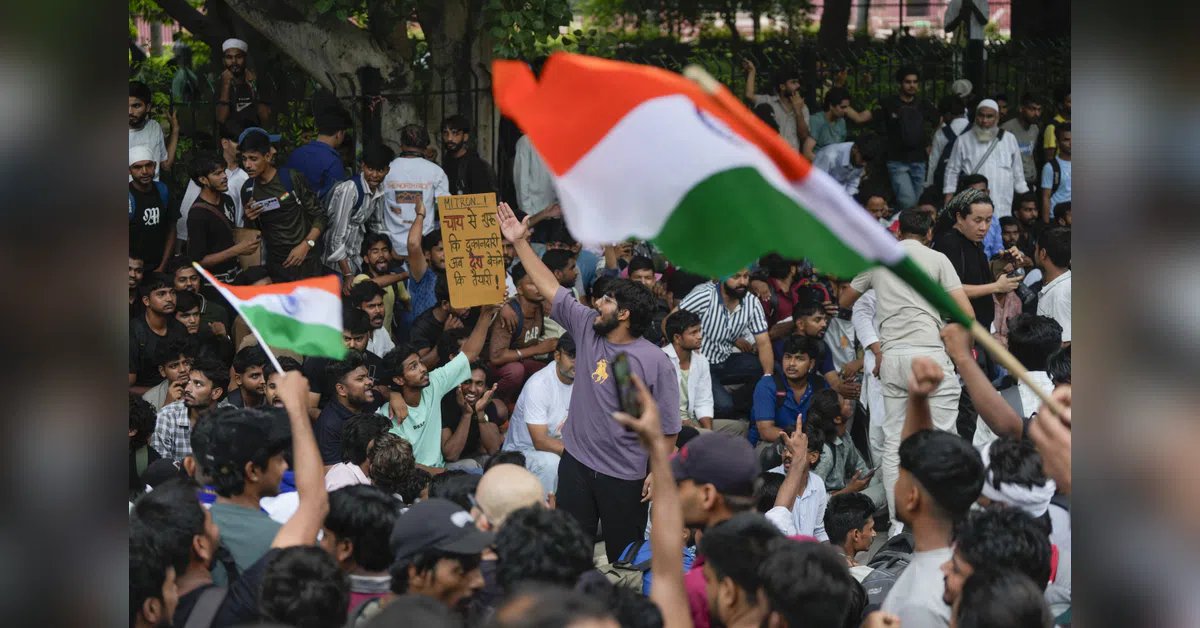
These developments have raised an important question: Can anyone protest anywhere in India?
What does the Constitution say about the right to protest?
The right to protest is protected under the Fundamental Rights guaranteed by the Constitution.
Article 19(1)(a) gives citizens the right to freedom of speech and expression, while Article 19(1)(b) guarantees the right to assemble peaceably and without arms.
However, these rights are not absolute. The Constitution allows the government to impose reasonable restrictions in the interests of:
• Sovereignty and integrity of India
• Security of the State
• Friendly relations with foreign States
• Public order
• Decency or morality
• Contempt of court
• Defamation
• Incitement to an offence
This means citizens can organise and participate in protests, but they must do so within the limits laid down by law.
Do protesters need police permission?
Yes, in most cases.
Across India, protests are generally regulated through local laws and police guidelines. Authorities often designate specific places for demonstrations, such as Jantar Mantar in Delhi, and organisers are usually required to obtain prior permission from the police.
Police may also impose restrictions on the size, timing and route of marches to ensure public order.
Can the government ban public gatherings?
Yes. The government can temporarily restrict public gatherings if authorities believe there is a threat to public peace.
Under the Bharatiya Nagarik Suraksha Sanhita (BNSS), executive magistrates have the power to issue prohibitory orders.
One of the most frequently used provisions is Section 163 of the BNSS, which replaced the old Section 144 of the Code of Criminal Procedure (CrPC).
Under this provision, authorities can prohibit:
• Public gatherings
• Processions
• Carrying weapons
• Activities that are likely to disturb public peace
Violating such orders can lead to police action.
Has India defended the right to protest internationally?
Yes. At the 47th Session of the UN Human Rights Council in Geneva in 2021, India’s representative, Pawankumar Badhe, first secretary at India’s Permanent Mission in Geneva, said that “peaceful assembly and marches” are a cherished part of India’s democratic life and a legacy of the freedom struggle.
He noted that Article 19 of the Constitution guarantees citizens the right to assemble peacefully without arms, and said the Supreme Court has recognised the right to peaceful protest as well. He added that while the government must maintain law and order and protect the right to life, India has always respected the freedom of peaceful assembly and association.
What has the Supreme Court said on protests?
The Supreme Court has repeatedly recognised that the right to peaceful protest is a fundamental right flowing from Articles 19(1)(a), 19(1)(b) and 19(1)(c) of the Constitution. At the same time, it has said that this right must be balanced with public order and the rights of other citizens.
Some of the key judgments are:
• Anita Thakur vs State of Jammu & Kashmir (2016): The court described peaceful protest as a fundamental right rooted in India’s democratic traditions.
• Mazdoor Kisan Shakti Sangathan vs Union of India (2018): While hearing a case related to demonstrations at Jantar Mantar, the court held that citizens have a constitutional right to protest, but authorities can regulate the time, place and manner of demonstrations to balance competing rights.
• Ramlila Maidan case (2012): The court said peaceful assemblies are a basic feature of democracy and deserve constitutional protection.
• Shaheen Bagh judgment (2020): The Supreme Court ruled that while peaceful protest is protected, public roads and public spaces cannot be occupied indefinitely in the name of protest.
Can protests be held outside Parliament?
Demonstrations are generally not permitted within the Parliament complex because of strict security arrangements.
Protests are usually allowed only at designated locations approved by the authorities. Any demonstration near Parliament or in high-security zones requires prior permission and is subject to security restrictions.
[ad_2]
Source link