

[ad_1]
External Affairs Minister S Jaishankar on Wednesday met US Secretary of State Marco Rubio in Manila to discuss the proposed India-US trade deal, tariffs and other key bilateral issues.
The meeting, held on the sidelines of the Association of Southeast Asian Nations (Asean) and Quad foreign ministers’ meetings, came hours after US President Donald Trump threatened steep tariffs on generic medicines, raising concerns among Indian drugmakers.
After the meeting, Jaishankar said in a social media post that their discussion “focused on areas which are priority” for the India-US comprehensive global strategic partnership, “including trade and tariffs, energy, defence and security, critical minerals and artificial intelligence.”
Rubio said on X that they discussed regional security, the Quad, trade and defence agreements. “Our relationship with India is vitally important,” he said.
US State Department spokesperson Tommy Piggott said Rubio and Jaishankar discussed recent developments in West Asia and the Indo-Pacific. He said they also “discussed finalising key defence agreements in fulfilment of commitments made between President Donald Trump and Prime Minister Narendra Modi last year”. Rubio and Jaishankar agreed on the importance of concluding the interim trade deal, which is almost complete, Piggott said. He did not mention that tariffs were mentioned in the discussions.
Addressing the India-Asean foreign ministers’ meeting in Manila, Jaishankar called for deeper cooperation amid the ongoing global disruptions. He said no single country or grouping could deal with the current volatility alone and stressed that deeper cooperation would help nations “de-risk and diversify”.
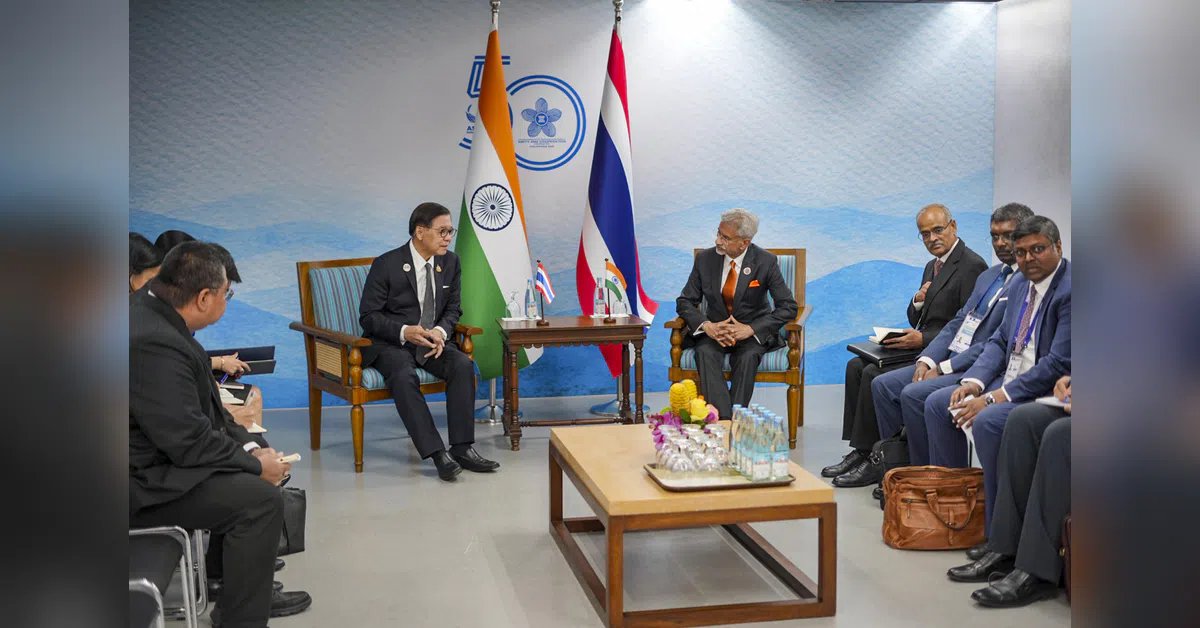
Jaishankar also held bilateral meetings with his counterparts from China, Russia, Australia, the Philippines, Singapore, Thailand, Canada and New Zealand.
During his meeting with Chinese Foreign Minister Wang Yi, Jaishankar noted the gradual “normalising” of India-China ties since October 2024, citing peace along the border, the resumption of direct flights, changes to the visa regime, the restart of the Kailash Manasarovar Yatra and the resumption of border trade.
However, he said other “important dimensions” of the bilateral relationship still needed to be addressed. “Fair market access and trade balance ranks high in that regard,” Jaishankar said. He also flagged India’s concerns over the predictability of supply chains and called for greater official and people-to-people exchanges. “We also need to agree on the meetings of various mechanisms and platforms as per our mutual priorities,” he said.
In his meeting with Russian Foreign Minister Sergey Lavrov, Jaishankar conveyed India’s concerns over the safety of seafarers in the Black Sea region after four Indian sailors were killed and another critically injured in a Russian missile strike on a merchant vessel off the coast of Ukraine earlier this week.
The Ministry of External Affairs (MEA) had summoned Russian Charge d’Affaires Vladimir Ladanov in New Delhi to convey its “grave concerns” and “unequivocal condemnation” over the Russian attack on the Guinea-Bissau-flagged merchant vessel Golden Leo on Sunday, which killed 10 people, including four Indian crew members. Jaishankar said he “reiterated” India’s “strong concern regarding the safety of Indian seafarers in the region” to Lavrov.
Jaishankar also attended the Quad foreign ministers’ meeting, where India joined its partners in calling for peace and stability in the Indo-Pacific while reaffirming Asean’s centrality amid China’s growing military assertiveness in the South China Sea. Rubio, Australian Foreign Minister Penny Wong and Japanese Foreign Minister Toshimitsu Motegi attended the meeting. The Quad foreign ministers last met in New Delhi in late May.
Jaishankar said on social media that the ministers reviewed “the Indo-Pacific landscape and discussed recent developments”. Rubio said the US, India, Australia and Japan shared a vision of a free and open Indo-Pacific grounded in the rule of law, sovereignty and territorial integrity. He added that the Quad remained a priority and that the ministers would meet again later this year.
[ad_2]
Source link