


[ad_1]
Inflation has fallen both in the UK – down to 2.6% in the year to June helped by slowing diesel and petrol prices – and in the US to 3.5%.
But questions remain whether the slow down will prove short-lived due to the renewed conflict in the Middle East.
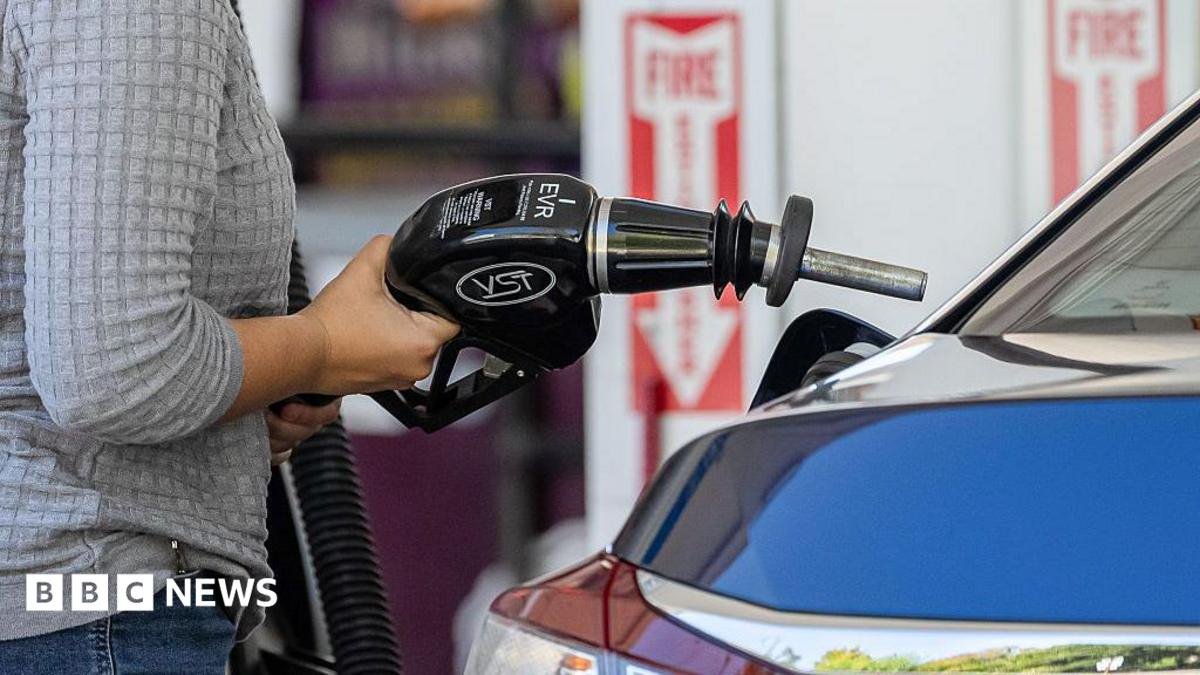
New data released on Thursday showed that UK petrol prices have risen by 5p a litre since the beginning of July, hitting reaching almost £1.56.
Diesel is at £1.72 a litre, on average, according to the RAC.
Average gasoline prices in the US have surpassed $4 a gallon once more, up from $3.92 a month ago, according to motorist advocacy group AAA.
“More expensive fuel and energy can ripple through the wider economy, increasing costs for businesses and ultimately feeding through into the price of food and other goods,” said Jonathan Raymond, investment manager at Quilter Cheviot.
“This creates another headache for central banks as they continue their battle against inflation.
“If energy prices remain elevated, policymakers may come under pressure to keep interest rates higher for longer or even raise them. This would come as a blow to mortgage holders and borrowers already feeling the strain.”
The Bank of England, which sets UK interest rates, has held them at 3.75% in its last four meetings.
Paul Dales, chief UK economist at Capital Economics, said he believed the Bank will “almost certainly” hold them again. But he said analysts still expected that interest rates could be cut next year if energy price rises ease.
Kevin Warsh, the newly-appointed chair of the US Federal Reserve, last week told Congress that the central bank had “no tolerance to persistently elevated inflation”.
US President Donald Trump had pushed Warsh’s predecessor, Jerome Powell, to cut interest rates.
Trump has made it clear he expects Warsh to fulfil his demand for reductions in borrowing costs for Americans.
But the Fed held US interest rates between 3.5% and 3.75% at Warsh’s first meeting last month. He also told Congress that he was committed to “restoring price stability” in the wake of the Middle East conflict impacting prices.
[ad_2]
Source link