
How often are pilots drug-tested in India?
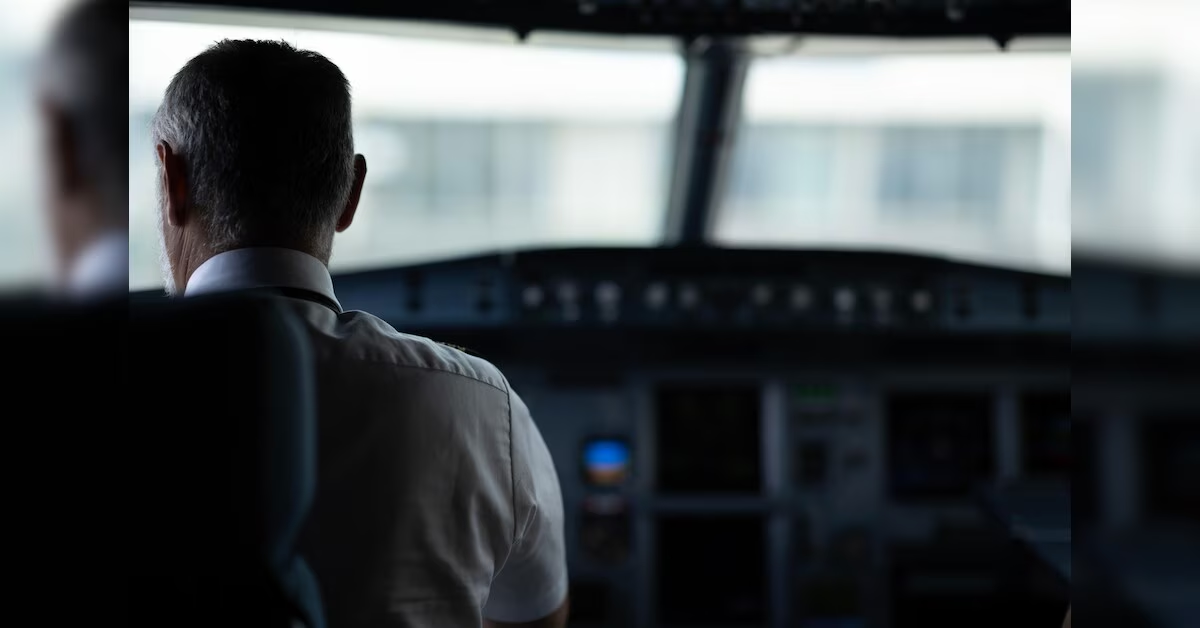
Under the Directorate General of Civil Aviation’s (DGCA) Civil Aviation Requirements (CAR), drug testing applies to flight crew members and air traffic controllers. There is no fixed testing date or interval for individual pilots. Instead, the programme is designed to cover at least 10 per cent of an organisation’s flight crew and air traffic controller employees each year, while pilots and air traffic control officers are also required to undergo testing before employment, after an accident, and as part of follow-up checks after a confirmed positive case.
Testing is carried out using urine samples, with an initial screening followed by confirmatory testing if the first sample tests positive.
What drugs are pilots tested for?
The DGCA’s testing framework covers a range of psychoactive substances, including marijuana or hashish, cocaine, amphetamines, methamphetamines, opioids such as morphine, methadone, oxycodone, benzodiazepines, barbiturates, MDMA, and other specified substances.
The initial screening is not necessarily the final verdict. If Sample A returns positive, Sample B is sent to a DGCA-authorised laboratory for confirmatory testing, while the sample’s chain of custody must be maintained.
The DGCA framework also provides for review by a Medical Review Officer, who can examine screening and confirmatory results before disciplinary proceedings begin.
What happens if a pilot tests positive?
A positive screening result can immediately affect a pilot’s flying duties. The DGCA rules state that a pilot who tests positive at the screening stage must be removed from safety-sensitive duties until the confirmatory result is received.
The consequences then depend on whether it is a first or subsequent confirmed positive:
First confirmed positive: The pilot must undergo de-addiction or rehabilitation and can return to active duty only after clearing another test, receiving clearance from a treating psychiatrist, and obtaining certification from the organisation’s chief medical officer.
Second confirmed positive: If the pilot tests positive again after returning to safety-sensitive duties, the person’s licence is cancelled under the DGCA rules.
Refusal to test: A pilot who refuses examination is removed from safety-sensitive duties and must clear detailed drug testing within one week. If they fail to do so, their licence can be suspended for three years.
Can medicines cause a non-negative result?
An initial non-negative result does not automatically establish drug abuse.
The Airline Pilots’ Association of India has warned that some commonly used cold, cough, allergy, and sleep-aid medicines can trigger non-negative screening results. It has advised pilots to consult doctors before taking medicines and retain prescriptions and pharmacy receipts.
The Telegraph reported the association’s advisory, which stressed that confirmatory testing is required before a result is treated as positive.