

[ad_1]
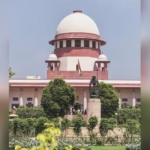
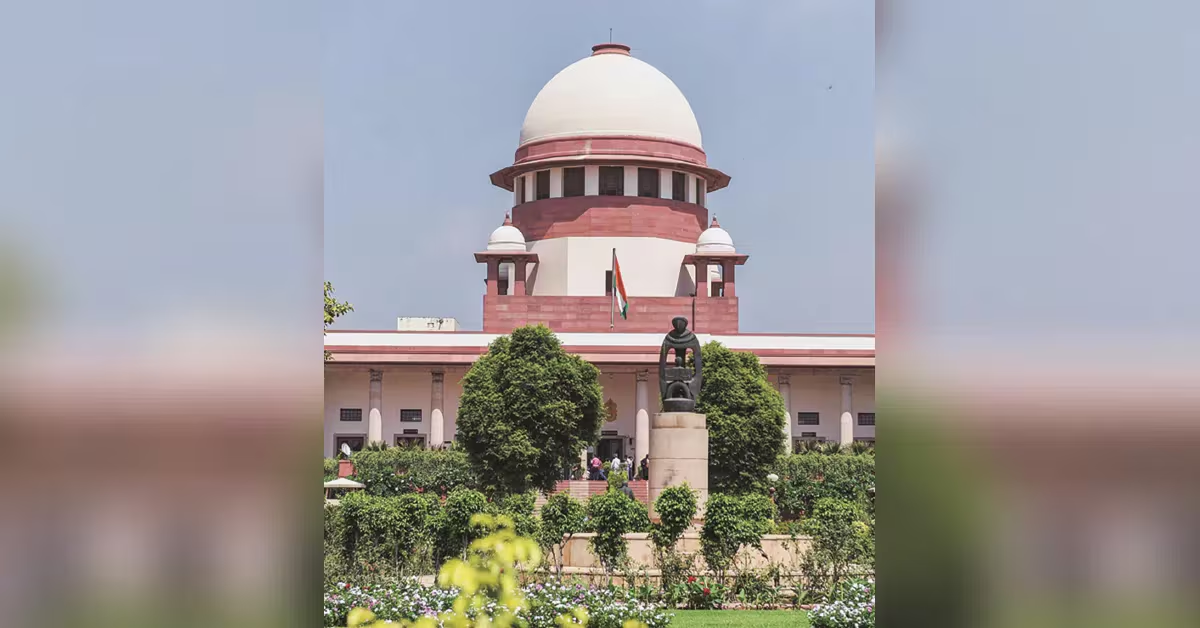
The Supreme Court on Wednesday pressed the Centre to strengthen the National Testing Agency (NTA) as a permanent, technology-driven institution, saying safeguards for entrance examinations cannot depend solely on individual officials or existing procedures.
A Bench of Justices P S Narasimha and Alok Aradhe said the NTA needs institutional memory, specialised expertise and upgraded infrastructure to prevent question paper leaks and ensure the credibility of competitive examinations.
“Our duty is to ensure that there is a vibrant institution that the country can be proud of,” the Bench said, stressing that frequent transfers of experienced personnel could result in the loss of institutional knowledge.
The court directed the Centre to file an affidavit detailing the progress made in implementing the recommendations of a high-level committee headed by former ISRO chairman K Radhakrishnan, as modified or supplemented by the Nandan Nilekani committee. The matter will be taken up after three weeks.
The Radhakrishnan panel was constituted in 2024 following the controversy surrounding the NEET-UG examination and had recommended several measures to strengthen the examination system.
The Nilekani committee, constituted this year, has examined technology-led reforms, including the possible use of artificial intelligence and blockchain.
The Bench said the government must spell out what permanent infrastructure has been created for examination security, cybersecurity, testing centres, confidential operations, research and development and other functions.
It also sought details of the senior personnel and dedicated structures put in place to oversee examination security. The judges said examination technology would continue to evolve and the NTA therefore needed its own research and development capabilities and secure database and storage infrastructure.
Solicitor General Tushar Mehta, appearing for the Centre and the NTA, told the court that several layers of safeguards were already in place.
He explained that question papers are generated through multiple moderators, with the final papers selected only at a later stage.
The papers are then printed at designated facilities under CCTV and security surveillance. The printing facilities are not informed about the examination for which the papers are being prepared, he said.
According to Mehta, sealed question papers are transported in secured boxes through GPS-tracked vehicles and stored in bank strongrooms until the examination.
The papers are released to examination centres only after instructions from the NTA, with the entire process videographed.
The litigation before the Supreme Court followed allegations of irregularities and question paper leaks surrounding NEET.
The court had declined to order a fresh examination in the 2024 episode after finding no evidence of a widespread leak, while directing reforms in the examination system.
Several petitions currently before the court seek structural changes to the NTA. One plea by the Federation of All India Medical Association has sought restructuring of the agency, digital locking of question papers, wider adoption of computer-based testing and publication of centre-wise results. Other petitions seek the creation of an independent statutory examination authority.
Separately, the Delhi High Court on Wednesday allowed the withdrawal of a petition concerning the NEET-UG 2026 re-examination after questioning the petitioners for combining several unrelated reliefs.
A Bench of Chief Justice D K Upadhyaya and Justice Tejas Karia was hearing a plea by two candidates seeking correction of scorecards, including marks for a dropped question and rectification of alleged calculation errors. They had also sought an expert committee and an order preventing the NTA from conducting future public examinations.
The court said the petition contained a “mixed bunch of prayers” and asked the petitioners to be clear about the reliefs being sought.
The plea was withdrawn with liberty to file separate proceedings, including a civil writ and a public interest litigation for broader institutional reforms.
[ad_2]
Source link