
[ad_1]
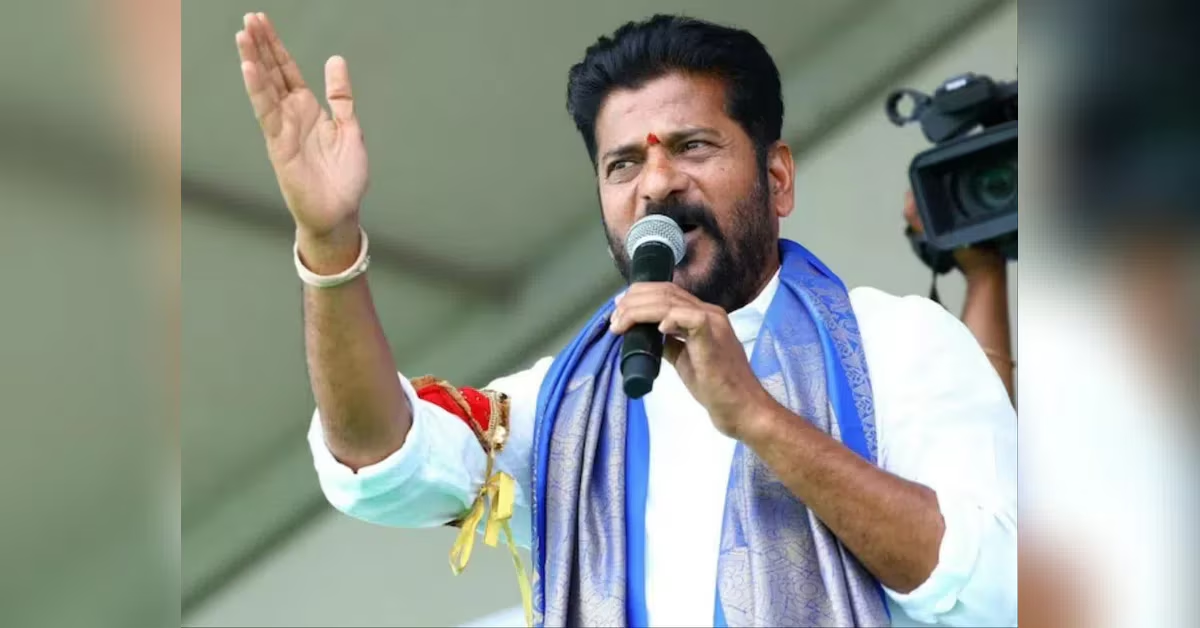
Telangana Chief Minister A Revanth Reddy’s proposed visit to the United States has been cancelled after the Centre denied permission, according to the Chief Minister’s Office (CMO).
Reddy, who is currently in London, was scheduled to travel to the US as part of an official TelanganaRising delegation and return to Hyderabad on August 30. However, a CMO release said the delegation was forced to cancel its US visit after the Ministry of External Affairs (MEA) denied permission, stating that clearance from a political angle was denied, PTI reported. Reddy will now return directly from London to Hyderabad on August 23 instead of travelling onward to Boston.
Have chief ministers been denied such clearance before?
Yes. There have been several instances where political clearance for foreign travel has been denied.
Former Delhi Chief Minister Arvind Kejriwal was denied permission to attend the C-40 Climate Summit in Copenhagen in October 2019. He was again denied clearance in July 2022 to attend the World Cities Summit in Singapore. Former West Bengal Chief Minister Mamata Banerjee was denied permission to visit China in 2018 for a political exchange programme. She was also denied clearance in September 2021 to attend a World Peace Conference in Rome.
Earlier, in 2012, the MEA denied political clearance to then Assam Chief Minister Tarun Gogoi for a high-level meeting in the US. In 2011, then Jharkhand Chief Minister Arjun Munda was denied clearance for a trip to Thailand.
What is the process for chief ministers to obtain foreign travel approval?
According to the Cabinet Secretariat circular dated May 6, 2015, the Cabinet Secretariat and the Ministry of External Affairs (MEA) must be informed about any proposed foreign visit, whether official or private, by chief ministers and ministers of state governments. It also says that prior political clearance and FCRA (Foreign Contribution Regulation Act) clearance are mandatory.
What is political clearance?
Political clearance is an approval granted by the Ministry of External Affairs for foreign travel by public servants. A chief minister is legally considered a public servant. The Supreme Court, in the landmark ruling M Karunanidhi v. Union of India, held that a chief minister receives a salary from the government treasury for performing public duties, making them a public servant under Section 21(12) of the Indian Penal Code and anti-corruption laws.
Political clearance is required not only for public servants but also for government servants undertaking foreign travel. The decision to grant or deny clearance is based on several factors, including the nature of the event, the level of participation from other countries, the nature of the invitation extended and India’s relations with the host country.
The system is intended to ensure that official foreign visits do not have diplomatic or foreign-policy implications that have not been assessed by the government. Since 2016, applications for political clearance can be submitted through the MEA website, epolclearance.gov.in. These applications are processed after coordination among various ministry divisions through a dedicated Coordination Division.
What other clearances are required?
Chief ministers, ministers of state governments and other state officials also need clearance from the Department of Economic Affairs.
For Union ministers, political clearance from the MEA has to be followed by additional clearance from the Prime Minister, whether the proposed trip is official or personal. Lok Sabha MPs need clearance from the Speaker, while Rajya Sabha members require clearance from the Chairperson, who is the Vice President of India.
For officers of various ministries up to the level of Joint Secretary, clearance is given by the minister concerned after political clearance. For officers above that rank, the proposal requires approval from a Screening Committee of Secretaries.
Back in 2019, the Union Department of Expenditure issued a circular directing ministries and departments to ensure that proposals for foreign visits requiring approval from the Screening Committee of Secretaries and the Prime Minister are received 15 days before the delegation’s departure date, but no later than five days before the date of departure.
The rules vary depending on the duration of the visit, the country being visited and the number of members in the delegation. If a foreign trip involves hospitality from organisations other than those of the United Nations, FCRA clearance is required from the Ministry of Home Affairs.
[ad_2]
Source link