

Kuang had relied on the Supreme Court’s ruling in Wu Chuaannan v State of Chhattisgarh, in which foreign nationals facing criminal proceedings were permitted to travel subject to safeguards
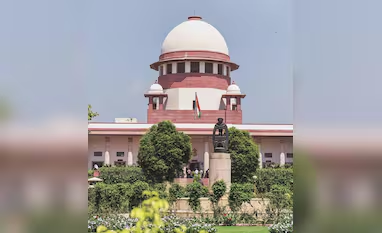
A senior executive of Vivo Mobile Communications has approached the Supreme Court against a Delhi High Court order refusing him permission to travel to China to visit his ailing 82-year-old father.
Guangwen Kuang filed a special leave petition on August 17, challenging the July 9 order that declined his request to travel to Guangzhou on humanitarian grounds. The plea is yet to be listed for hearing.
Kuang is facing prosecution under the Prevention of Money Laundering Act (PMLA) in a case concerning alleged proceeds of crime exceeding ₹20,000 crore.
He had sought temporary permission to leave India, submitting that he had cooperated with the Enforcement Directorate’s investigation, appeared regularly before the special court and complied with all conditions imposed on him.
He had also offered an undertaking through his employer assuring his return to India after the proposed visit.
The Enforcement Directorate opposed the plea, pointing to Kuang’s Chinese nationality and the absence of an extradition treaty between India and China.
The agency argued that there would be no effective mechanism to secure his return if he failed to come back. It further questioned whether the undertaking furnished by his employer would be legally enforceable.
The High Court, while considering the request, placed emphasis on the nature and scale of the allegations, as well as the difficulty in securing Kuang’s presence in India if he were to remain abroad.
The court also noted that India and China do not have a mutual legal assistance treaty in criminal matters. According to the court, this could create difficulties in independently verifying the medical condition of Kuang’s father within the time required.
Kuang had relied on the Supreme Court’s ruling in Wu Chuaannan v State of Chhattisgarh, in which foreign nationals facing criminal proceedings were permitted to travel subject to safeguards, including a bank guarantee, an undertaking by the employer and an assurance from the Chinese Consulate.
The Delhi High Court found that comparable safeguards were not available in Kuang’s case. It acknowledged the humanitarian considerations arising from his father’s illness but held that these circumstances could not, in the present case, outweigh the need to ensure his availability for the ongoing proceedings.
The Supreme Court will now consider Kuang’s challenge to the High Court’s refusal to permit the proposed China visit.
First Published: Aug 24 2026 | 7:14 PM IST