

[ad_1]
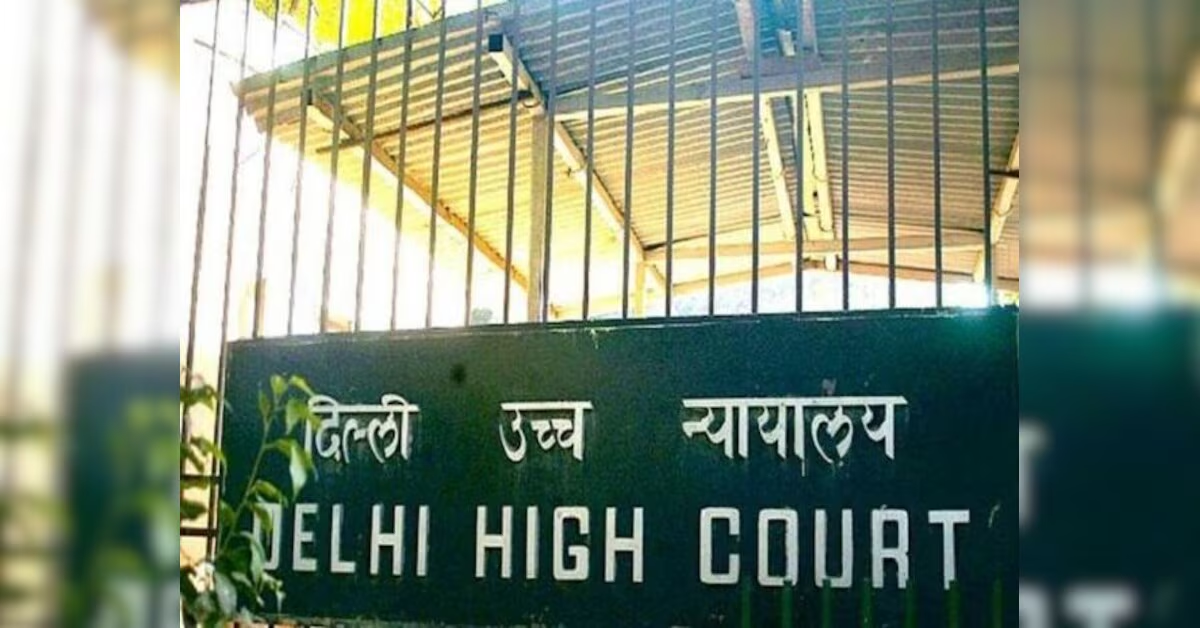
The Delhi High Court on Tuesday directed the Food Safety and Standards Authority of India (FSSAI) not to proceed with any decision to cancel ITC Limited’s food business licence over the labelling of its Aashirvaad MP Chakki Atta as “100% Atta”, “100% Madhya Pradesh Wheat” and “0% Maida”.
Justice Swarana Kanta Sharma passed the interim order after ITC informed the Court that the August 13 improvement notice, requiring compliance within 15 days, would lapse on August 28. The case has been listed for further hearing on September 9.
The Court, however, made it clear that it had not yet determined whether it possessed territorial jurisdiction to entertain ITC’s challenge. Both sides were directed to submit brief written notes addressing the issue.
The dispute stems from an August 10 show-cause notice issued to ITC for allegedly violating an FSSAI advisory issued in May 2025, which called upon food businesses to stop using “100%” claims on product labels, packaging and promotional material. Although ITC was given 30 days to respond to the show-cause notice, the regional authority issued an improvement notice just three days later, granting the company only 15 days to comply.
ITC contended that the improvement notice was issued before it had an opportunity to respond to the show-cause notice, rendering the action contrary to the principles of natural justice.
The company has also questioned the legality of the May 2025 advisory, arguing that FSSAI could not impose a binding restriction through an advisory without following the statutory process applicable to framing regulations, including prior publication, Central Government approval and parliamentary scrutiny.
The company further submitted that there was no allegation that Aashirvaad MP Chakki Atta contained maida, included ingredients other than whole wheat flour, or was made from wheat sourced outside Madhya Pradesh.
FSSAI, meanwhile, challenged the maintainability of the proceedings before the Delhi High Court. It argued that the improvement notice had been issued by its Kolkata regional authority and that ITC had an alternative statutory remedy under Section 32 of the Food Safety and Standards Act, 2006.
Under Section 32(4), a person aggrieved by an improvement notice or by refusal or cancellation of a certificate may appeal to the Commissioner of Food Safety.
ITC disputed this position, maintaining that the matter involved a central licence. It relied on Section 10(5) of the Act, which confers on FSSAI’s Chief Executive Officer the powers of a Commissioner of Food Safety when dealing with matters falling within the central licensing authority.
Since the CEO is based in Delhi, ITC argued that a part of the cause of action arose within the territorial jurisdiction of the Delhi High Court.
The Court will determine the jurisdiction issue after considering the parties’ written submissions. Pending that determination, FSSAI has been restrained from taking any decision to cancel ITC’s food business licence.
In recent months, the regulator has stepped up enforcement against misleading advertising and labelling by food business operators, using social media to publicise action against manufacturers and e-commerce platforms.
Its latest action forms part of a broader crackdown on absolute claims that, according to FSSAI, may create an exaggerated impression of a product’s purity or quality.
Earlier this month, consumer goods major Dabur had moved the Delhi High Court challenging a Food Safety and Standards Authority of India (FSSAI) order directing it to immediately stop selling food products carrying claims such as “100% Pure”, “100% Natural”, “100% Purity Guaranteed” and “100% Organic”.
[ad_2]
Source link