
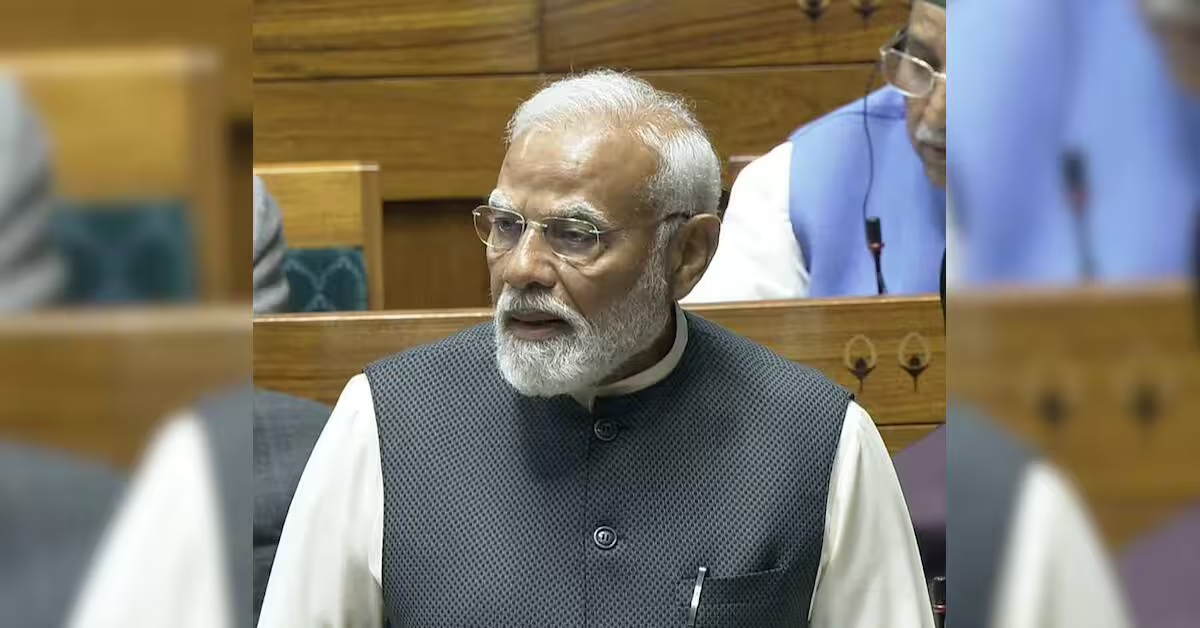
A little over a month after announcing from the ramparts of the Red Fort that his government will move aggressively towards the next-level reforms in the coming days, Prime Minister (PM) Narendra Modi will chair a two-day conclave, or “Chintan Shivir”, of the entire Union Council of Ministers from Wednesday. Discussions will focus on the reforms that the government could take in the remainder of its current term.
In his Independence Day speech on August 15, and in his “high-level” meetings with secretaries in recent months, the PM has spoken of his government’s commitment to reforms. At a meeting with key secretaries of the government dealing with economy and finance, commerce and industry, and technology sectors on July 28, Modi had said reforms are not merely a fashionable term but a continuous necessity for effective governance. He stressed the need to reform processes, improve work culture and ease of living, and strengthen institutional efficiency.
The two-day conclave will take place as the government nears the halfway mark of its current term, while the country confronts challenges to its exports and energy security because of the conflict in West Asia and the prospects of facing further sanctions. The government has worked to diversify its exports and energy sourcing. It has also signed and is working towards operationalising free trade agreements (FTAs) with several countries and trading blocs, including New Zealand, Canada, and the European Union (EU).
The two-day brainstorming sessions on September 23 and 24 will be held at “Seva Teerth”, which houses the Prime Minister’s Office (PMO). The conclave is expected to discuss the progress of government schemes, policy implementation, time management, inter-ministerial coordination, and public service delivery, among others. The conclave takes place with Assembly polls due in five states — Uttar Pradesh, Punjab, Goa, Manipur, and Uttarakhand. Barring Punjab, the Bharatiya Janata Party (BJP), along with its allies, currently runs governments in the other four states. The conclave, where ministers will be expected to submit a self-assessment of their respective ministries, comes amid speculation related to a reshuffle of the Union Cabinet.
The government earlier constituted six groups comprising eight ministers each to brainstorm on issues like time-bound implementation of programmes and other governance matters. The groups have held a number of meetings where they discussed the presentations to be made at the conclave. Some ministers are likely to make presentations on policies and measures undertaken by their respective ministries to advance reforms in various sectors. The PM chaired a “Chintan Shivir” on October 21, 2021, which focused on governance and policymaking.
In his recent meetings with secretaries, the PM has spoken of better inter-ministerial coordination, the need to break both horizontal and vertical silos within the government, more effective use of technology and preparing the government’s future agenda. Ministries have been asked to have live dashboards of their activities, review progress and hold interactions with all staff to get feedback and ideas.
In his Independence Day address this year, Modi reiterated his commitment to reforms, and detailed the contours of his government’s “Sapta Dhara” (seven-pronged strategy) to create jobs for the youth. He said the country has to take the pace of reforms forward. “Reform is neither a compulsion for us, nor is reform a buzzword for us, this reform of ours is a conviction out of conviction,” Modi had said.
In Sapta Dhara, Modi said the country needed to significantly advance its manufacturing sector, move forward in the direction of food processing, focus on technology and innovation, work on seamless and fast connectivity across the country, achieve self-reliance in defence production, including next-generation defence technologies, pay attention to the green economy and blue economy, which also create green jobs, and leverage India’s soft power, including yoga, and its traditional holistic healthcare system. The PM said that 50 Indian corporations should be in the Fortune 500 companies within the next decade. For this to happen, the Centre, state governments, and the institutions of local self-government must accelerate the pace of their reforms, he said.