


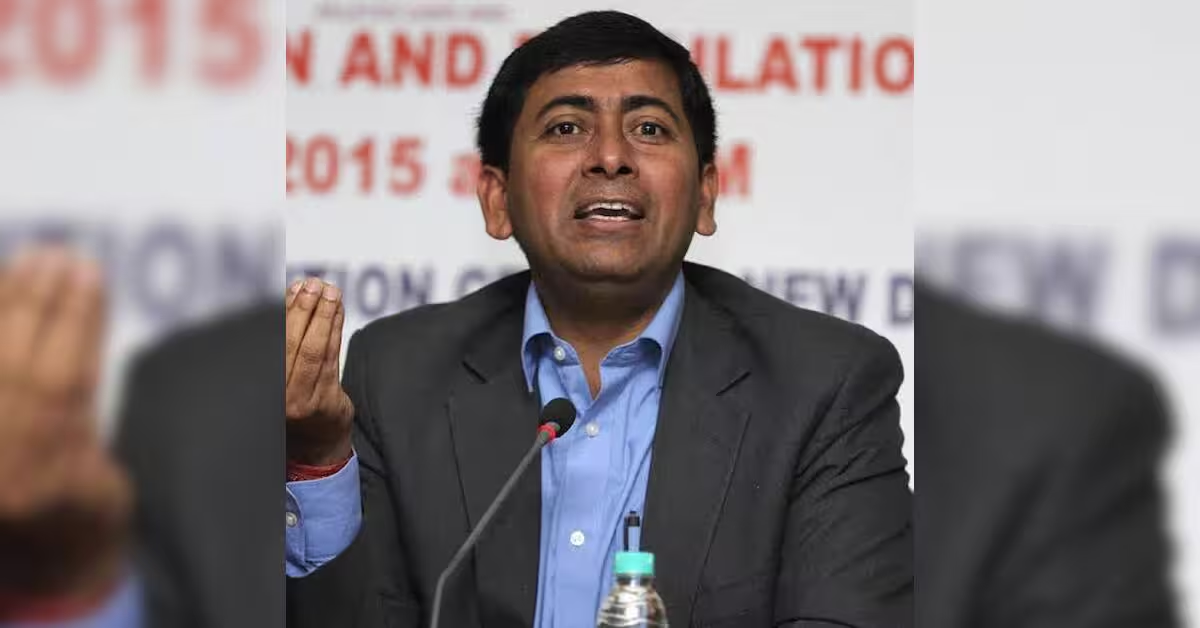
The government expects all states and Union Territories to publish rules under the four labour codes by October 31, Labour Secretary Chandra Bhushan Kumar said on Thursday, as the Centre steps up efforts to operationalise the new labour law framework.
Ten states have already published their rules, while the remaining states and Union Territories have put out their draft rules for consultation, Kumar said while addressing a seminar on the new Labour Codes by the PHD Chamber of Commerce and Industry (PHDCCI) and Grant Thornton Bharat.
“I had a personal meeting with all the states and Union Territories and we are hoping by 31st October, we will have the rules at the state level. So this is going to be a major, major exercise because the appropriate government in most of the cases where our industries operate and trade operates, is the state government,” Kumar said, launching a report by GT Bharat on the implementation of the labour codes.
The four labour codes, which replaced 29 central labour laws, came into force in November 2025, consolidating provisions on wages, industrial relations, social security, and occupational safety and working conditions. The Centre notified the rules under the codes in May 2026, but their implementation also depends on states framing their own rules, as labour falls under the Concurrent List. With several provisions requiring state-level rule-making to take effect in practice, the completion of state rules has emerged as a key step towards fully operationalising the new framework.
The report by GT said the new framework had substantially reduced the number of compliance requirements for employers. The number of rules had fallen from 1,436 to 351, while the number of returns had been reduced from 31 to a single consolidated return. Forms had declined from 181 to 73 and registers from 84 to eight, according to the report.
However, the report flagged several areas where implementation remained unsettled. These included the two-working-day requirement for payment of wages after specified forms of separation, with employers seeking clarity on whether it applied only to statutory wages or the entire full-and-final settlement.
Questions also remained around workforce classification, particularly because the codes did not define managerial, administrative and supervisory roles, while the classification determined the application of provisions on working hours, overtime, leave and industrial relations, according to the report. It also flagged the need for further guidance on registration and contribution mechanisms for gig and platform workers, as well as the implementation of social security schemes.
Separately, Kumar also said the government was developing a Labour Stack model to bring worker databases and information on government welfare schemes onto an integrated platform. The objective was to allow different databases and schemes to “talk to each other”, enabling the government to identify which workers were already receiving benefits, where gaps in social security coverage existed and whether workers eligible for certain schemes were being left out, he said. The system could also help assess whether workers receiving existing benefits needed additional or top-up support, Kumar said.
A pilot of the Labour Stack is expected within around 15 days, after which the government planned to test the model in at least one state or Union Territory before expanding it further, he noted.
The model was intended to bring together information across different categories of workers, with a particular focus on unorganised, gig and platform workers covered under the Code on Social Security, and the government had already undertaken a data-matching exercise involving worker and welfare databases to understand existing coverage and identify gaps, Kumar said.
The government has approved 200 modern career lounges to provide employment and career-related guidance, of which 40 are expected to become operational during the current financial year, Kumar said. These will be in addition to the 407 career lounges already operating across the country, he said.
The government’s career lounges are employment facilitation centres that provide jobseekers with career counselling, information on job and skilling opportunities, and support in accessing employment-related services.
Kumar also urged industry to make greater use of the government’s National Career Service (NCS) portal for posting vacancies and connecting employers with jobseekers, saying wider industry participation would help strengthen the platform’s role in facilitating employment.