

There was a moment in the second half of the Asian Games kabaddi gold medal match against Iran when Aslam Inamdar made a daring raid deep into the Iranian half.
His teammate Pawan Sehrawat groaned inwardly as he did so. The Indian lead was narrow. Iran was still in the contest. It was a risk that could have gone badly wrong.
“It was a bad decision,” Sehrawat would say later.
But Inamdar made the dash count, securing two touches and emerging unscathed. The two points brought India closer to victory.
“It was a wrong move, but ant bhala toh sab bhala (if the end is good, it’s all worth it),” Inamdar said after the match.
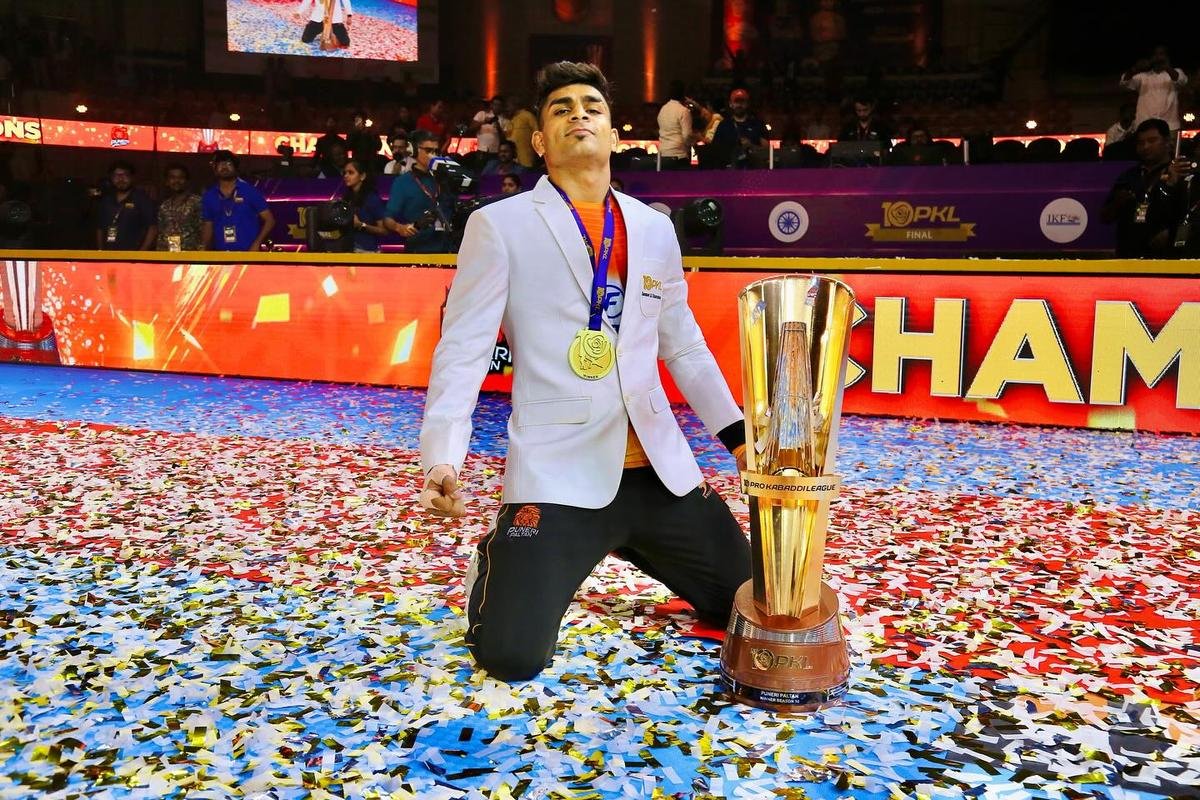
Aslam captained Puneri Paltan to their maiden Pro Kabaddi League season 10 title in 2023-24 and won the Most Valuable Player award for his stellar performance.
| Photo Credit:
Instagram/Aslam Inamdar

Aslam captained Puneri Paltan to their maiden Pro Kabaddi League season 10 title in 2023-24 and won the Most Valuable Player award for his stellar performance.
| Photo Credit:
Instagram/Aslam Inamdar
He grinned when he recalled the sequence later. It had been a tough decision to make. Wasn’t he worried when he made that move? What would have happened if it had gone wrong?
“ Bhai, I’ve gone through things you wouldn’t even imagine. This is nothing,” he said.
That, in many ways, is the story of Aslam Inamdar.
There was a time when, as a 14-year-old, he travelled across Maharashtra in search of kabaddi tournaments without even having enough money for a train ticket. He slept under train seats, survived on stale vada pav or whatever food was available at tournaments. He sometimes stuffed leftover food which often spoiled into his bag to eat later.
“If there was work to be done, I did it. I’ve cleaned toilets. I’ve sold juice and made tea. I’ve worked in fields. If there was a kabaddi tournament to play, I found a way to get there,” he said.
On Sunday, in Nagoya, Inamdar stood on the mat as India beat Iran to win the Asian Games men’s kabaddi gold.
It is his second Asian Games gold medal.
The distance between those two versions of Inamdar is difficult even for him to comprehend.
“It still feels like a dream to me,” he said. “I often think about how someone who didn’t even have food at home now holds two international medals.”
The medals are the latest chapter in a journey that began in Takli Bhan in Maharashtra’s Ahilyanagar district, where Inamdar grew up as one of five children.
His father died when he was young, leaving his mother to raise the family. She worked in other people’s homes, doing household chores and washing utensils, to keep the family going. Later, his elder brother Waseem joined the police force and took responsibility for the family, including helping arrange the marriages of their two sisters.
Money was scarce. Inamdar remembers growing up in a house without proper flooring or a proper roof. There were times when even food was difficult to come by.
So he learnt early that work meant survival.
At around 11 or 12, he collected discarded bottles and sold them to scrap dealers to buy food. Later, he worked at tea stalls and juice bars, washed tea utensils, cleaned washrooms and worked in farm fields. Sometimes he admits he stole.
“It was just to fill my stomach. I faced many hard situations without letting them break me,” he says.
Through all of it, there was one constan: kabaddi.
ALSO READ | From Manga to the mat: How India vs Iran gave Japan a teaser of kabaddi’s charm
His elder brother Waseem was a well-known player across several districts, while senior player Rahul Bhor also inspired him. Inamdar wanted to establish his own identity.
“No matter how long I worked during the day or night, I always went to the ground to practise,” he said.
Kabaddi was a sport he could afford. It required little equipment, and the village ground was enough. For a boy with very little money, it offered something priceless: a chance.
By the time he was 14 or 15, Inamdar was travelling alone to tournaments in the 50kg and 55kg categories. He earned between Rs 200 and Rs 500 a match.
The money was small, but it mattered. It bought him meals when he might otherwise have gone hungry. More importantly, it kept him moving from one tournament to the next.
The path was neither smooth nor uninterrupted.
WATCH | ASLAM INAMDAR ON SPORTSTAR’S SPECIAL SERIES ‘KINGS OF KABADDI’
In 2014, while India competed at the Asian Games, Inamdar was at home nursing a fractured leg and watching kabaddi on television. His life at the time seemed a world away from an international career.
“I was just watching kabaddi on TV,” he said. “But I believe God’s plans are always better. My hard work never stopped.”
He kept working.
Eventually, the Pro Kabaddi League changed the scale of his life.
In his first season, he earned Rs 8 lakh.
For someone who had once struggled to put food on the table, the money was almost incomprehensible.
“Eight lakh felt like eight crore to me,” he said.
He did not forget where he had come from. With his first major earnings, he bought a gold necklace for his mother.
Kabaddi had given him something that had once seemed almost impossible: financial security, recognition and a career. He went on to captain Puneri Paltan and establish himself as one of India’s leading players.
Then came the international medals.
Inamdar won his first Asian Games gold in Hangzhou. Four years later, in Nagoya, he has another.
And once again, the final was against Iran — the one opponent that has consistently pushed India hardest at the Asian Games.
“Iran is generally the main challenging opponent for us in the Asian Games,” Inamdar said. “They have a strong defence and very experienced players like Fazel, who played in his fifth Asian Games.”
For Inamdar, beating such a formidable opponent made the gold even more meaningful.
ALSO READ | Anahat says Olympic spot kept her going in semifinal comeback
“A tough challenge makes winning the gold medal feel even more rewarding,” he said.
But the significance of the medal for Inamdar lies beyond the result on the scoreboard.
It is the culmination of a journey that began when he was a boy travelling across Maharashtra for a few hundred rupees, when he collected scrap bottles for food and worked whatever jobs he could find before heading to the kabaddi ground.
Today, he tries to pass that experience on to younger players.
At his training ground in Thane, he speaks to juniors, particularly those from underprivileged backgrounds, about his own journey. He wants them to understand that difficult circumstances do not have to determine where they end up.
“I want young, underprivileged players to dream big and aim to achieve even more than I have,” he said. “I want them to know that whatever happens, they shouldn’t stop working hard. They shouldn’t stop believing,” he says.
Published on Sep 26, 2026